
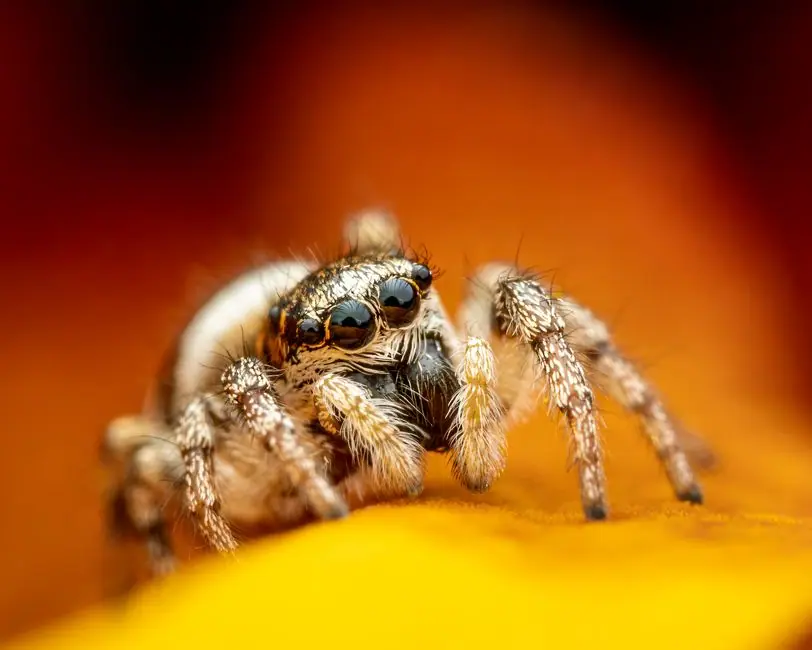
An Australian jumping spider sleeps in two stages, researchers at the University of Bonn say. Portia fimbriata has a quiet, still rest that is broken by bouts of leg twitching and eye movements, similar to REM sleep in mammals. The finding comes from a team at the university's Institute of Organismic Biology. The study covers one species, uses only behavioural data and does not address whether spiders dream.
The work by Nadja Geiger and Daniela Roessler is published in the Proceedings of the National Academy of Sciences under the title "Behavioral evidence for two-stage sleep in spiders". An adult Portia fimbriata is about the size of a one-euro coin and hunts other spiders. The team is returning to an observation of its own from 2022, when REM-like behaviour was recorded in another jumping spider, Evarcha arcuata, but it was not shown that the animals were asleep.
Posture, rhythm and waking threshold
Invertebrates cannot be fitted with an electroencephalogram, so researchers judge sleep by behaviour. The team checked several signs: a typical posture, rest, a higher waking threshold, a daily rhythm and catching up after lost sleep.
The posture is unusual. Before falling asleep, the spider looks for a spot, often a silk retreat, and hangs head down from a small silk platform. Its abdomen hangs loose and its pedipalps are tucked in. Most spiders fall asleep within half an hour of the lights going out. On average they sleep about 10.7 hours a night, including short wake-ups.
A 60-hour watch under different lighting showed a daily rhythm. The spiders are mostly active by day. In constant dim twilight, the pattern of rest and activity holds, which the authors say points to an internal clock. In constant bright light the rhythm weakens but does not vanish.
To measure the waking threshold, the team played a sound that rose over 10 seconds. It used 30 adult spiders, each tested once. Awake spiders reacted in about 1.7 seconds, still ones in about 2.7, and those in the REM-like phase in about 4.3. Of the 10 spiders in the REM-like phase, six reacted within 10 seconds. The other four did not move, but they responded at once when awake, so hearing was not the problem.
Two phases and catching up on sleep
The first phase is the quiet rest. The second is short bouts that interrupt it: the legs twitch, the mouthparts tremble, and the retinal tubes the spider sees with move as if following something. In 10 spiders recorded overnight, there were about 11 bouts a night on average, each lasting about 80 seconds. The first comes about four hours after the spider falls asleep, but in individual animals it appeared anywhere from just over an hour to about 10 hours after.
Catch-up sleep points to the role of the REM-like phase. For one night, the team put 25 live fruit flies into the cage of each of 17 spiders. The flies nudged the spiders without triggering a full hunt. Usable recordings came from 13 of them. The next night, total sleep time rose by about 8.5%, and REM-like time rose from an average of 9.4 to 16.9 minutes, about 80% more. The number of bouts grew, not their length. The five spiders in the control group did not change their sleep over three nights in a row. The authors call this "REM rebound" and say it is the first such evidence in an invertebrate.
The function of the phase has not been tested. The team says the spider may be processing visual information or "replaying" a day's hunt, as is thought to happen in vertebrates, but this remains a hypothesis.
Behavioural data only, and one species
Brain activity was not recorded, so the likeness to human REM is in behaviour only. The authors therefore speak of a "REM-like" state, and they found no equivalent of deep sleep without rapid eye movements. They warn that "identifying REM-like movements does not prove whether spiders dream".
The study has other limits. The samples are small, and all the spiders were raised in a lab and belong to one species, an unusually visual one. The results may not hold for spiders that spin webs or hunt by touch. After correction, the difference in reaction time between the quiet and REM-like phases is not statistically significant. Some of the quiet periods may have been light wakefulness. And "sleep disruption" is not total sleep deprivation.
The team plans to compare sleep in other spider species, set sleep in the wild against sleep in the lab, study its link to thinking skills, and record brain activity in arachnids and insects. A further study will look at how climate and artificial light at night affect sleep.

Comments (0)
No comments yet.