
A shipwreck about 30 metres down off Kekova island in Antalya dates to 2700–2400 BC.
That would make it older than any wreck known so far. But its age is judged by clay, not wood, so the "oldest" title is only provisional for now.
The ship was about 10 metres long, and its wooden hull has vanished completely. Divers have found more than 30 ceramic vessels and three large stone anchors. They work in 30-minute shifts because of the depth. Excavations began in 2026 under Assoc. Prof. Hakan Yonyoz of Akdeniz University, with the Antalya Museum and the culture ministry. Minister Mehmet Nuri Ersoy said: "In our 'Blue Homeland' we are bringing to light the traces of the oldest shipwreck in the world."
Dating by amphorae
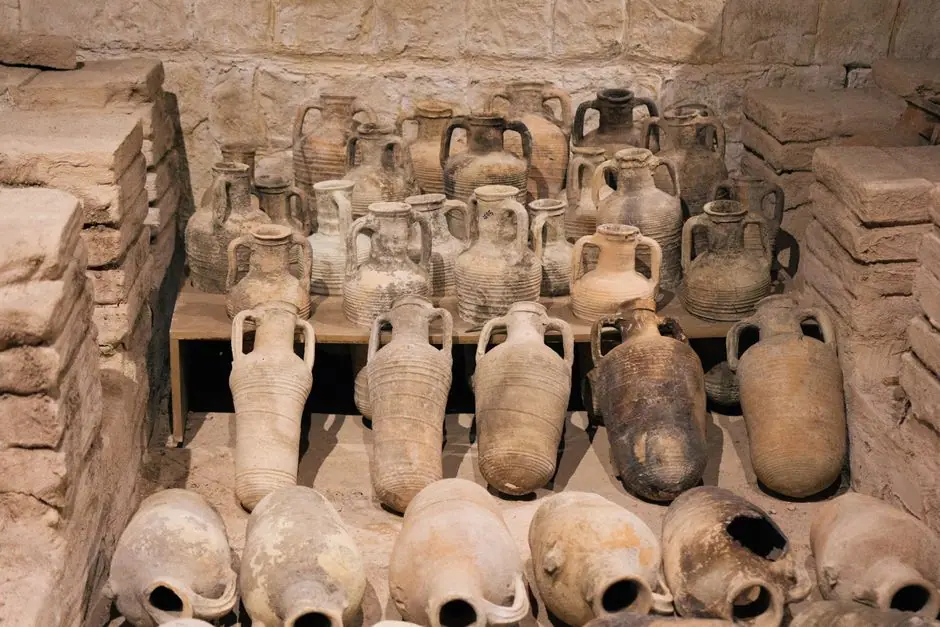
The most precise way to date wood is radiocarbon dating, which measures how much radioactive carbon is left in it. Here there is no wood, so the age comes from the shape and decoration of the amphorae. Amphorae are clay jars with two handles, used to carry olive oil, wine and other goods.
The method is comparative. Archaeologists line up known finds from dry land and from sunken sites in a timeline, then look for where the new vessel fits. In a published preliminary report, two researchers from Akdeniz University write that the first amphora raised resembles Levantine vessels of the Early Bronze Age, with side handles and a flat base. The second has incised parallel lines and a zigzag, and resembles jars for farm goods such as wine and olive oil.
Clay analysis points to workshops in the Jordan Valley. Similar vessels have been found near the pyramids at Giza, at Saqqara and Abusir, and in Troy and Crete. The Great Pyramid of Khufu was built in the same era.
Two amphorae and three anchors
The 2026 report says only two amphorae have been raised, one in 2024 and the other in 2025. There are three anchors: two with three holes each and one with a single hole, found at different distances from the remains. It is not clear whether they belong to this ship. News reports present all three anchors as part of the find, but the report is more cautious.
The figures are not the same in all reports. The academic report gives no depth and no number of vessels. "About 30 metres" and "more than 30 vessels" come from media accounts. Some outlets write "about 4,700 years", others a range of 4,400–4,700 years.
Until now the oldest known shipwreck has often been named as the one at Uluburun near Kas, from around 1300 BC. A 15-metre Syro-Palestinian merchant ship lay there, found by a sponge diver. If the Kekova dating is confirmed, the gap is more than a thousand years.
Journalists also point to the wreck at Dokos in Greece, about 4,200 years old, as the previous benchmark. The earlier Turkish record, a 3,600-year-old wreck at Kumluca, is beaten by the new one by at least 800 years, according to the minister.
Uluburun was dated from preserved cargo and wood, while Kekova is older and has less evidence. The call on its age rests with the experts. Confirmation will come from more amphorae and from linking the anchors to the ship.
The trade route traced by pottery
Researchers rebuild Bronze Age trade routes by looking for the same type of vessel on different coasts. The clay shows where a vessel was made, and where it turns up, it arrived by sea. If vessels from the Jordan Valley appear in Egypt, Troy and Crete, there must have been regular trade between those places.
The Kekova ship probably sailed from a Levantine port to Troy or Crete, but this is the researchers' hypothesis, not a proven fact. The Akdeniz University report also says it was a small vessel that sank while sailing from east to west.
One of the vessels has two openings and nine marks. The researchers say it may have been a churn for turning milk into cheese or butter, but this needs more checking.
Work continues in 2026 with a survey of the deeper parts of the site.

Comments (1)
две хиляди години и какво? сигурно пак румънски кораб, а?