
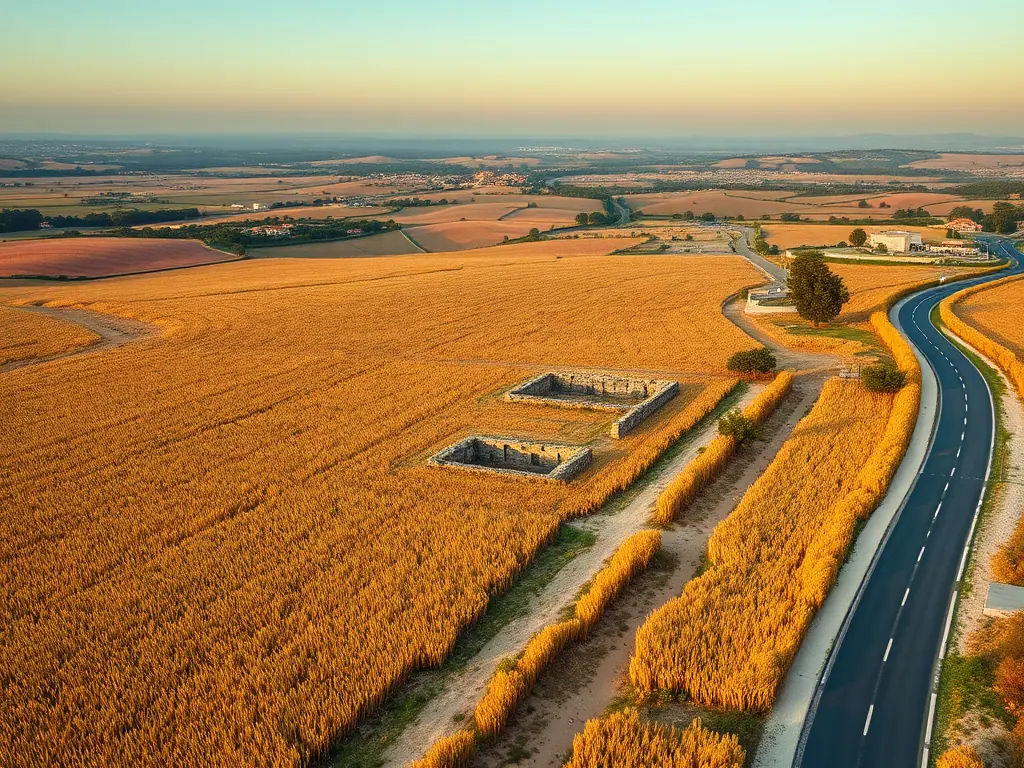
A building of about 1,290 sq m and 48 metres long has been mapped under farm fields near the Roman town of Melaria, next to today's Fuente Obejuna in Córdoba province. Researchers read it as a mansio, an official stop for travellers on the Roman road between Córdoba and Mérida. The plan was made only with instruments that scan the ground from above. No one has dug there, and there are no pottery, coins or inscriptions.
The group HUM 1150–Unidad Patricia at the University of Córdoba did the work as part of the Ager Mellariensis project. It scanned the land between 2021 and 2023. A paper by Miriam González Nieto of the University of Hamburg is coming out in the Journal of Archaeological Science: Reports, volume 75, 2026.
A magnetic map without digging
Buried walls, hearths and banks slightly change the magnetic field of the soil. The instruments record these shifts, and a map is drawn from them. In the field, the team pushed a cart with four gradiometers, each with two magnetometers one metre apart. A satellite system logged the exact spot of every reading, so no grid squares were marked out on the ground. Software filters removed random spikes caused by metal objects.
Nothing was dug up, and the remains lie untouched. The map does not show when the building was put up or what each room was used for. That would need excavation.
Eight rooms alongside the road
On the map, the long side of the building runs parallel to the road. Along its front are up to eight rooms of equal size, about 3.6 by 4 metres. Near the western end is a larger room of about 45 sq m, which the author compares to a bath block at a road station in Rottweil, Germany. Similar rows of rooms appear in the barracks at Carnuntum and Vindonissa. The closest explanation, then, is a standard-class mansio for ordinary travellers, soldiers and staff.
A mansio was a state stop in the Roman road and courier system, the cursus publicus. Travellers spent the night there, changed horses and bought supplies. Higher-class stations stood further from the road, were built around a courtyard and had wall paintings, mosaics and underfloor heating. No such traces show up here.
The site fits the written records. The road between Córdoba and Mérida is Route XI in the Antonine Itinerary, a Roman list of roads and the stops along them. It puts Melaria 52 Roman miles from Córdoba, and the building stands at that spot. The main buildings of known stations cover 600 to 1,600 sq m, so Melaria is near the top of that range.
Courtyard and bath are guesses
Part of the account is conjecture. The university's press release speaks of a large courtyard that may have been a stable or a place for carts and draught animals, and of a bath. González Nieto's paper describes an open, unbuilt area 11 metres wide behind the rooms and does not mention a central courtyard. She says it is high-class stations that have such a courtyard. What went on in this area is unclear: "We do not yet know the exact layout of activities in the building." Whether the large room was a bath is also an interpretation.
The building's official status is not proven either, and the label mansio is provisional. Other anomalies nearby may be a storehouse, workshops or stables, but this has not been established.
The University of Córdoba also reports further anomalies, which show the complex was bigger than the building. About 50 metres to the north is a structure that the team rates as first-class and linked to the first. The reports give no details on it, and no excavations have been announced so far. One of the project's authors is Antonio Montero Checa, who leads the team in Córdoba.
Comments (0)
No comments yet.