
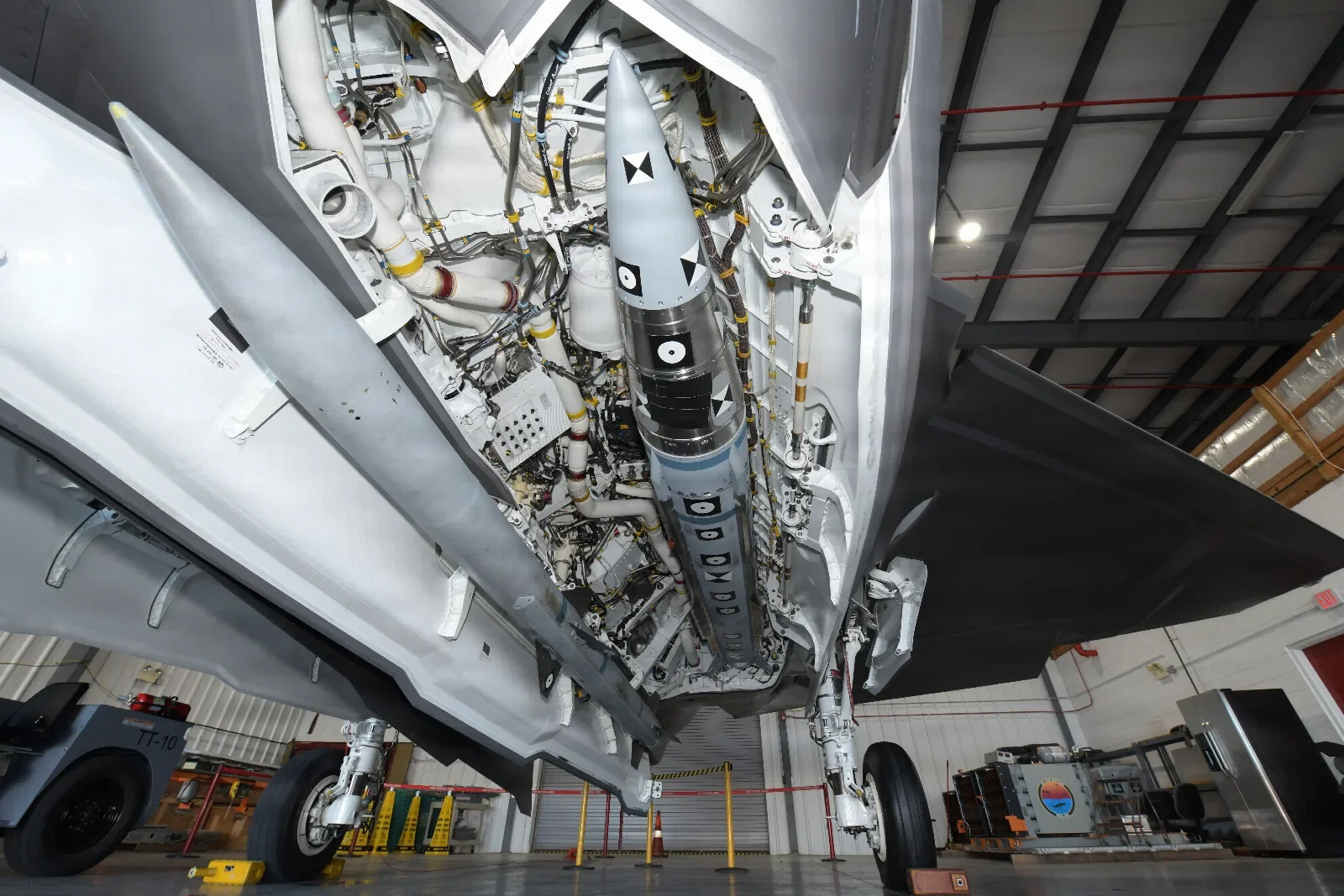
The US Navy has publicly unveiled the AIM-424 for the first time – a new long-range air-to-air missile, also known by the name "Malice." The system is already undergoing flight tests and is designed to engage aerial targets at significant distances.
The development is being carried out by the company Raytheon. The missile is part of the United States' efforts to expand the capabilities of its tactical aviation in long-range air operations.
Which aircraft it is intended for
"Malice" is designed for combat aircraft of current and future generations. Among the platforms planned for its use are the F/A-18E/F Super Hornet, the F-35C Lightning II, and the future carrier-based fighter F/A-XX.
The missile is already being tested aboard the F/A-18E/F Super Hornet and the F-35C. It is intended to be carried in the internal weapons bay of the F-35C, which would allow the fighter to maintain its low radar cross-section.
A response to new threats
The new system is important for US aviation against the backdrop of the development of long-range air-to-air missiles by Russia and China. According to available information, these countries are working on armaments that exceed the capabilities of the AIM-120D currently used by the US.
The AIM-424 is intended to give US aircraft the ability to act against enemy targets from a greater distance. This would allow combat groups to react earlier to aircraft, missiles, and other aerial threats.
How the missile will be guided
In long-range combat, the onboard radar of the carrier aircraft cannot always independently detect, identify, and track an enemy target at all times. Therefore, the AIM-424 will likely receive targeting data from other platforms during the initial phase of its flight.
Such information could come from airborne early warning and control aircraft, other combat aircraft, ships, or systems from a shared intelligence network.
In the terminal phase of the flight, "Malice" is expected to use its own active radar homing seeker. It is intended to detect the target and ensure its destruction.
Details remain limited
The US Navy has not announced what stage the program is at, when the missile might be introduced into service, or when serial production might begin.
Details regarding the price, exact characteristics of the warhead, or the expected date of achieving operational readiness have also not been announced. At the moment, it is known that development continues with flight tests on the F/A-18E/F Super Hornet and the F-35C.






Comments (3)
AIM-424, значи? Интересно име
Айм 424… доста дълго име за ракета, а?
абе "malice" ли? звучи яко!