
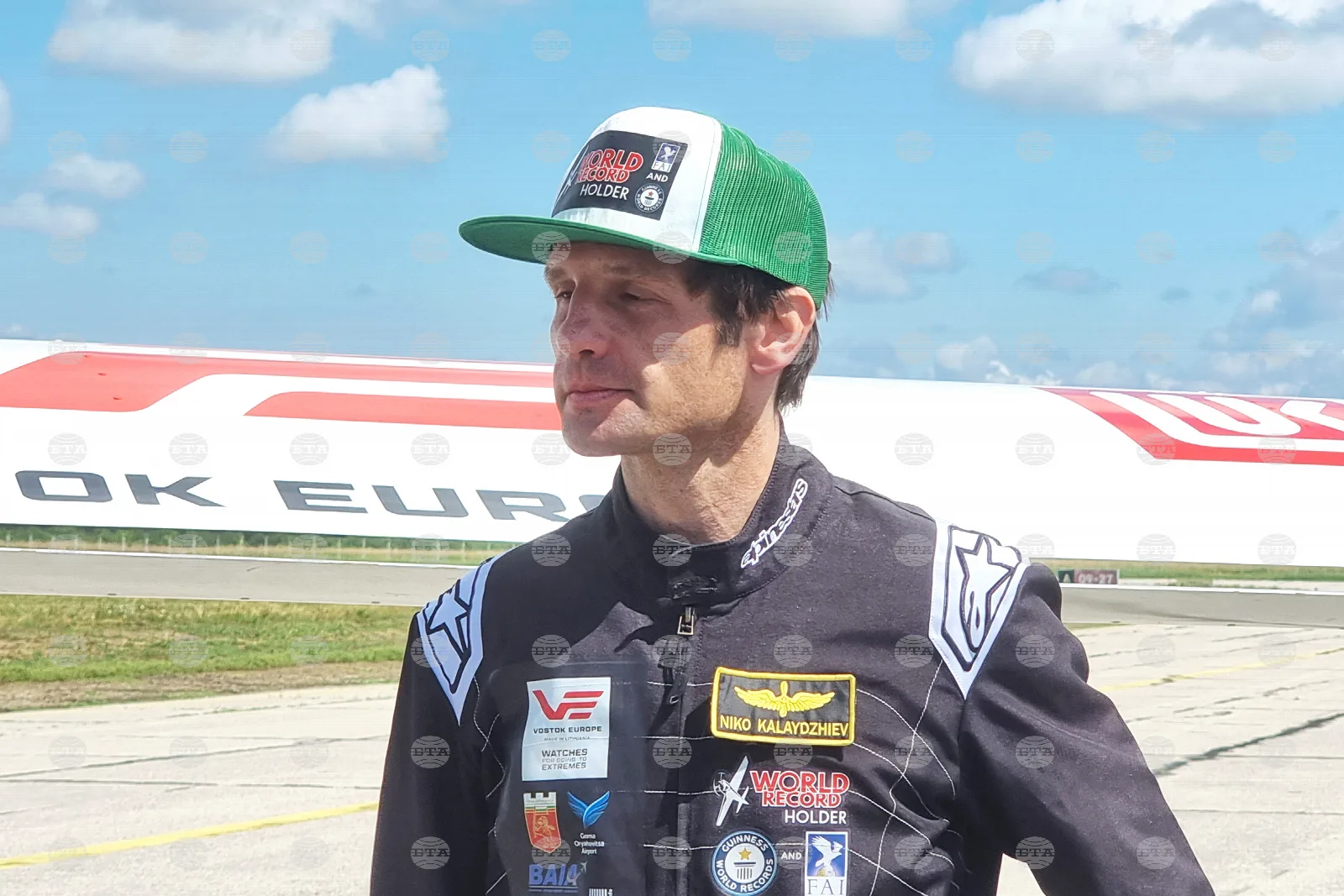
A landing every half a minute, hour after hour, in a cockpit at 38 degrees Celsius — and then a number that made the Guinness Book of Records: 1,021 take-offs and landings in 14 hours and 28 minutes. Captain Nikolay Kalaydzhiev set the mark at Gorna Oryahovitsa airport on 13 June this year, and in September Guinness confirmed the record was official[1][2].
The number wasn't picked for looks. The old record, held by an American pilot, was 442 landings — Kalaydzhiev more than doubled it[1][3]. "Until now, only an American pilot had managed 442 take-offs and landings in 23 hours," he said once the news became official[4].
What the pilot did on 13 June
The day at Gorna Oryahovitsa airport started at dawn and ran into the evening. The municipality and the Bulgarian Aviation Industry Association put on a full air show for the region, with a stand for gyroplanes, drone football and meetings with aviation firms[5]. But the day belonged to Kalaydzhiev, who flew a light aircraft with a target of 1,000 circuits — a goal he didn't just hit but beat, with more than 20 extra landings[5][2]. Every circuit followed the same pattern: take off, loop round, come in to land, then what pilots call a "touch and go" — the plane touches the runway for a moment and is straight back in the air, without ever fully stopping[2][6]. In the hottest part of the day, Kalaydzhiev stopped once an hour to dunk himself in ice water so he could keep going to the end[5].
How Guinness judges counted the landings
For a landing to count, the plane can't just touch the runway. Under the rules Kalaydzhiev had to follow, every landing had to happen inside a marked 20-metre zone between two lines — the wheels had to touch down before the first line, and the plane had to be back in the air before the second. A landing beyond the second line simply didn't count[2][6]. That's why the whole attempt was filmed from start to finish — Guinness asks for full video coverage of records like this, not just bits and pieces, so judges can check every single landing afterwards[7]. Guinness usually relies on video or on independent witnesses who don't work for the same company, and sometimes sends its own trained judge to confirm a result on the spot[7]. In Kalaydzhiev's case, that check took place — which is why it took three months to confirm the record, while a Guinness team went through the paperwork and hours of footage. "We waited a long time, almost three months, for the world record to be approved, because all the documents and video have to be checked in detail," the pilot said[6].
Who held the record before
The old record wasn't set on purpose — it came out of a completely different mission. In May 2001, American pilot Thomas Bishop flew a small Pilatus Porter near Decatur, Texas, landing and taking off 442 times in close to 24 hours — a landing roughly every three minutes, climbing to about 640 metres each time. But he wasn't chasing a record of his own — he was dropping skydivers for someone else's attempt at a 24-hour parachute-jumping record, and his landings ended up becoming a record in their own right[3]. Twenty-five years later, the Bulgarian pilot didn't just beat that mark — he smashed it, landing more than twice as often in nearly ten hours less time.
Why Gorna Oryahovitsa made aviation headlines
Kalaydzhiev was no random choice for an attempt like this. Before this record, he already held five world marks recognised by the International Aeronautical Federation (FAI) and by Guinness in light aviation — including the record for the most landings in one hour[1][5]. That's part of why the attempt at Gorna Oryahovitsa drew attention beyond Bulgaria: representatives from a US space company were at the airport and said they were interested in working together in future, including on space-related projects[6][2]. Bulgaria's first astronaut, Georgi Ivanov, reacted too, and his emotional response was picked up by the media[2]. For the small airport near Gorna Oryahovitsa — known mainly for its local flying club, not for world records — this was a rare moment in the global aviation spotlight.
Kalaydzhiev himself is keen not to make it sound like a numbers game. "The most important thing for me isn't the numbers, it's the message to children — to show them through actions that a person can achieve things that seem unthinkable," he said after the record was confirmed[2][6]. For the airport near Gorna Oryahovitsa, and for the municipality that put real effort into organising a whole air show around him, the message landed in another way too — with international partners who now know exactly where this small town sits on the map, and with a story that swept through Bulgaria's national media within days as one of the few proud, feel-good stories in Bulgarian aviation this autumn.




Коментари (0)
Все още няма коментари.