
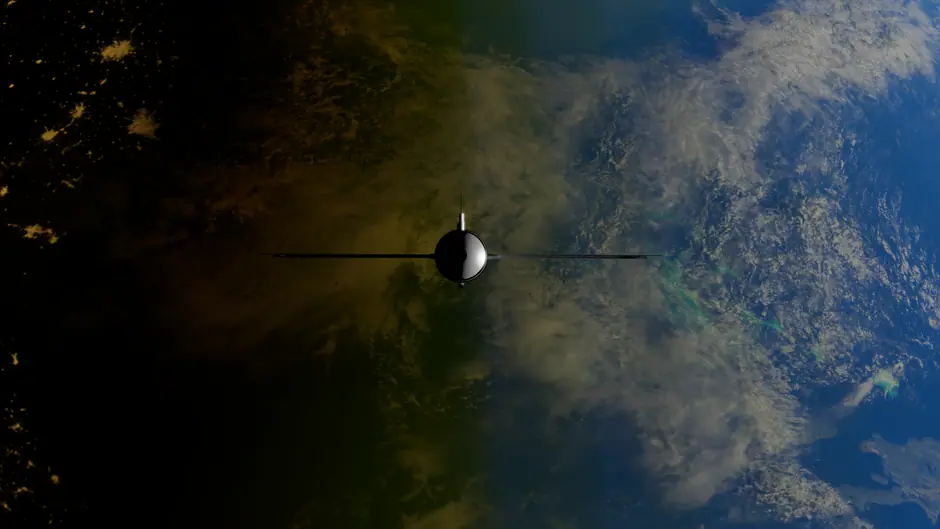
NASA's Swift observatory is due to fall back to Earth at about 3:30am US Eastern time on 4 November, or about 10:30am in Bulgaria. The US Space Force forecast is uncertain by about 11 hours either way. An attempt by a private company to lift the observatory higher failed.
After more than 21 years in orbit, Swift weighs about 3,200 pounds, or about 1,450kg. NASA expects most of it to burn up, but some parts may survive.
Swift was launched on 20 November 2004 and was built to work for two years. It lasted nearly 22.
It studies gamma-ray bursts, short flashes of the most energetic light in the universe, which are the brightest events since the Big Bang. The observatory was designed to react fast. When its gamma-ray instrument spots a burst, the craft turns towards it and watches in X-ray, ultraviolet and visible light, while an alert goes to other telescopes around the world.
In that time Swift has recorded more than 2,000 bursts, taken more than 1.5 million images and studied more than 1,400 supernovas. In 2005 it found the first precisely located short burst, and in 2017 it picked up ultraviolet light from the merger of two neutron stars, which was linked to gravitational waves. Since observations resumed in late August, it has imaged hundreds more targets, including remnants of exploding stars, active black holes and comets.
Thin air and solar storms
Swift orbits low, where the air is thin but not absent, and drag slowly pulls every satellite down. At launch its orbit was about 600km up, and the observatory has no engine to climb back.
After the end of 2024, solar storms made things worse. The upper atmosphere swells, denser air from lower down moves up and drag grows. The team at Pennsylvania State University stopped observations to cut drag, but after they resumed, Swift again began to fall fast. On 20 October it reached 275km, could not make up for the drag and went into safe mode. NASA ended its science work on 23 October.
The LINK craft and the reaction wheels
In September 2025 NASA hired the company Katalyst Space to build a craft called LINK, to grab Swift and lift it higher. The craft was launched on 3 July 2026. LINK reached Swift but did not raise it. Controllers called off the approach about 15km from the observatory because of problems with its orientation.
The craft's orientation is controlled by spinning flywheels called reaction wheels. On 28 July NASA said LINK had begun to spin out of control, two of its three wheels were not working and its cold-gas thrusters had lost some of their power. Katalyst then said the craft had a "viable path to rendezvous with Swift". The wheels never started working again and NASA cancelled the lift.
Fall zone and new forecasts
Swift's orbit is tilted at 20.6 degrees to the equator. So any surviving debris can only land in a band between that latitude south and north. Bulgaria is far outside this zone. NASA puts the risk of anyone on Earth being hurt at about 1 in 2,100, which it calls unlikely.
An older forecast gave 6 November as the rough date, and NASA's latest statement is based on the Space Force estimate of 2 November. NASA and the Space Force are tracking the craft and will post new forecasts on the mission blog.



Comments (0)
No comments yet.