
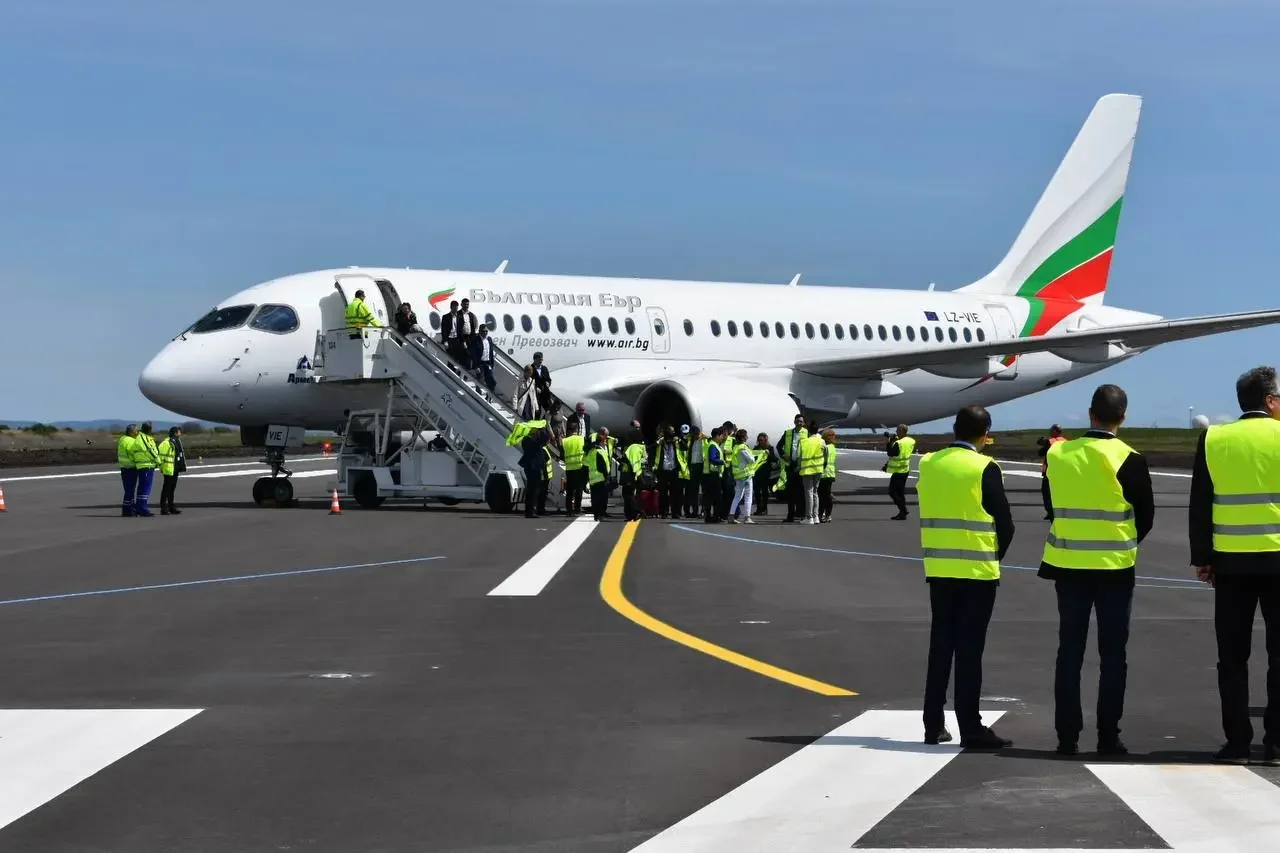
Summer 2026 arrives with several key changes for the Bulgarian Black Sea coast: an "increased number of flights" to Burgas and Varna, an "official transition to the euro," and a "noticeable rise in prices" compared to previous seasons. Against this backdrop, businesses along the coast are trying to answer two questions: will more flights lead to actual growth in tourists, and will tourists from the EU not prefer a "more attractive Greece" for their summer vacations?
More flights: a strong summer for Burgas and low-cost carriers
Following the completion of a major runway reconstruction, "Burgas Airport" enters the 2026 season with an ambitious program: over "70 direct destinations" and a designation by the operator "Fraport" as "one of the strongest seasons in recent years." New and restored routes connect Burgas with key markets in Central and Eastern Europe, including Poland, Germany, and the Scandinavian countries.
Low-cost carriers are also strengthening their presence. "Wizz Air," for example, is adding "two weekly connections" between "Warsaw-Radom" and Burgas starting in July 2026, as part of its strategy to expand its Polish network. Similar routes, combined with an ultra-low-cost model, promise "more capacity" and "more competitive prices" for air tickets – a factor that could tip the scales in favor of Bulgarian resorts for price-sensitive tourists.
Advance bookings: moderate, but real growth
The Ministry of Tourism reports "about a 3% increase" in advance bookings for the summer season and projects "up to 5% growth" in the total number of tourists compared to previous years. This is not a "tourist boom," but it shows that despite inflation and global uncertainty, interest in Bulgaria remains stable, and in some segments – even growing.
Data from the National Statistical Institute for the beginning of 2026 show that the number of "foreign citizens" who visited the country is hovering around the levels of the previous year, with a slight increase in guests from "Romania," "Poland," and "Germany." This confirms that traditional markets for the Bulgarian seaside remain active and are responding positively to the expanded airline network.
The euro and prices: fears and reality
From "January 1, 2026," Bulgaria officially switches to the "euro," with the lev being used in parallel only during a transition period, after which only the euro remains legal tender. Tour operators and analysts have been warning for months that the "transition to the euro" will be accompanied by an "inflation-backed price increase" – especially for packages for tourists from outside the eurozone.
General inflation in 2025 and early 2026 has raised the cost of services by about "10–20%," according to economist estimates. This means higher prices for accommodation, food, and transport, which are inevitably passed on to the end consumer. Nevertheless, compared to other Mediterranean destinations, Bulgaria continues to position itself as a "more affordable option," especially for families and budget-conscious tourists.
Bulgaria vs. Greece: price and image balance
The direct comparison between "Bulgaria" and "Greece" remains at the center of many European tourists' choices. According to tourism analysis, a "vacation in Greece" in 2026 is in most cases "20–30% more expensive" than in Bulgaria, especially regarding accommodation and restaurants. In the peak of the season, a three-star hotel or studio in Greece often costs "between 70 and 120 euros" per night for two, with prices continuing to rise under the pressure of costs and tourist taxes.
In Bulgaria, even with inflation, it is considered that a vacation "remains cheaper," especially in less popular resorts and when staying in private lodgings. Dining is also more affordable – the abundance of restaurants, fast food, and all-inclusive packages allows for greater budget flexibility. An additional plus is the "free zones" on the beaches, whereas in Greece, paid umbrellas and sunbeds are often the norm.
Why Greece remains a competitor: sea, atmosphere, service
Despite Bulgaria's price advantage, many Europeans continue to choose "Greece" – not so much because of the price, but because of the "clean sea," "high level of service" in tavernas, "variety of beaches," and a calmer atmosphere compared to overcrowded resorts. Greece is reporting steady growth in tourism, and many of the favorite islands and resorts have been operating at high occupancy since May.
This puts Bulgarian tourism in a difficult position: on one hand, the price still works in Bulgaria's favor; on the other, Greece's image as a "more authentic, orderly, and calm" seaside destination attracts tourists willing to pay more for a certain level of experience. In this context, the increased number of flights to Bulgaria must be complemented by "better service" and "clearer positioning" of Bulgarian resorts as a quality, not just a cheap, alternative.
What the Bulgarian business expects in summer 2026
Businesses on the Black Sea coast are entering the season with "moderate optimism." More flights and good advance bookings provide a basis for an expected "growth of about 5%" in traffic. At the same time, uncertainties surrounding the budget, inflation, and potential social tensions in the country are forcing hoteliers and restaurateurs to be more cautious in their investments and in hiring staff.
Part of the industry is trying to compensate for increased costs through "dynamic pricing" – higher prices during peak weeks and promotions at the beginning and end of the season. Another line of adaptation is "product differentiation": focusing on niche markets (families with children, digital nomads, health and spa tourism) and on new markets in Central and Eastern Europe, supported by the new flight routes.
Will the euro and rising prices scare off tourists?
For tourists from the eurozone, the introduction of the "euro" actually makes planning easier – exchange rates and currency risks are eliminated. More sensitive to prices are guests from countries outside the EU, for whom the combination of a "stronger euro exchange rate" and "price increases" could make a vacation in Bulgaria significantly more expensive compared to periods when the lev was an independent currency.
Currently, there is no mass "withdrawal of tourists because of the euro." The "general inflationary environment" and the price of packages have more influence. Compared to Greece, Bulgaria maintains its role as a "more budget-friendly alternative," which will likely retain a significant portion of tourists looking for lower prices at acceptable quality.
Will Europeans choose Greece instead of Bulgaria?
The answer is more "both Greece and Bulgaria" than "either-or." Greece remains a "magnet" for tourists with higher budgets and expectations for a specific level of service and atmosphere. Bulgaria, with its lower price and wider range of products – from mass all-inclusive to quieter family resorts – maintains a strong position in the mid-range and budget segments.
The real danger for Bulgaria is not so much a sudden "transfer" of tourists to Greece as it is the gradual solidification of the country's image as a "cheap but compromised" destination. The increase in flights and stable interest will not bring sustainable growth if they are not supported by "investments in quality" – better infrastructure, cleaner beaches, noise control, and more professional service.
Summer 2026 will be a kind of "stress test" for Bulgarian tourism: more tourists, more flights, a new currency, and higher prices – all under the increased attention of European markets. Whether Bulgaria will use this combination to improve its image or will rely solely on the lower price compared to Greece will become clear by the end of the season.




Коментари (16)
А бе, чакай малко! Евро през 2026? И това на фона на гърците? Се
Пълна лудница! 2026-та? Ама че чакане! И еврото... все едно ще се оправят нещата с ЕДНА валута. Конкуренцията от Г
АБЕ 2026 ли? Сериозно?! И после пак да си гледаме заплатите... Ни
Ебаси, 2026?! Дано поне цените да не станат като в Гърция
Абе, здравейте всички! 🧐