
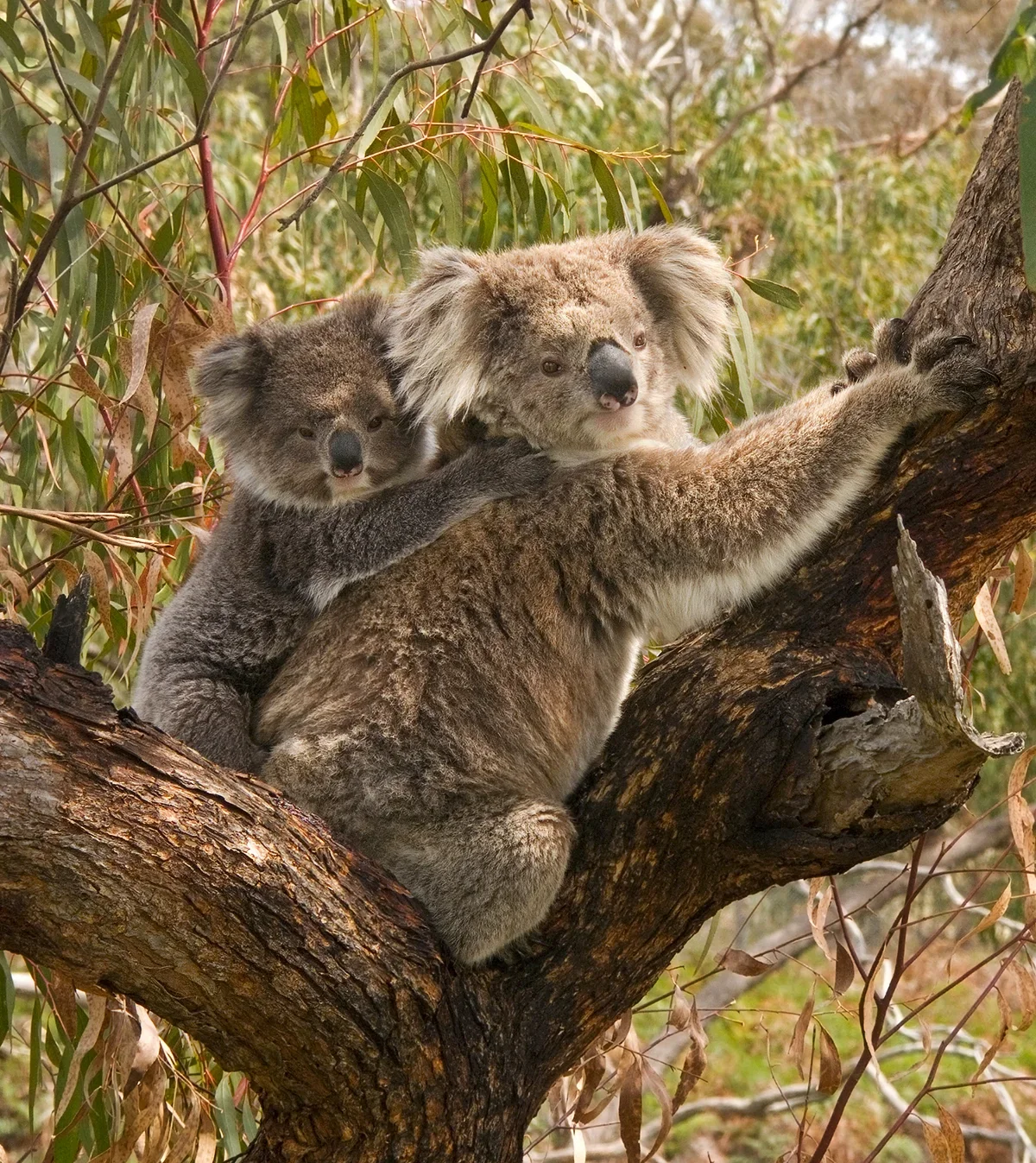
A new genomic study challenges the long-held theory that the ancient collapse of the koala population was directly linked to the arrival of humans in Australia. The analysis shows that the numbers of these iconic animals began to decline sharply about "100,000 years ago" – tens of thousands of years before the first humans set foot on the continent. The main suspect turns out to be the "climate", not human activity.
New genomic study rewrites the timeline
The study was published in the journal "Molecular Biology and Evolution" on "June 9" and was led by doctoral student "Toby Kovacs" from the "University of Sydney" in collaboration with scientists from "Texas A&M". The team calculated the "first direct estimate" of the mutation rate in koalas by sequencing the genomes of four "parent-offspring" trios. It turns out that the mutation rate in koalas is approximately "two times lower" than that in humans.
The researchers then applied this new value to "457 individual koala genomes" to reconstruct the species' demographic history. "This research rewrites the timeline of the koala's genetic history in Australia," comments Kovacs. "By calculating the mutation rate of modern koala populations, we can estimate and reconstruct the genetic record back to 100,000 years ago to gain insight into the genetic diversity and abundance of ancient koala populations."
Old models crumble: koalas decline before humans
Older reconstructions of population history suggested that koalas experienced a dramatic decline only after the appearance of "modern humans" in Australia – approximately "65,000 years ago". However, these models relied on mutation rates borrowed from distant relatives like "humans" and "mice". The new, directly measured rate changes the timeline.
The data indicate that koala populations began a "sustained contraction" about "100,000 years" ago, reaching a critical "bottleneck" approximately "60,000 years ago". This period coincides with "intense climate change" at the end of the Pleistocene – colder and drier conditions that radically changed the face of the Australian continent.
The climate footprint: drought, population splitting, and extinction
As the continent dried out about "70,000 years" ago, the "Nullarbor" plain turned into "vast semi-arid shrublands". This dramatically reduced suitable habitats for koalas and "split" the eastern and western populations. The western population eventually "vanished", while a "small group of eastern koalas" managed to survive the harshest glacial conditions.
"Genomic analysis shows that in the past, koala populations survived massive declines due to changes in climate and loss of habitat. When environmental conditions improved, their numbers recovered and koalas re-populated most of eastern Australia," explains Kovacs. Thus, climate emerges as a key factor in the long-term fate of the species.
Splitting, recovery, and new threats
The surviving eastern population expanded during the current "interglacial" warming. Genetic data show that it split into "five distinct genetic populations" between "16,500" and "6,000 years" ago along the east coast of Australia. This branching was the result of a combination of climatic, geographic, and environmental factors.
Today, however, koalas are facing a new set of threats, this time clearly "anthropogenic": "deforestation", "wildfires", "habitat fragmentation", and "disease". Since "2022", the species has been officially recognized as "endangered" in the states of "Queensland", "New South Wales", and the "Australian Capital Territory" – a status that highlights how fragile its current position is.
Lessons for conservation: humans as a new factor
"It is important to clearly understand: many of the threats facing modern koala populations are human-made," emphasizes Kovacs. The species' history shows that koalas have already been through a dramatic decline due to "natural climate change", but managed to recover when conditions became favorable again.
The difference today is that "human factors" are layered over natural climate variations: urbanization, infrastructure, transport, and habitat degradation. "Understanding how koala populations responded to past declines and population recovery will help develop evidence-based conservation strategies needed to save this species in the future," says Kovacs. Genetic reconstruction becomes not just a scientific exercise, but a "roadmap" for future protection programs.
From blame to responsibility
The new study does not "exonerate" humans from responsibility for the state of koalas today, but rather reorders the factors over time. If the ancient decline was driven primarily by "climatic processes", the modern risk is a combination of climate and human activity. For conservation, this means that the species' genetic resilience can be leveraged, but only if "new, human-made" threats are limited.
Koalas are becoming a symbol of a broader dilemma: how to use knowledge of "natural cycles" of species without underestimating our own contribution to current crises. The genomic research of Kovacs and his colleagues shows that science can tell us not only "what was", but also "what else we can save" – if we are ready to turn these data into policy and action.

Коментари (10)
Абе, пич, да го кажа направо – малко ми е странно цялата работа. 100 хиляди години, значи ли, че коалите са били в кюшета от преди да се научим да си правим огън? Хмм... Не искам да звуча като отрицател, ама все пак… Да не би някой умишлено да го пробутва това, за да ни заблудят, че ние сме най-големите виновници за всичко 🔥
Уау! Наистина е впечатляващо това изследване! Да видим, 100 хиляди години… Това е огромен период от време, а фактът, че коалите са били в трудна ситуация още тогава говори много за силата на природните процеси и климатичните промени. И не говоря само за коали – това ни учи нещо важно за всички видове!
Хубаво изследване! 100 хиляди години наистина е много време. Важно е да се
абе, хора, к'во става с коалите? 100 хиляди години?! добре де, хубаво е да се знае, ама малко ми е тъпо все едно да ни учат на баналности – климатът променял и преди, кой да го ползва. сега вижте колко дървета режем, колко гори изсичаме... а те коалите, сички животни, да се оправят сами! нали все па
Абе, сериозно ли? 100 хилади години... значи пак си играем на "не е от нас"? Добре де, важното е да разберем какво става, ама дали ще го използваме наистина, за да предпазим и други