

An international team of astronomers has identified the source of one of the most mysterious classes of repeating signals in the Universe – long-period radio transients. It turns out that behind this type of pulse lies a white dwarf that is "ruining" its companion star by stripping matter from it. Researchers describe the discovery as a kind of "Rosetta Stone" for understanding similar phenomena throughout the galaxy.
A cosmic mystery with a new face
The results were published in the journal "Nature Astronomy" on June 1 and provide the first clearly identified explanation for a long-period radio transient – signals that manifest as bright radio pulsations with periods ranging from a few minutes to several hours. In this specific case, it concerns a magnetic cataclysmic variable system, designated as "ASKAP J1745−5051".
The system consists of a white dwarf with a size comparable to Earth, but with a mass close to that of the Sun, and a companion star – a red dwarf with a mass about one-tenth of the solar mass. The white dwarf attracts matter from its partner, and the infalling material triggers periodic bursts of radio waves and X-ray radiation.
Pulses every 1.4 hours
Observations show that the system emits powerful radio signals and X-ray flashes that repeat approximately every 1.4 hours. This regularity allows the object to be defined as a long-period radio transient, but with unprecedentedly well-characterized properties thanks to combined observations across different ranges.
The simultaneous registration of radio and X-ray radiation makes "ASKAP J1745−5051" the most fully studied long-period radio transient to date. This gives scientists a unique opportunity to track the connection between the accretion of matter onto the white dwarf, the magnetic field, and the generation of the observed signals.
A "Rosetta Stone" for a new class of objects
"For the first time, we have managed to precisely establish the source of these signals and confirm that it is a cataclysmic variable, that is, an accreting white dwarf," commented lead author Kovi Rose, a PhD student at the University of Sydney's School of Physics and CSIRO. According to him, this clarity is exactly what makes the object a key to interpreting other similar signals.
Long-period radio transients have puzzled astronomers since they were first discovered in 2022. To date, about a dozen such sources have been recorded, but their nature remained unclear. Proposed explanations ranged from isolated magnetic white dwarfs to neutron stars and complex binary systems.
Binary systems with white dwarfs – a key to the mystery
Earlier this year, another study, also published in "Nature Astronomy", presented evidence that one of the longest-lived long-period radio transients – "GPM J1839−10" – is most likely a white dwarf generating radio beams with the help of a companion star. The new discovery of "ASKAP J1745−5051" further strengthens the hypothesis that such binary systems are responsible for at least some of these mysterious signals.
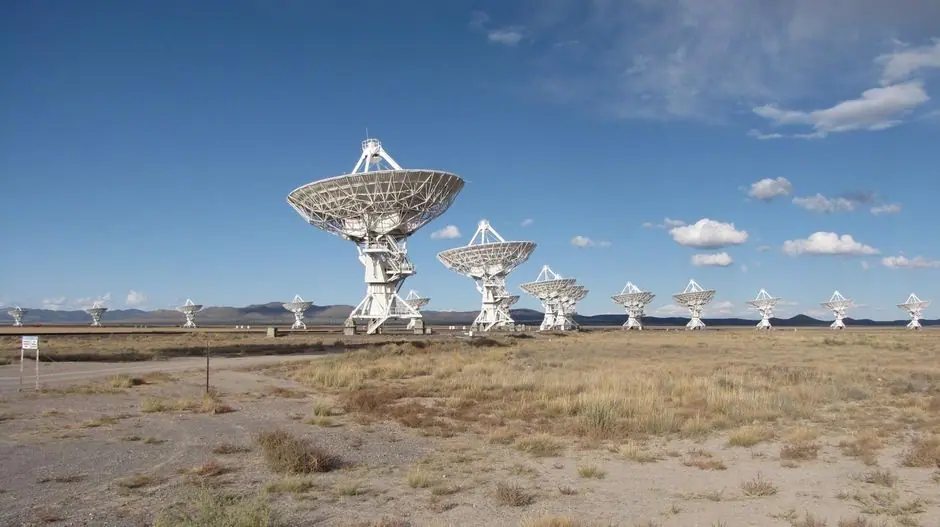
The "ASKAP" radio telescope of the "CSIRO" organization, located in Western Australia, was used to discover the object. After the initial registration in the radio range, the team also confirmed X-ray radiation from the same position, which allowed the nature of the system to be definitively determined as an accreting white dwarf in a pair with a red dwarf.
A natural laboratory for extreme physics
The identification of "ASKAP J1745−5051" paves the way for a better understanding of the remaining, still unknown sources of long-period radio transients. Because the system emits simultaneously in the radio and X-ray ranges, it becomes a kind of "natural laboratory" for studying extreme physical processes.
Among the main questions that scientists hope to study are how strong magnetic fields direct accreting matter to the surface of the white dwarf, how coherent radio emission is generated, and how the various energy channels are connected – from radio waves to X-ray photons. The study is titled "Periodic radio and X-ray emission from an accreting white dwarf binary" and is published with the DOI "10.1038/s41550-026-02882-x".




Comments (8)
Абе, хора, сериозно ли?! "Бел карлик изяжда звезда"... звучи като лош трилър, а не научен факт! 😄 Все едно някой е решил да симулира апокалипсис за забавление.
Абе, к'ви са тия "бели джуджета" дето изяждат звезди? 🤦♀️ Явно си имат апетити, ама да не се окаже че следващия път ще ни
Мале-е-е! Пак нещо ново в космоса... 🤯 Абе, тва бяло джудже
Ебаси! Пак ли нещо ново?! Ама харесвам науката, важно е да развиваме технологиите,
Абе, щом са открили нщо ново, значи пак сме дали материал на фантастичните филми, а? Да видим кат' направят поне една прилична анима