
The James Webb Space Telescope has found the galaxy that produced the most distant fast radio burst with a known location. The galaxy is small, young and actively forming stars. The find makes it more likely that some bursts come from young magnetars, but it does not show what caused this one.
Fast radio bursts are flashes of radio waves that last about a millisecond. The first was spotted by chance in 2007, and thousands have been found since. Most are seen only once, and no one knows for sure what causes them.
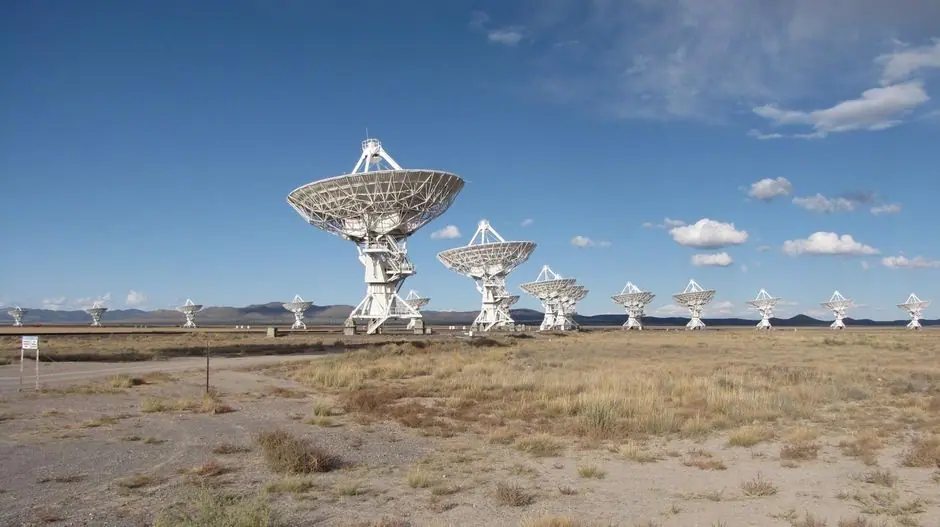
The MeerTRAP team detected the burst, FRB 20240304B, on 4 March 2024 with the MeerKAT radio telescope in South Africa. The telescope is an array of 64 dishes, each 13.5 metres across. In a few milliseconds, the burst released more energy than the Sun does in a whole year.
Faint galaxy 0.23 arcseconds from the burst
Radio data show where to look, but not what is there. So astronomers search for the "host" galaxy where the burst began, because only it gives the exact distance. The Keck and MMT ground telescopes, along with archive images, see nothing at the burst's position.
Webb's NIRCam camera shows a faint galaxy about 0.23 arcseconds from the burst's position. The authors put the chance that the two are linked at 97.5%. The NIRSpec spectrograph picks up emission lines of hydrogen and oxygen, which give the redshift. Redshift measures how much light is stretched as the universe expands, and scientists use it to work out the time.
The redshift is 2.148. The burst was sent out when the universe was about 3 billion years old, and it travelled for more than 11 billion years to reach us. The previous record for a burst with an identified galaxy was a redshift of 1.016, so the new distance is more than twice as great.
The galaxy itself is a dwarf with a stellar mass of about 1% of the Milky Way's. The authors say about 90% of its stars formed in the last 30 million years or so, and its metal content is about a tenth of the Sun's.
Study leader Manisha Caleb from Sydney said: "We thought it would be a large, well-formed galaxy with lots of stars." NASA says the galaxy is about 1,000 times less massive than expected.
Magnetars and neutron star mergers
There are two main models. In one, the burst comes from two neutron stars merging, which takes hundreds of millions to billions of years. In the other, a magnetar produces it. A magnetar is a young neutron star with a strong magnetic field, left behind after a supernova. It can flare up soon after it is born, for example in a starquake.
A young galaxy only 3 billion years old, where stars are born in a rapid burst, fits the second model. "Our work shows it is very unlikely that this burst was produced by a merger," Caleb says. Ben Stappers of the University of Manchester, also one of the authors, notes that the host "stands out in the whole sample of galaxies".
The conclusion is statistical. No one has seen a specific magnetar behind this burst, and a single event does not prove that all bursts share one origin. Other explanations remain possible, and the question of origin is still open. NASA says the theories lack convincing evidence.
The burst also serves as a probe of the universe. Its signal passed through gas that spans about 80% of cosmic history, and through a previously unknown galaxy cluster at redshift 0.3, as well as through the Virgo Cluster. Scientists believe MeerKAT can detect a few such bursts a year at redshifts above 1. The SKA-Mid telescope, which is being built in South Africa and will include MeerKAT, is expected to detect even more distant bursts.

Comments (1)
три милиарда години... ама тоя номер ме накара да се замисля колко е старо вселената изобщо! някой да знае дали има пенсионери там горе?