
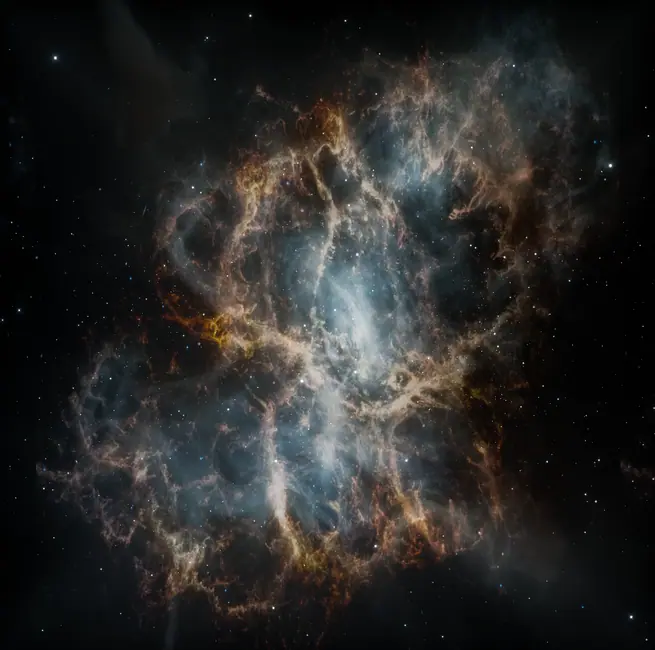
A white dwarf known as HS 0209+0832 may have a planet that formed from material thrown off when the star died. It is only a candidate: astronomers worked out its existence from the star's chemistry and a faint repeating signal, and have not seen it directly.
Hubble took an ultraviolet spectrum of the star in 1999. A spectrum splits light into colours, and dark lines in it show which elements are in the star's atmosphere. About 100 of those lines were not identified at the time. A team led by Jamie Williams of the University of Warwick re-examined the archive data using an updated line database and found that many of the lines come from niobium. The paper came out in Nature Astronomy on 5 October 2026.
Niobium in the atmosphere of HS 0209+0832
A white dwarf is what is left of a star that has shed its outer layers. HS 0209+0832 lies about 270 light years away in the constellation Cetus and is about 5 million years old, which makes it young and very hot. Metals in the atmosphere of such a star usually come from broken-up planetary bodies.
The make-up here is unusual. The star has more than 1,000 times as much niobium as the Sun, and none has been found in any of 33 other white dwarfs with metal pollution. The spectrum shows 5 lines of doubly ionised niobium and 57 of triply ionised niobium.
Copper and zinc are present, while silicon and iron are scarce. Nickel is at least twice as abundant as iron, unlike in the Sun, the Earth and primitive meteorites, and the mix looks like nothing known in the Solar System.
Niobium is made by slow neutron capture, which happens mostly inside some red giants. According to the authors, wind from the star's last giant phase, rich in such elements, formed a disc from which a gas giant grew. The model predicts more niobium, nickel, copper and zinc, while oxygen, silicon, calcium and iron barely change. The planet should be losing its atmosphere in the star's intense heat, and the evaporated material falls back onto it.
A repeating signal and the weak points of the model
The TESS satellite detects a faint change in the star's light, with a period of 4.399 days and a size of about 0.12%. A white dwarf typically spins in about 1.25 days, so this is not the star's own rotation. If it is a planet, the period fits a gas giant about 0.04 astronomical units, or about 6 million kilometres, from the star, with one side hotter than the other. The authors also allow another explanation: a comet-like tail from an evaporating giant passing in front of the star.
According to the caption of the paper's first figure, the model does not reproduce well the unusual structure of the ionised helium He II line. This may be due to extra absorption by gas around the star.
An analysis by other researchers points to three more open questions. Strontium, which is expected to appear together with niobium, has not been found. The star's former companion, which would return material to orbit, has not been found either. And it is possible that a new atmospheric layer formed on a surviving first-generation core.
Williams calls the planet the most reasonable explanation but describes it as a candidate awaiting confirmation. Xifan Lin of Washington University in St. Louis, who was not part of the study, says the process was until now more of a guess, and that for the first time there is evidence for it. On whether the planet will survive, Williams says: "If the second-generation planet is there, I think it will probably survive."
Over the next few years, Williams plans to use Hubble to study how such planets form, how common they are and how they change.


Comments (0)
No comments yet.