
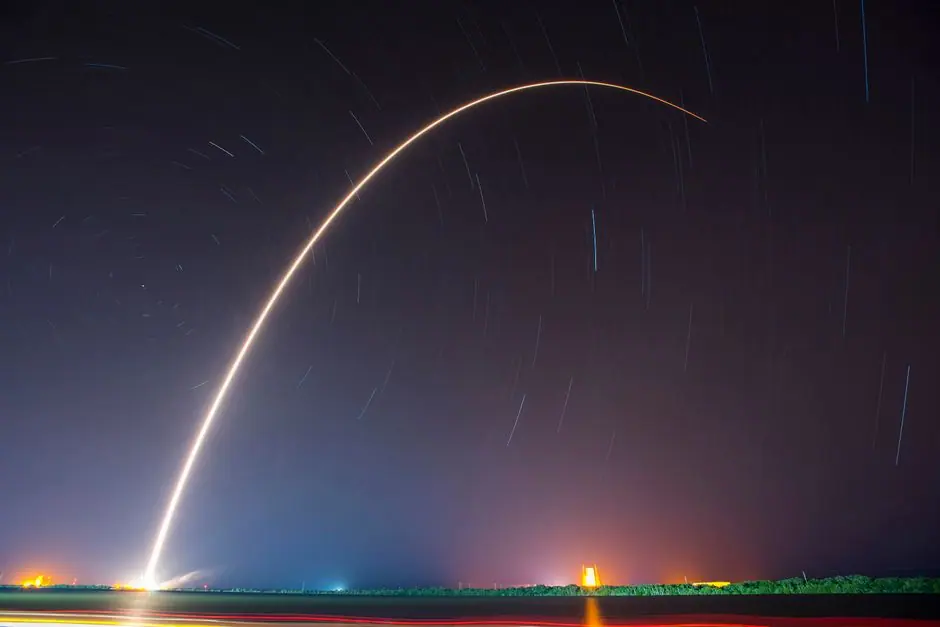
Japan's MMX probe will launch on 20 October 2026 at 4:41am Japan time on an H3 rocket from the Tanegashima Space Center. If all goes to plan, it will be the first mission to bring back a sample from a moon of another planet. The sample will not reach Earth until 2031.
The date depends on the time zone. Japan's space agency JAXA gives 20 October, but France's CNES says the launch falls on 19 October at 9:41pm Paris time. In Bulgaria it will be 10:41pm. If the rocket does not lift off then, it has a back-up window from 21 October to 7 November 2026. The exact time may change within that window.
Where the two moons came from
Phobos is about 22km across and Deimos about 13km. Phobos orbits about 6,000km above the surface of Mars. No spacecraft has ever landed on either moon.
Scientists have two main explanations. One is that the moons are asteroids captured by the gravity of Mars. The other is that they formed from debris thrown up when a huge object hit the young Mars. Their spectra, which show how they reflect light, look like those of asteroids from the outer solar system. But the moons' almost circular orbits, close to the Martian equator, argue against capture.
The two ideas predict different makeup. An impact would have boiled off most of the water, so the sample would be a mix of Martian material and material from the body that hit it. Captured asteroids should be rich in water and organic matter. In the lab, researchers will measure isotopes of oxygen, chromium, titanium and zinc. They will also look for traces of carbon compounds. Lead scientist Kiyoshi Kuramoto says the moons "look very much like carbonaceous asteroids".
How the sample will be taken
The aim is to collect more than 10 grams of material from Phobos, described as sand. The probe will land twice and use two kinds of sampler.
One is a drill on a robotic arm, which takes regolith, the loose dust and small stones, from more than 2cm down. The other is pneumatic: it fires a jet of gas that lifts material from the surface through a tube into a container. A full sampling cycle takes about two and a half hours. About 1% of the mass will go to Japan for a first check.
During the descent, the probe will also release IDEFIX, a small German-French rover weighing under 30kg. It will work on Phobos for at least 100 days. France's CNES built it with Germany's DLR.
What is planned to 2031 and what could go wrong
The trip to Mars takes about a year, with arrival in 2027. From 2027 to 2030 the probe will be in a quasi-satellite orbit around Phobos. This is the name for orbits near the moons, which are too small in mass for an ordinary orbit. The probe will observe the moon, land twice and, in the last phase, survey Deimos. It leaves the Mars system in 2030, and in 2031 the sample capsule enters Earth's atmosphere. It is due to land in Australia.
Only the launch has an officially announced date and time. The years 2027, 2030 and 2031 are JAXA's plans, not agreed dates for individual events. The schedule has slipped before: in 2020 the launch was planned for September 2024, with a return in 2029.
The rocket is also a risk. On 22 December 2025, the eighth H3 flight lost the Michibiki 5 satellite. The Payload website says the satellite separated early because of an overly strong shock when the fairing came off. The H3 returned to flight in June 2026 with six satellites. The rocket's tenth flight will be the one carrying MMX.
There are also unknowns in the science. It is not known whether the sample will be primitive or from erupted rock. Deimos and Phobos may be so alike that dust from Deimos is hard to tell apart. Martian material in the regolith may be only a few hundred parts per million, and some isotope tests need more material than the mission will bring back.
The first step is the launch itself on 20 October at 4:41am Japan time. If that fails, the rocket has back-up dates until 7 November.

Comments (0)
No comments yet.