
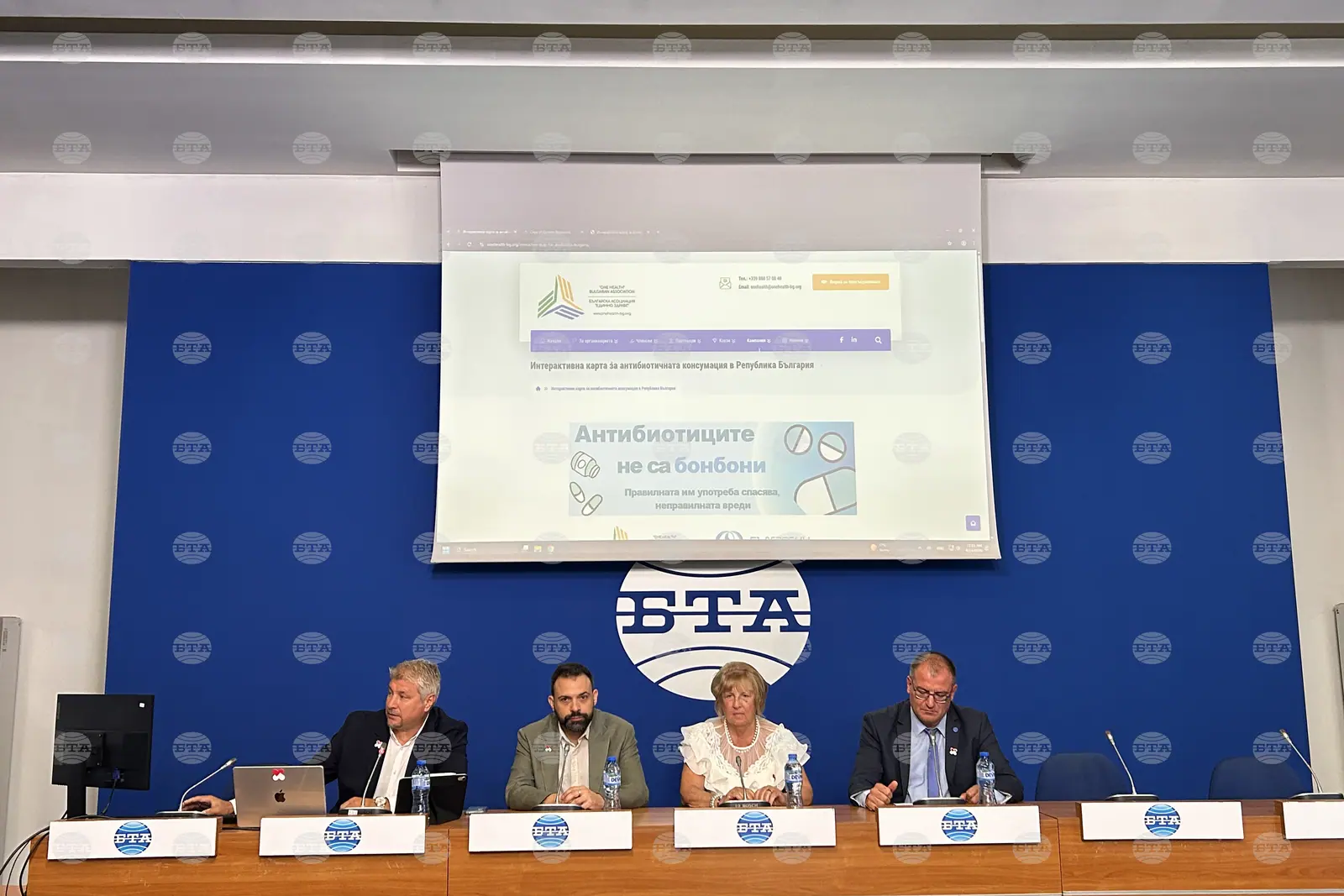
The issue of irrational antibiotic use and the alarming rise of antibiotic resistance were the main topics of discussion at the National Press Club in Sofia. Experts emphasized the need for a shift in public habits, presenting a specialized interactive map tracking medication consumption in outpatient care. The meeting addressed both responsible drug procurement and how proper prescribing can curb the impact of resistance. It was noted that in 2025, a 20% reduction in antibiotic use was recorded.
Global statistics highlight the scale of the challenge facing Europe and the world. According to data presented by Prof. Emma Koleyan, coordinator for the Ministry of Health on EU-JAMRAI 2, approximately 700,000 people lose their lives annually due to infections resistant to standard drugs. Financial losses are also significant—about 8 billion euros in Europe and nearly 20 billion dollars in the USA. The projections are stark: if the trend is not brought under control, annual mortality could reach 10 million people by 2050. Prof. Koleyan explained that restoring antibiotic sensitivity is an extremely complex and lengthy process, taking 20 to 30 years, without any guarantee of success even then. She added that the genetic mechanisms of resistance development are linked to plasmids, which spread between bacterial cells in 20 minutes, transmitting their resistance.
To assess the situation, experts rely on objective sources:
- Data on the number of prescriptions and prescribed packages come from the National Health Information System (NHIS).
- Demographic indicators are provided by the National Statistical Institute (NSI).
Assoc. Prof. Ivan Ivanov, head of the National Reference Laboratory for "Control and Monitoring of Antibiotic Resistance" at the National Center for Infectious and Parasitic Diseases (NCIPD), highlighted the role of the WHO, which classifies antibiotics into three groups: "Access," "Watch," and "Reserve." Both the WHO and the European Centre for Disease Prevention and Control insist that the share of the first group should reach at least 65%. In countries like Norway, Sweden, and Denmark, this threshold is strictly maintained and reaches about 90%. In Bulgaria, however, there has been a decline since 2014, with the current rate at about 40% in outpatient care and between 23% and 25% in hospitals.
The Chairman of the Bulgarian "One Health" Association (BAEZ), Dr. Dragomir Ivanov, noted that a conference for management personnel in the sector is planned for October 29 at the Center for Infectious and Parasitic Diseases, where tackling resistance will be set as a priority activity. He emphasized the need to develop pharmacotherapeutic guidelines. Prof. Koleyan pointed out that in Bulgarian hospitals, nursing staff are severely insufficient to maintain the necessary standards, and general practitioners should implement a delayed prescribing strategy for antibiotics when an infection is suspected.
This information is relevant to residents of Burgas and the region, as responsible use of antibiotics is critical for the effectiveness of healthcare for every local household.
Dimitar Marinov, chairman of the Bulgarian Pharmaceutical Union, signaled a discrepancy between prescribed and actually sold quantities. He expressed concern that patients are bypassing NHIS controls by purchasing drugs from grocery stores or through illegal imports, known as "suitcase trade," from neighboring countries such as Serbia, Turkey, or North Macedonia. Marinov urged the public to rely solely on the pharmacy network, as only there can quality and non-counterfeit medicines be guaranteed.





Коментари (0)
Все още няма коментари.