
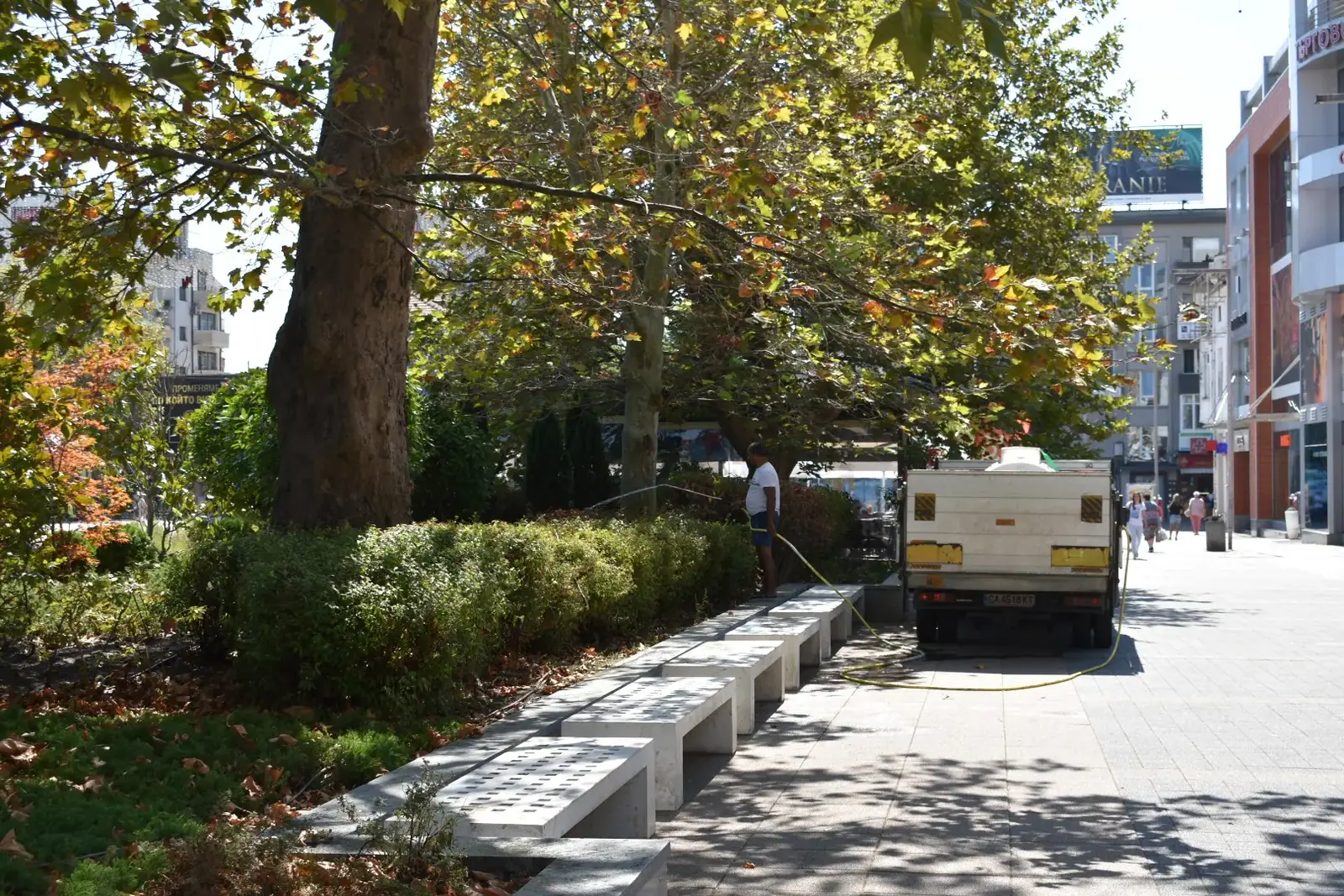
Taking down a tall or risky tree in Sofia costs between 150 and 600 euros, according to public price lists from specialist firms, and more for the toughest jobs.
In Burgas, the rule covers long-established decorative plants. A request to cut down, uproot, move or trim a tree goes to the mayor from the owner or another interested party. Under the city's rules, it must come with proof of ownership, details of the plant and a health check, plus a fee.
Under permits Burgas city council issued in 2026, cut wood and branches can only be taken away after they've been marked and a transport permit has been issued.
The rule comes from Article 63 of the Spatial Planning Act. Under it, cutting down or uprooting long-established decorative trees or trees of historic value is only allowed as an exception, based on a health check and with written permission from the mayor. Owning the land a tree grows on is not, by itself, a reason to remove it. The same rule applies in Varna, even on private land.
The price depends on the tree's height, the width of its trunk, how much open space is around it, and how close it stands to roofs, fences, cars and power lines. If there's no room to fell the trunk in one go, it's cut in sections using rope systems, a cherry picker or climbing gear. On top of that come the costs of cutting up the wood, chipping the branches, loading and hauling it away. Prices are highest when a tree stands over a house, next to a power substation, between two buildings or near cables, because then every branch and every cut section has to be secured and lowered down under control.
According to the price list from the firm Kastro, a conifer costs 150–400 euros, a Lombardy poplar 150–450 euros, a branching poplar or "kavak" up to 600 euros, and beech, oak, walnut and lime trees 150–500 euros. Hauling away around 5 cubic metres of cut branches costs 100 euros. Eco Expert quotes a starting price of 40 euros and gives a final quote after inspecting the site, depending on access and risk. A third price list for Sofia goes up to 665 euros for conifers, up to 921 euros for poplars and up to 819 euros for some broadleaf trees.
In Varna, two hours' work with a 22-metre cherry picker costs 100 euros, four hours costs 150 euros, and a full shift with an operator costs 250 euros. For a 31-metre cherry picker, a full shift alone can cost up to 300 euros, not counting the cutting itself, the ground crew or the clean-up.
In Sofia, anyone who cuts down, uproots, destroys or damages a long-established plant without written permission faces a fine of between 511.29 and 2,556.46 euros if they're a private individual, or between 1,022.58 and 25,564.60 euros if they're a sole trader or company. On top of the fine, the rules on the city's green spaces also call for separate compensation for damage to green areas. Walnut, horse chestnut, beech, oak and lime are among the protected decorative broadleaf trees, and the compensation is worked out based on the type, size and condition of the tree. In March 2024, Varna city council announced a fine of between 5,000 and 10,000 levs, under the rules in force at the time, against a landowner whose property had 80 decorative and forest trees cut down without permission.
The claim that prices have risen by 30 to 50% compared with last year isn't backed up by any single set of public figures, and firms use different ways of pricing: fixed ranges, a starting price only, or a price given after inspecting the site. There's no official data either to support claims of a nationwide shortage of tree climbers. Nor is it accurate that walnut trees enjoy the same special protection everywhere in the country, since the Spatial Planning Act covers long-established decorative plants in general, while the actual rules and checks are set by each city council. The Association of Arborists in Bulgaria keeps a list of its certified members, but it doesn't cover everyone working in the trade.
If a tree is dangerous, dried out or leaning badly, the owner reports it or files a request with the city council, which then decides how it will be inspected and removed.


Comments (0)
Все още няма коментари.