
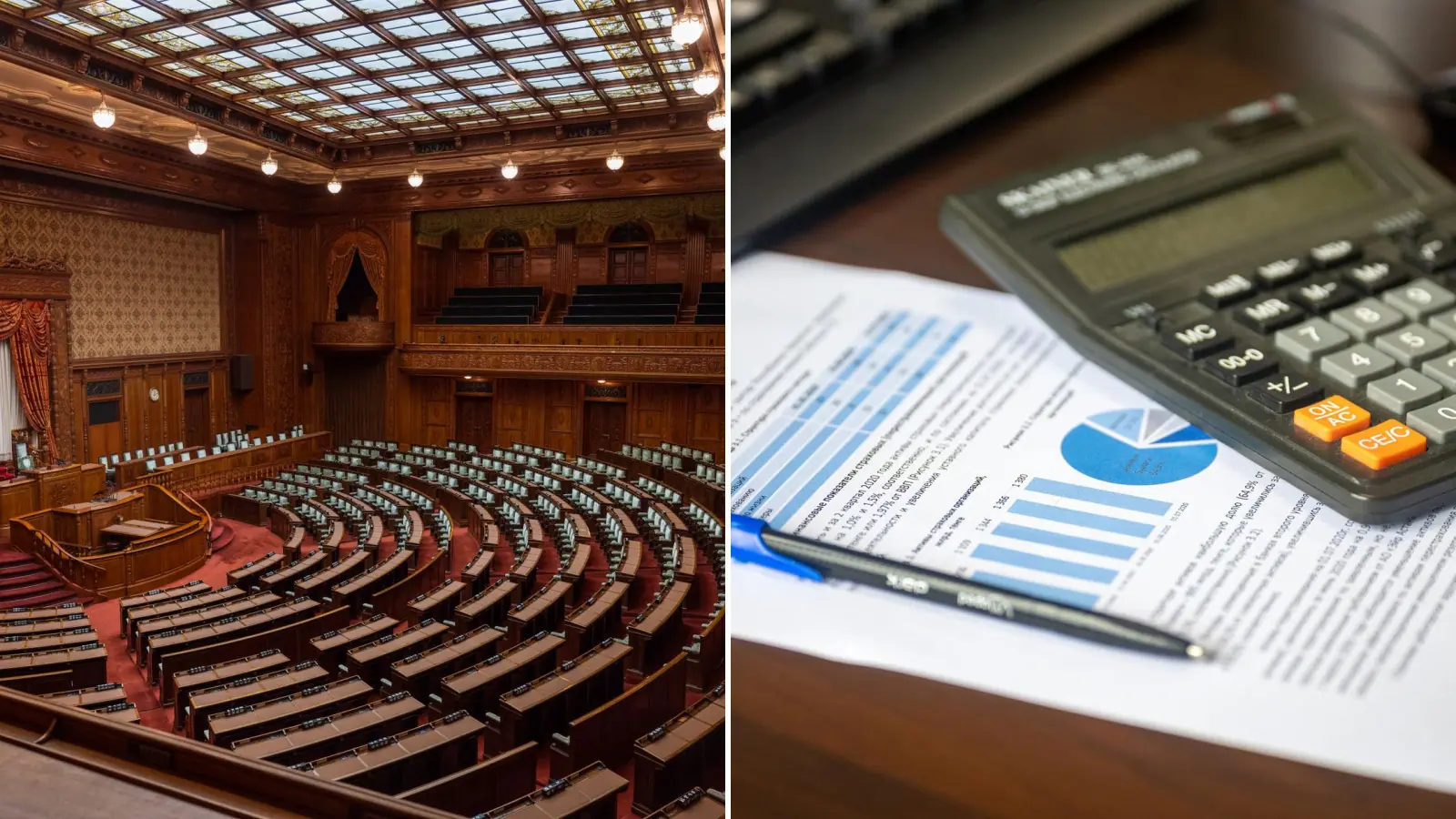
Parliament passed changes to the Public Finance Act at first reading that set new rules for budget planning. The Council of Ministers submitted the bill.
In the main chamber, 117 MPs voted for the changes and 55 voted against. No one abstained.
More on this story: Budget committee backs replacing national fiscal rules with EU ones
If a budget is not passed on time, the state will be able to refinance its debt, both principal and interest, on the domestic market and through issues on international markets. The bill's explanatory notes say that refinancing abroad protects against liquidity risk, meaning a shortage of cash to make payments, and lets the state look for the best terms.
The main limits on the deficit and debt under the Stability and Growth Pact stay. What is new is that the growth of net spending will be tracked against Bulgaria's net expenditure plan, which the EU Council has approved. For the first time, the law says that investments paid for from national funds can enter the budget only after an assessment and ranking by priority.
Two new documents will replace the convergence programme and the National Reform Programme: a National Medium-Term Fiscal-Structural Plan and an Annual Progress Report.
Martin Dimitrov of Democratic Bulgaria (DB) said that scrapping the national corrective mechanisms is a serious mistake and that Bulgaria cannot rely on the European ones alone. "You are creating a perfect storm: first you run high deficits, and then you remove the limits that should correct them automatically," he said.
Konstantin Prodanov of Progressive Bulgaria replied that one mechanism is simply being swapped for another. He said the old one did not stop the 4% deficit for 2025. Prodanov added that the European Commission itself admits the structural deficit approach is harder to apply. "The new mechanism is fully adequate and is like a helmet that protects us, while you insist that we put a helmet on top of a straw hat," he said.
Temenuzhka Petkova of GERB said the change is normal given the new European rules, but she has concerns. She said any interim or caretaker government will be able to take on new debt if the State Budget Act is not passed, and this undermines the foundations of public finances.
Petkova also disagrees that the Council of Ministers will set the size and type of pre-approved public investments each year, using criteria from a regulation. She said this comes close to a lack of transparency. She also objected to dropping "extraordinary circumstances" as a ground for a deficit above 3%. Petkova noted that Bulgaria is in an excessive deficit procedure and said such limits should not be removed at a time like this.
Ayten Sabri of the DPS said the text does not strike the right balance. She called for parliament to get a calculation of upcoming payments, available cash and the shortfall that debt is taken on to cover. When spending limits are exceeded, people should know when and how the state will return within them, Sabri said.
MPs rejected two proposals from Bozhidar Bozhanov of DB. The first was for a method to divide budgets among municipalities. The second would have required the Finance Ministry to publish budget execution data on a clear schedule.
The changes still have to be voted on at second reading.






Comments (0)
No comments yet.