
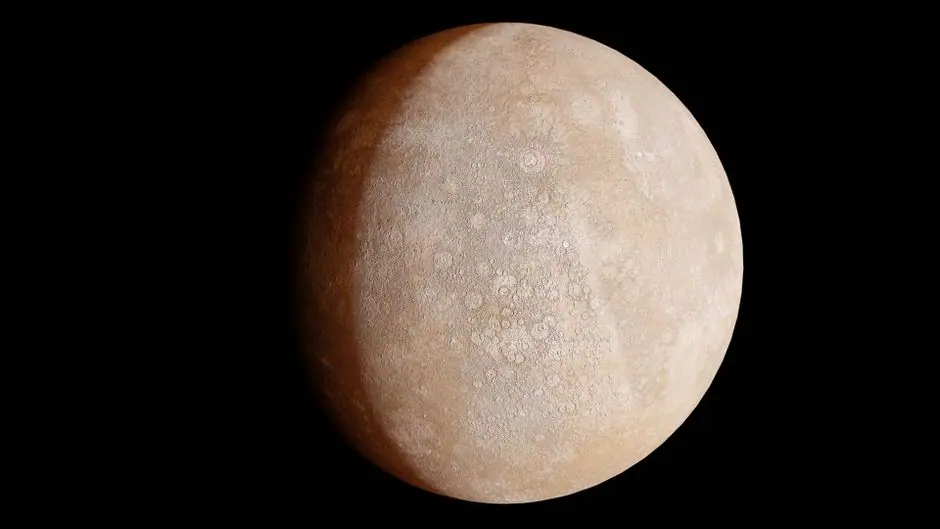
The European-Japanese spacecraft BepiColombo is due to enter orbit around Mercury on 21 November 2026, eight years after it launched on 19–20 October 2018. As of 19 November, the manoeuvre has not yet happened. ESA, the European Space Agency, last issued an official update on 29 October, and it still gives that date. Observations will not start straight away: ESA plans them for April 2027.
The spacecraft is a joint project of ESA and the Japan Aerospace Exploration Agency (JAXA). The European part is MPO, which weighs 1,230 kg. The Japanese part is Mio, at 255 kg. A third module, the transfer module, carried them to Mercury.
Nine flybys and a "weak stability boundary"
ESA says the Sun's huge gravity makes it hard to put a spacecraft into a stable orbit around Mercury. The agency says a trip to Mercury takes more energy than a trip to Pluto. The spacecraft falls towards the Sun and has to shed a lot of speed before the small planet can hold on to it.
To do that, it has made nine flybys: one past Earth, two past Venus and six past Mercury, the last on 8 January 2025. Each one used the planet's gravity to slow the spacecraft. Under the original plan, the six flybys were to bring its relative speed down to 1.84 km/s. Four final thrust arcs, long periods when the ion engines run, would then cut it further, so that Mercury "catches" the spacecraft only weakly, at the edge of its gravitational pull. ESA calls this "weak stability boundary" capture. After that, only a small manoeuvre is needed to reach a first orbit of about 674 by 178,000 km. This is safer than a single hard burn.
These details come from the original plan. ESA's latest update does not break down the arcs or give a speed for the manoeuvre itself, so it is not confirmed that there are still exactly four. Other data say the last thrust arc of the ion engines ended on 15 June 2026, and that MPO's chemical engines will handle the approach and orbit entry. The transfer module separated on 3 September 2026. On 24 September, MPO fired its engines for 8 minutes and 42 seconds and made a correction of 11.4 m/s. More small corrections are planned before 21 November.
Engines without full thrust and a new route
The spacecraft was first due to enter orbit in December 2025. In April 2024, the electric engines on the transfer module stopped working at full power. Engineers found the likely cause a few months later but could not fix it, and the thrust stayed below the minimum needed to enter orbit under the old plan.
Instead of a repair, the flight dynamics team worked out a new route. The fourth Mercury flyby passed 35 km closer to the planet than planned, so that the next one would need less thrust, and the six flybys steered the spacecraft onto the new path. Arrival slipped by 11 months, to November 2026. ESA said the main science programme stays the same.
From separation in December to the first data
After the spacecraft enters orbit, the two probes stay together. On 9–10 December 2026, MPO and Mio separate. Mio goes into a polar orbit with a period of about 9.3 hours. On 16 December, the MOSIF sun shield also detaches from MPO. The team rehearsed this on 29 October. According to ESA, Mio will fly at 590 to 11,640 km and measure the magnetic field and plasma. MPO moves into a lower orbit to study the surface and interior. Other sources give slightly different heights for Mio, so these figures are approximate.
MPO is due to reach its final orbit of 480 by 1,500 km, with a period of 2.3 hours, by 10 March 2027. Instrument checks follow, and the main science phase starts on 6 April 2027. MPO's 11 instruments were switched on together on 15 September and are working normally. They include the MERTIS infrared spectrometer, which maps minerals, and the BELA laser altimeter, which measures terrain, including, for the first time, in the southern hemisphere.
ESA keeps a news page on the arrival and will post there if the date changes.





Comments (0)
No comments yet.