
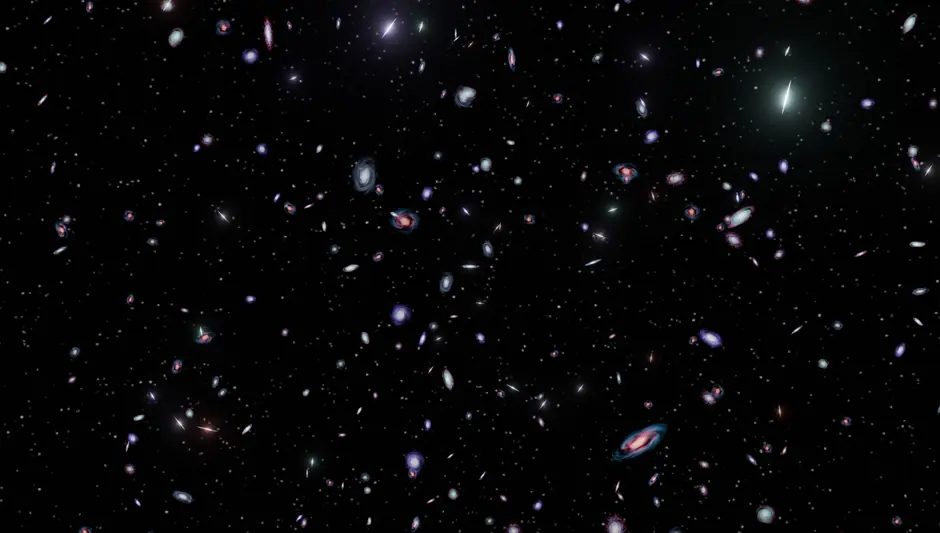
The European Space Agency (ESA) on 12 November 2026 released the first big batch of data from its Euclid telescope, called DR1-Foundation. It covers about 13 months of observations and 1,900 square degrees of sky, around 14% of the area the mission plans to survey over six years. It has no finished 3D map. It holds the material the map will be made from, and the full first data release (DR1) is due in mid-2027.
The data run from spring 2024 to spring 2025. The total is about 1.7 million gigabytes, or 1.7 petabytes. The previous release covered a few days of observations over about 60 square degrees, so the area is roughly 30 times larger. Valeria Pettorino, Euclid project scientist at ESA, said the agency is releasing more than a year of data for a much larger area.
Catalogues of galaxies, lenses and quasars
The catalogues list more than 900 million galaxies, about 15,000 candidates for strong gravitational lenses, more than 60 million quasar candidates and spectra of more than 160 million sources. The release also includes raw and calibrated images, spectra and large mosaics of the sky.
Most of the millions of galaxies are not new discoveries. They are objects entered in the catalogues after software pipelines processed about 10,000 science images. These pipelines are programs that turn raw data into ordered results step by step. They run in computing centres in Europe and the US, and the German science data centre is one of them.
A gravitational lens forms when a massive galaxy bends the light of a more distant object behind it and distorts it. Such lenses help scientists weigh the galaxy together with its dark matter and trace how the universe is expanding. ESA says this is the largest catalogue of lenses so far, bigger than all earlier ones put together.
The lenses and quasars are candidates, not confirmed objects. Quasars are the very bright cores of distant galaxies. For lenses, machine-learning systems flag the likely cases, and volunteers and then experts check them. Other telescopes must make observations to confirm them. So the figure is the most that can be expected, not a final count.
Distances come from spectra
The images show the position and shape of each galaxy, but not how far away it is. That comes from spectroscopy, a method that splits light into its wavelengths. The telescope looks for the hydrogen-alpha line, given off by clouds where stars are born, and uses it to work out the distance to the galaxy. Once distances are known for many galaxies, the flat picture becomes three-dimensional. It then shows how matter is spread across the cosmic web of filaments and clusters.
The spectra in the release still have to be turned into reliable distances, and the lenses and quasars still have to be checked. These steps take time because brightness must be measured very precisely, and processing so much data puts a heavy load on the computing centres. Mischa Schirmer and Kerry Paterson of the Max Planck Institute for Astronomy coordinate the calibration, which removes the instrument's errors and turns the data into physical quantities. Schirmer says the work also includes checking whether the telescope's properties change over time.
Weak lensing and the cosmic web wait for DR1
This batch does not include measurements of weak gravitational lensing, in which slight distortions in the shapes of galaxies show where invisible matter lies. Nor does it include analyses of the cosmic web. Both are planned for the full DR1, because such products take a long time to process and check over a huge area. For the same reason, the release gives no new limits on dark energy and dark matter. The 3D map is not part of it and is expected in 2027.
Prof Jochen Weller, head of cosmology at the University of Munich, says the data are a step toward understanding why the expansion of the universe is speeding up. The puzzle has occupied physics for nearly 30 years. His colleague Martin Kümmel says the data could write an entirely new chapter in observational astronomy.
Access is open through ESA's Euclid Data Space platform. The results from the first year are described in 26 papers submitted to the journal Astronomy & Astrophysics.



Comments (0)
No comments yet.