
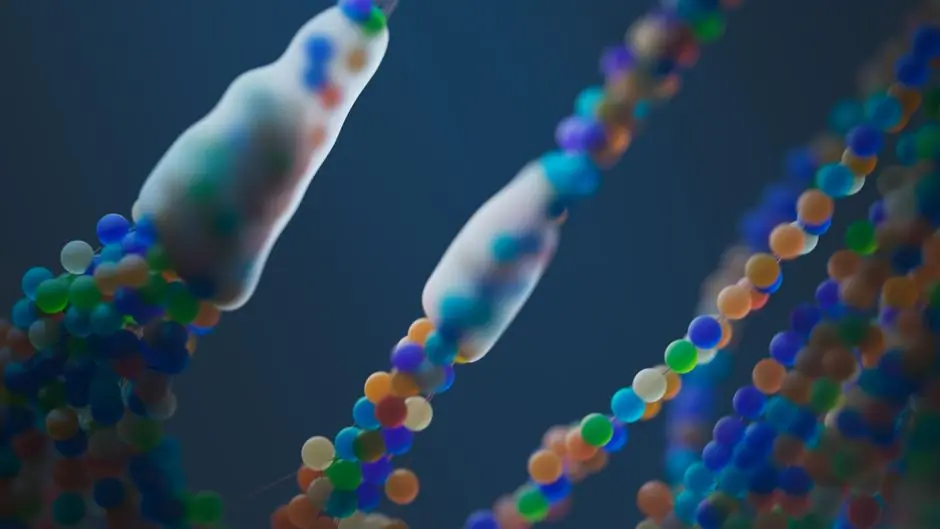
Picture a long thread of yarn, wound tight into a ball. That's how over two metres of DNA fit inside the core of every one of our cells. A small protein called histone H1.4 does this job. It works like an invisible clip that pulls the strand tight so it can't unravel. Now an international team of scientists, including three researchers from the Institute of Molecular Biology "Acad. Roumen Tsanev" at the Bulgarian Academy of Sciences, has shown what happens when that clip breaks — and why the result is a serious birth condition known as Rahman syndrome.
The finding is clear. A specific change in the tail of the H1.4 protein strips away most of the electric charge it uses to grip DNA. Without that charge, the clip can't close all the way. Chromatin — the tangled strand of DNA and proteins inside the cell's nucleus — stays loose, and the cell loses control over which genes it reads and which it doesn't.
What the scientists found
The study came out on 24 September in Nature Communications, one of the most cited science journals in the world. It's the work of a group of labs in France (Grenoble), Turkey (Izmir), the US (Rochester) and Bulgaria (Sofia), with Ramachandran Boopathi and Carlo Petosa of the Institute of Structural Biology in Grenoble as lead authors. The link between H1.4 and Rahman syndrome has been known for years, but this is new: for the first time, scientists show step by step exactly what the mutation does to the shape of DNA at the molecular level.
What the Bulgarian scientists contributed
The Bulgarian side of the team includes professor Stefan Dimitrov, associate professor Anastas Gospodinov and associate professor Dimitar Iliev from the Institute of Molecular Biology — professor Dimitrov is one of the paper's lead authors. The group works on the subject with support from a European project to build up epigenetics research (the science of how a cell switches genes on and off without touching the DNA letters themselves), funded under the Horizon Europe programme.
How one "clip" keeps DNA tight
DNA is wound into small balls around bundles of proteins called nucleosomes, with a short stretch of bare DNA — called linker DNA — running between each ball. That's exactly where H1.4 sits. Its positively charged end pulls the two ends of the linker DNA toward each other, turning the whole chain of nucleosomes into a tighter coil. Without H1.4, chromatin looks like a loose string of beads. With it, chromatin looks like a well-wound rope.
In Rahman syndrome, the mutation cuts off the end of the protein. Where a long run of positive charges should sit, only part of it remains — the study says the net charge drops from +43 to +6. Put simply, the clip loses most of the "glue" that holds the two ends of the DNA together.
The numbers behind the loose packing
Computer simulations show what happens next. The gap between the two ends of the linker DNA jumps from about 30 to almost 40 angstroms (a unit used to measure distances the size of an atom) — chromatin literally opens up. Tests with fluorescently tagged DNA back this up: the mutant protein can't pull the two ends of the strand close together.
There's another effect, harder to explain at first but important to the scientists: healthy cells rely on a kind of droplet clustering, where proteins and DNA gather briefly into tiny liquid drops before chromatin locks into a denser structure — somewhat like oil separating out in water. Scientists call this phase separation, and it helps the cell keep different parts of the genome apart from one another. In healthy H1.4, this happens easily. With the mutant version, it takes roughly four times the salt concentration to happen at all, and the drops that do form don't tighten up properly — they stretch out into threads instead.
Why the picture isn't so simple
Here's a detail that doesn't fit the simplest explanation — "the protein just stops working." The mutant H1.4 doesn't vanish, and it doesn't fully stop attaching to DNA. It just sits far less stably where it lands, moving around inside the nucleus roughly 7 to 20 times more than the normal protein. In practice, mutant and healthy copies of the protein end up mixed together in the same stretches of chromatin, and the whole mix comes out damaged — like a few loose screws in a tight frame shaking the entire structure, not just the spot where they sit. Scientists call this a dominant-negative effect: it's not the absence of the protein but the "bad company" of its mutant form that throws off the work of its healthy copies too.
A disease mechanism, not a cure
It's worth being clear about what this finding does and doesn't do. The scientists haven't found a cure for Rahman syndrome, and they don't claim to have. The paper explains the mechanism behind the disease, not a way to stop it. Loose chromatin stops the cell from reading its genes correctly while the nervous system develops, and that's where the typical signs of the syndrome come from — trouble with speech and learning, distinctive facial features, low muscle tone, and sometimes changes to the heart, skeleton or eyesight. But understanding exactly how chromatin loosens is the step nobody can skip before looking for a way to "tighten" it back up. That's why the researchers call the finding a door to future targeted treatments, not a ready-made solution.
What this means for patients in Bulgaria
Rahman syndrome is rare in the strictest sense of the word. Rare diseases as a group affect roughly 1 in 2,000 people. In Bulgaria, between 350,000 and 400,000 people live with some rare diagnosis; in Europe, the figure tops 30 million. For most of the more than 7,000 known rare diseases, there's still no specific treatment today. That's why every piece of a disease mechanism that gets worked out carries weight — not because a pill will show up tomorrow, but because drug development starts exactly here: with a precise understanding of what breaks and why. For families of children with Rahman syndrome, the news won't change anything in the coming months. But it puts a concrete cause where, until now, there was only a diagnosis with no explanation — and that's already a step forward in the medicine of rare diseases, a field where Bulgaria, through the team at the Academy of Sciences, turns out to be not just a bystander but a participant.
Source: pmc.ncbi.nlm.nih.gov





Коментари (0)
Все още няма коментари.