
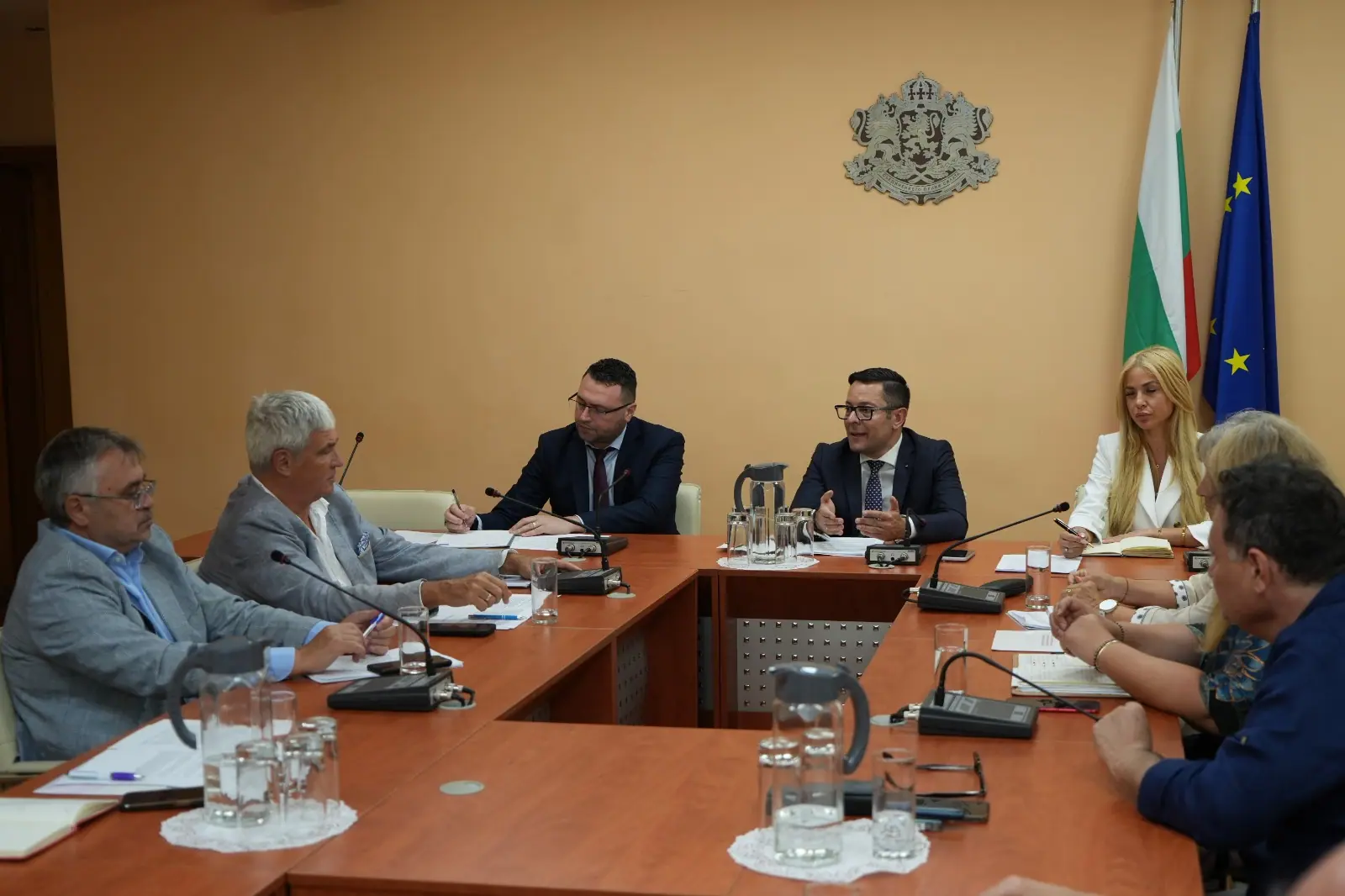
Deputy Prime Minister and Minister of Economy, Investments and Industry Alexander Pulev held a working meeting with the President of the Confederation of Independent Trade Unions in Bulgaria (CITUB), Plamen Dimitrov, and representatives of the trade union's branch organizations. During the talks, the Minister emphasized that the institution's door remains always open for open dialogue, placing particular emphasis on the importance of people and good working conditions. Pulev stated that the government is actively working on restructuring the economy to attract high value-added investments and generate high-quality employment, noting firmly that reforms must not come at the expense of those working in enterprises.
An important element of the discussion was support for energy-intensive industries. Despite the less-than-optimal state of public finances, the state has earmarked a resource of approximately 200 million euros in the 2026 budget to help companies maintain their competitiveness and preserve jobs. The Minister explained that this is a response to long-standing demands from branch and employer organizations. Furthermore, he added that state policy would focus on combining support for existing industry with the stimulation of new production facilities, with future aid being tied to the creation of new jobs and the payment of taxes within the country to expand the social base.
A central theme of the talks was also the National Industrial Strategy, prepared by the Ministry of Economy, Investments and Industry. The unionists expressed satisfaction with the analytical report presented, which lays the foundation for the preparation of the strategic document outlining the vision, priorities, and specific measures for the development of Bulgarian industry until 2035. In addition, the CITUB representatives expressed their gratitude for the restored social dialogue at "Lukoil" following the appointment of the new commercial manager, Evgeniy Simeonov, as well as for the efforts to secure a derogation for the refinery's operations. They also spoke positively about the decision to lift the ban on diesel fuel exports, which is currently being discussed in the National Assembly as a key measure for the company's stability.
Looking to the future, the participants united around the need to take the following steps:
- Resuming the activities of the industry-specific tripartite cooperation councils at the Ministry, which cover key sectors such as metallurgy, the chemical industry, mechanical engineering, and light industry, in order to form joint solutions.
- Implementing early warning mechanisms for employment risks, with the aim of more effectively managing enterprise restructuring.
- Focusing on the retraining of workers and the adaptation of the workforce to impending changes in the industrial sector, in order to limit job losses.

Comments (3)
Двеста милиона, а? Интересно къде точно ще отидат тия пари...
КНСБ ли? Странно, не ги бях чувал да предлагат НЕЩО полез
Двеста милиона евро през 2026-та… Да видим дали наистина ще