
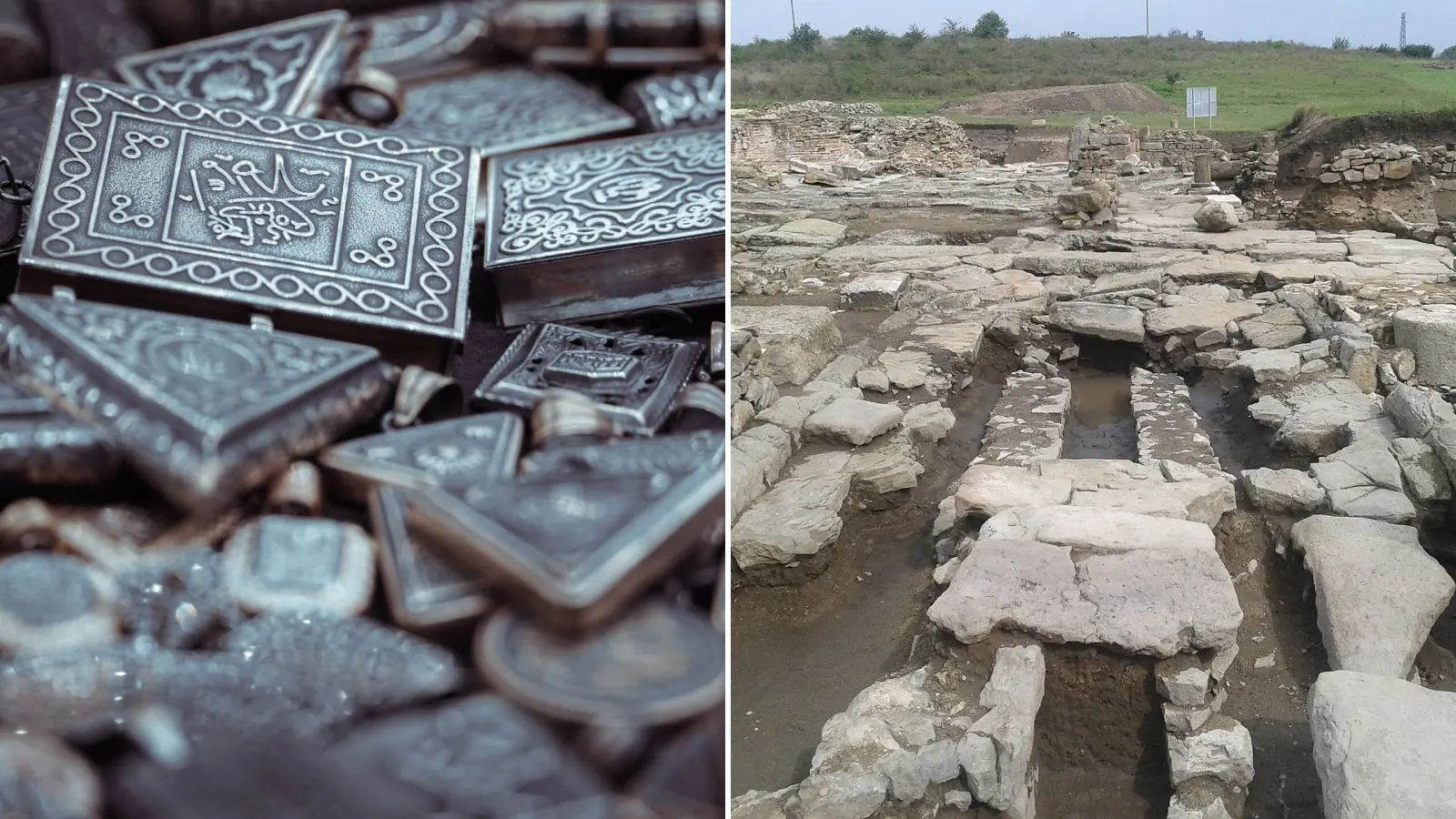
A silver amulet with the name of Christ, found in a teenage boy's grave in the necropolis of the Roman colony of Deultum near the village of Debelt, between Burgas and Sredets, is the earliest mention of Christ found in Bulgarian lands. It dates from the second half of the 2nd century or the early 3rd century AD.
It is also the first sign of the cross found in Bulgaria and the earliest archaeological proof of Christians here.
The amulet is a small rectangular strip of thin silver foil with letters scratched into it with a sharp tool. It was rolled into a tube and put in a cloth or leather pouch, worn on the neck as a pendant or hidden in clothing. Archaeologists found it beside the skull and think it was probably placed there at the burial.
At first only parts of a few letters were visible. The full text could be read after the strip was carefully unrolled. The inscription is in ancient Greek and reads "Gabriel, Michael, Guardian – Christ". The names are on separate lines, but there was no room left for Christ, so the last letter was added below it.
Jewish, Christian and pagan magic texts often call on archangels, usually four, sometimes more. The Deultum amulet names only two, Gabriel and Michael, but together with "Guardian" and Christ they still make four names. Both are archangels of the New Testament. In the Gospel of Luke, Gabriel announces the births of John the Baptist and of Jesus. In the Epistle of Jude and the Book of Revelation, Michael is the first warrior against the Devil.
The word "Guardian" (ΦΥΛΑΞ) refers to Christ, but it also shows what the amulet was for: to protect whoever wore it. The letter X in Christ's name is turned 45 degrees, which makes it a cross, as in some very early Christian inscriptions. Archaeologists say the cross and the choice of these two archangels clearly show the amulet belonged to a Christian community.
They regard the date as secure, because it rests on several independent signs. Some letters have a form found only in the 2nd and early 3rd centuries. The latest possible date is the first quarter of the 3rd century, because the necropolis was not used after that. The dead boy's head does not point west, as with later Christians, and the style of the text fits a time when Christianity was a very young religion. The early date is also backed by the spelling +ΡЄICTOC, with ЄI instead of I. The grave holds no other objects, which fits the early Christian rule against leaving gifts with the dead.
Early Christians did not show their faith in public inscriptions. They used birds, fish or harmless words such as "God" and "Lord", which pagans also used for their own gods. Until now the only early example in Bulgaria that mentions the Son of God was a gravestone inscription from Plovdiv (Philippopolis) from the first quarter of the 3rd century. In it the name Jesus is given as the cipher 888, probably known only to Christians. On the hidden Deultum amulet the name Christ is written openly, with no code.
The early history of Christianity in Bulgarian lands is poorly known. Much of what Christian writings say about apostolic times and local martyrs is legendary or set in the wrong period. It was written after Christianity became official, to prove that local communities had ancient roots. Saint Sebastiana, for example, is shown as a pupil of the Apostle Paul who died under Emperor Domitian (AD 81–96), but she is linked to Marcianopolis, today's Devnya, which was founded only in the 2nd century.
The earliest reliable written record of Christians in Bulgaria concerns the bishop of Deultum and dates from the late 2nd century, roughly the time of the amulet. According to the "Ecclesiastical History" of Eusebius of Caesarea, Serapion, the patriarch of Antioch, spoke out against the Montanist heresy, which had appeared a few decades earlier. His letter against it, from the early 190s, reached churches in Asia Minor and along the Black Sea coast. To give it more weight, Serapion asked other church leaders to sign it. Among them was "the bishop of Debelt, a Roman colony in Thrace", who had earlier opposed Montanism together with Sotas of Anchialus, today's Pomorie, probably bishop there. The first bishop of Deultum may have begun his service as early as the 170s.
So the find is no surprise to archaeologists. Deultum is the first settlement in Bulgarian lands with a firmly attested Christian community and bishop. The dispute between Christian groups in the city in the last quarter of the 2nd century shows the community was large and well developed, and the archaeological evidence for Christianity flourishing here is plentiful.
In printed editions the bishop is recorded as Aelius Publius Julius, while the manuscripts and the ancient Syriac and Latin translations give variants: Aurelius instead of Aelius and Julian instead of Julius. The three names show that, as a resident of the colony, he was a Roman citizen, probably the descendant of a veteran who received citizenship and settled in Deultum under Emperor Hadrian, whose full name was Publius Aelius Hadrianus. The names of the city's later bishops are not known, but two bishops of Deultum who took part in church councils are recorded in the 5th century.

Comments (0)
No comments yet.