
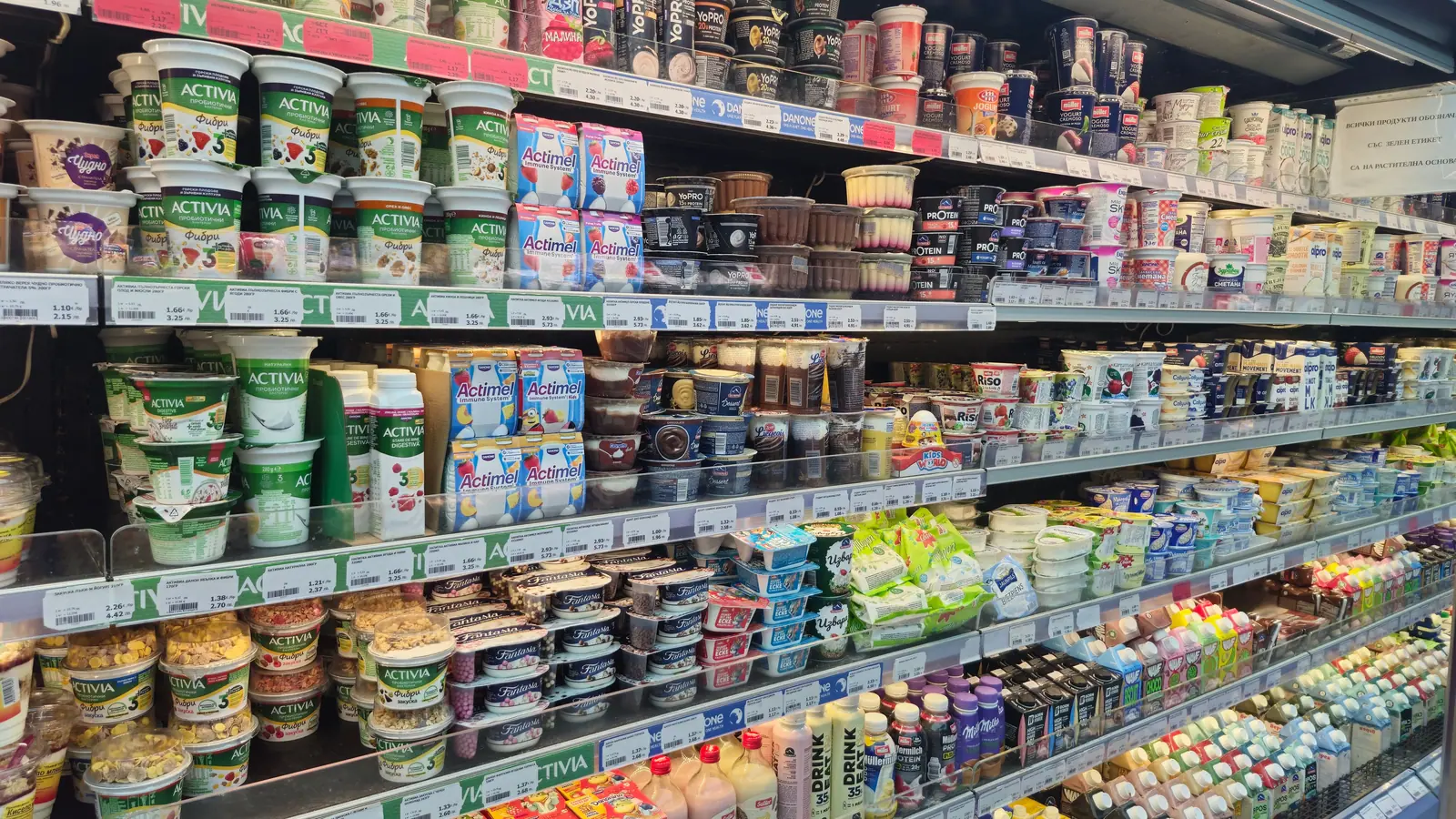
Food prices have not risen steadily since October 2025, but the small shopping basket costs different amounts across Bulgaria's regions. This is shown by data the Association for Modern Trade (AMT) presented at its forum. The Commission for Protection of Competition (CPC) fined Kaufland Bulgaria €75m.
The basket costs €52.07 on average nationwide. It is dearest in Sofia, at €55.95. It is cheapest in Montana, at €48.04, almost €8 below the capital's price, according to AMT and merim.bg.
Next come Varna with €55.2, Kardzhali with €54.4 and Plovdiv with €53.2. In Vidin the basket costs €51.9, in Pernik €51.7 and in Yambol €50.5. Shumen, Targovishte and Pleven are also slightly below the national average.
The association says prices have risen mainly for services and transport. Nikolay Valkanov of AMT said there is inflation, but the data cover food prices in big supermarkets, which report them every day. He believes the rules must be followed, but the problem is that they change every few months and are written unclearly.
A shopper from Sofia buys groceries every week at a big chain for four adults. She buys the same products, and she says their prices rise by 5 to 10 cents every week. Before the euro, her weekly bill was about €50–55 (100–€56.24 (110 leva)). Now she pays €95 for cheese, kashkaval, toilet paper, cooking oil and iceberg lettuce, which last a few days. That is almost double. She does not know what products go into the basket.
A shopper from Montana buys mainly bread, cheese and eggs. By her count, all goods have gone up by about 10%, most of all dairy products and cold cuts. She thinks the rise for these may be smaller than elsewhere.
Since 2015, the CPC has found unfair practices by the chain in three cases. The latest fine equals about 2% of Kaufland's turnover on average. "The latest case, from May 2026, found that the unfair trading practices continue even after the earlier penalties," the commission said.
"What the Commission's findings have in common is that the chain used its stronger position when it agreed and applied trading terms, to the harm of the suppliers affected," the CPC said.
Kaufland rejects the charges and will appeal the fine. Chief executive Mihail Petrov said the charges could shake the economy. If the chain collapses, he believes the effects will be worse than the failure of Corporate Commercial Bank (KTB), because it has many loans and 8,800 employees.
Economy minister Alexander Pulev called Kaufland's tone arrogant and said he does not approve of it. He said the market does not leave a gap, and if one chain loses ground, others will take its place.
Since the end of May, the CPC has also been running a case against another chain. No fines have been issued in it yet.




Comments (0)
No comments yet.