
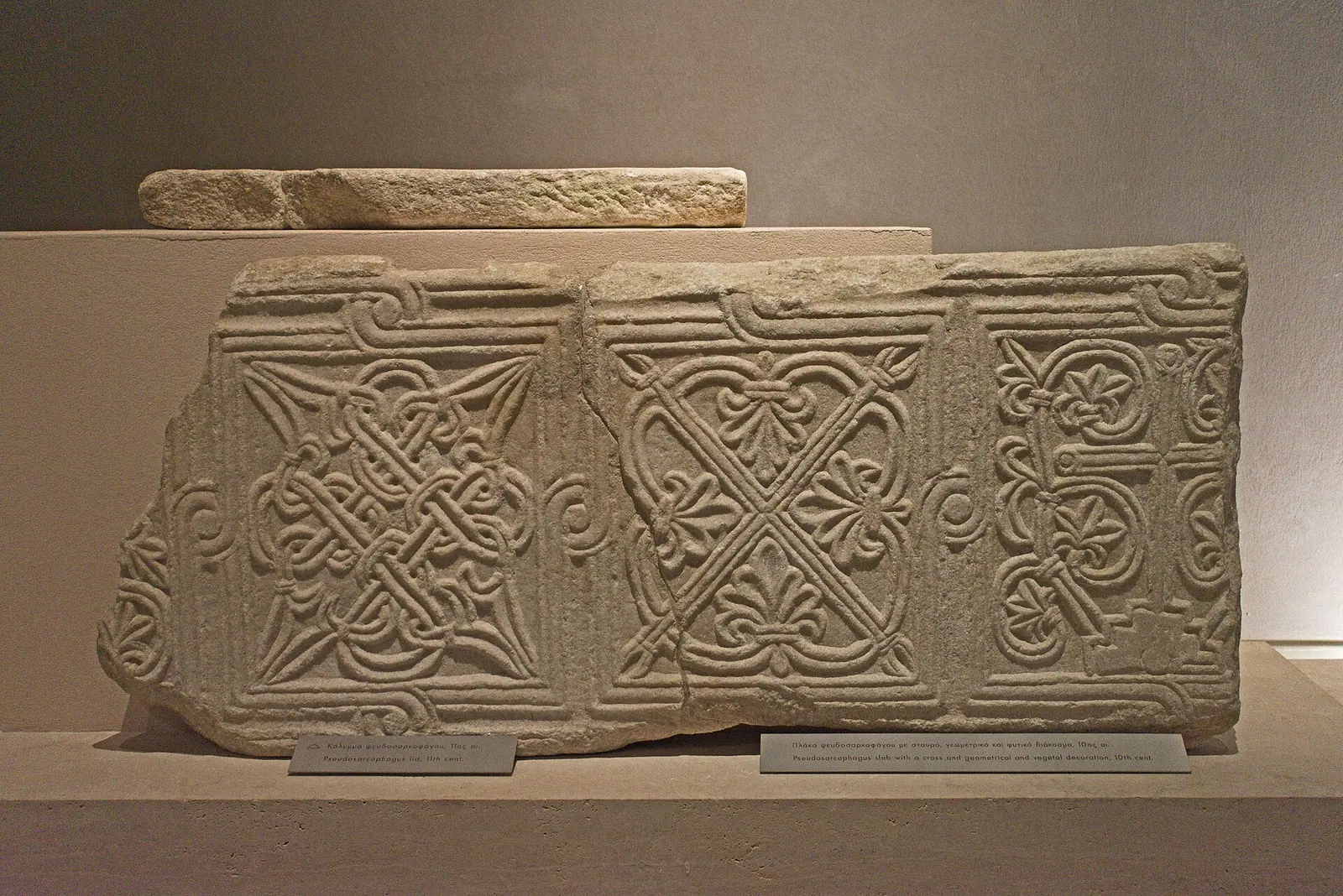
Tsar Samuil ruled Bulgaria from the throne for almost 20 years, from 997 to 1014. Of all Bulgaria's medieval rulers, he is the only one whose grave has been found and whose remains have survived. His bones are now kept at the Museum of Byzantine Culture in Thessaloniki, and historians, archaeologists and Bulgarian institutions have repeatedly called for them to be brought back to Bulgaria.
Samuil was born around 950-960, the youngest son of komit Nikola and Ripsimia. His brothers were David, Moses and Aaron, and he began the line of rulers known as the Cometopuli.
Tsar Peter died in 970 and the four brothers ruled together. They recognized Tsar Boris II when he returned from Constantinople, but in 971 Byzantium seized northeast Bulgaria and took Boris II prisoner. The brothers then took charge of the free lands west of the Iskar river.
Under this joint rule, Samuil held the northernmost share, based in Vidin. In 976 he took part in throwing off Byzantine rule and fought north of the Stara Planina mountains. After David and Moses died, he took sole charge of the state.
In 977 he welcomed Roman, son of Tsar Peter, to Vidin, recognized him as tsar and became his chief military commander. The capital moved to Skopje.
Between 977 and 983, Bulgarian forces took Thessaly and captured Larissa after a three-year siege. On 17 August 986, at the Trayanovi Vrata pass, Bulgarian troops led by Samuil, together with his brother Aaron and Tsar Roman, crushed the Byzantines. Basil II fled to Plovdiv, then called Philippopolis. According to chroniclers, he left behind his imperial tent and the marks of his rank. The victory boosted Samuil's confidence in his army and cemented his place at the head of the Bulgarians.
Fighting resumed in 991 and Tsar Roman was captured. In 996 Samuil marched as far as Thermopylae, but was defeated on the way back at the Sperchios river.
When Roman died in 997, no heir from the line of Simeon remained, and Samuil was chosen as tsar. He made his capital first at Prespa, then later at Ohrid.
In 998 he attacked the Serbian principality, bringing Zeta, Duklja and Trebinje under his control and capturing Prince Ivan-Vladimir. He wanted to stop Byzantium from using the Serbs as allies behind Bulgarian lines.
Around this time Samuil won recognition of his crown from the papal court and struck an alliance with Hungary, marrying his son Gavril Radomir to the daughter of the Hungarian king Géza. He married his daughter Kosara to Ivan-Vladimir, whom he sent back to Zeta as governor. He gave his other daughter, Miroslava, in marriage to the captured Byzantine commander Ashot Taronites and sent him to govern Durrës.
From 1001, Byzantium began taking back what it had lost. That year it retook northeast Bulgaria. In 1002 it took Thessaly. And in 1003-1004 Byzantine forces besieged and captured Vidin. To draw enemy forces away from Vidin, Samuil marched into eastern Thrace and took Edirne. Basil II captured Skopje, but was beaten back with heavy losses at Pernik.
Samuil also led two campaigns against Thessaloniki. Fighting dragged on until 1013 without a decisive battle.
His army built a long wall, called a dema, across the gorge between the Belasitsa and Ograzhden mountains, near what is now the village of Klyuch, close to Petrich. On 29 July 1014, Byzantine troops went around the fortification and struck the Bulgarians from behind at the northern foot of Belasitsa, forcing Samuil to retreat.
On the orders of Basil II, around 14,000 captured Bulgarian soldiers were blinded. For every hundred men, one was left with a single eye so he could lead the rest, and all of them were sent back to the tsar. For this cruelty, Basil II earned the name "the Bulgar-Slayer."
At the sight of his blinded soldiers, Samuil died of a heart attack on 6 October 1014. His contemporaries described him as unmatched in strength and courage, a man who never knew rest. His reign was one long struggle to keep the Bulgarian state alive against Byzantium, during which he held off Basil II's attacks and inflicted serious defeats on him.
The tsar's grave was found in 1969 in the Basilica of St Achilleios on the island of Agios Achilleios in Small Lake Prespa, now in Greece. The excavation was led by Greek archaeologist and Byzantinist professor Nikolaos Moutsopoulos, who said he came across the grave by chance.
Four sarcophagi were found in the basilica, and Moutsopoulos believes one of them held Samuil's remains. Anthropological analysis of the presumed bones points to a man about 1.60 metres tall who died at around 70 years of age. As for the scattered bones found in one of the other graves, the Greek scholar concluded they belonged to Samuil's son, Tsar Gavril Radomir, killed in 1015, and to his children.
The church on the island predates Samuil himself. In the late 9th century, Prince Boris I the Baptizer ordered the building of one of the largest churches in newly Christianized Bulgaria there. A century later the island became Samuil's favourite residence, and he had palaces built on it. After the fall of Veliki Preslav, the church became the seat of the Bulgarian patriarch, who had sought refuge in the western reaches of the state. The island witnessed some of the most dramatic moments at the end of the First Bulgarian Empire.
In December 2003, Bulgarian viewers saw the first footage shot by a Bulgarian TV crew on the island of Agios Achilleios, in the documentary "The Island of Tsar Samuil," written by Goran Blagoev and directed by Ralitsa Dimitrova.
On 15 March 2004, a stone slab measuring about 65 by 70 cm was found in the yard of a house in the village of Samuilovo, near Petrich. It bears a three-line inscription reading "Samuil tsar and autocrat of all Bulgarians," with a larger cross carved to the right. The text was deciphered by senior researcher Dr Stefan Smyadovski, an expert on epigraphic monuments, who said that although short, the inscription carries valuable historical information. Ten days after it was found, the slab was donated to the History Museum in Blagoevgrad.
On 13 February 2007, the Bulgarian edition of professor Moutsopoulos's monograph "The Basilica of St Achilleios in Prespa," with a foreword by professor Vasilka Tapkova-Zaimova, was presented at the St Cyril and St Methodius National Library in Sofia. The richly illustrated book runs to more than 300 pages. First published in Greek and other languages in 1999, it sums up the author's research on Prespa. It gives a detailed account of the inscriptions in the central apse, including a Greek inscription quoting a psalm, dated and deciphered by earlier researchers.
On 6 October 2014, marking 1,000 years since the ruler's death, president Rosen Plevneliev paid his respects before Samuil's remains in Thessaloniki and laid a wreath. At Bulgaria's request, the bones were put on public display for the first time.
Comments (0)
Все още няма коментари.