
Researchers say they have found stone tools at the edge of an ancient lake in what is now the Rub' al Khali desert that may have carried plant poison. A team from the Saudi Heritage Commission, KAUST and Griffith University collected 5,511 stone tools larger than 2cm from the main area of the Khall Amayshan...
Sorry — let me give the full, correct output:On the shore of an ancient lake in what is now the Rub' al Khali desert, a team from the Saudi Heritage Commission, KAUST and Griffith University has collected 5,511 stone tools larger than 2cm from the main area of the Ʊruq al Julaybah site. Some of the stone points were fixed to handles as hunting weapons, and several carry chemical traces linked to the tree Acokanthera schimperi. The authors therefore say the points may have carried plant poison.
The paper in the journal Science was published on 12 November 2026. Griffith's press office describes it as accepted for publication.
Mundafan lake 125,000 years ago
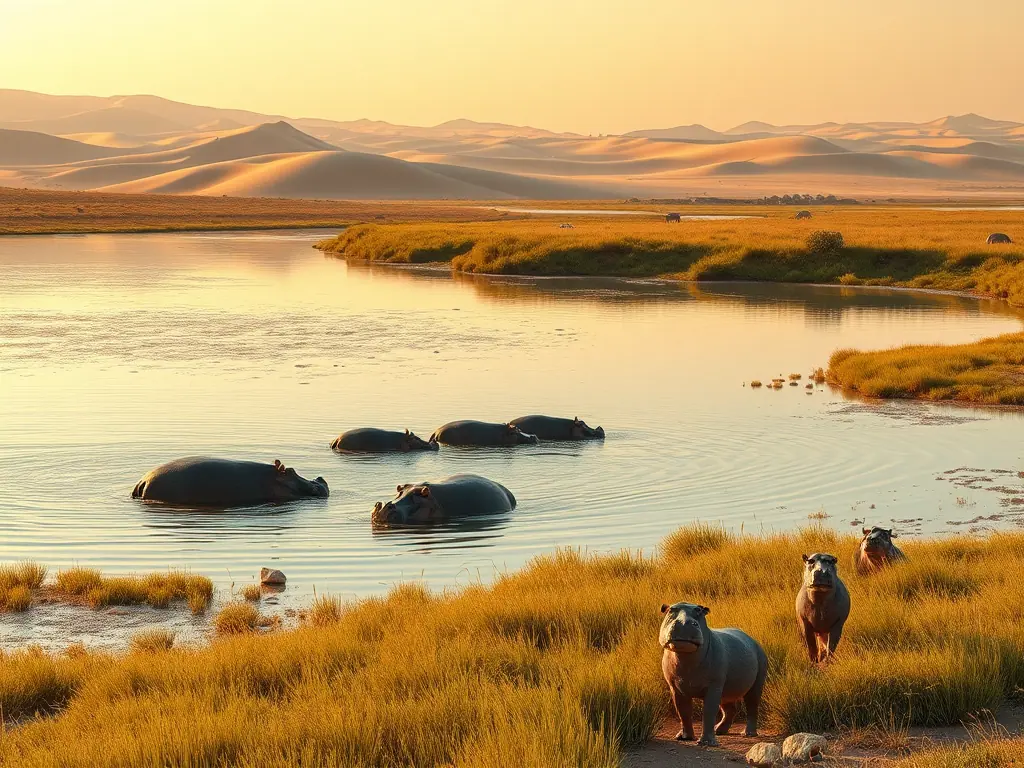
During a warm, wet period known as "Green Arabia", the Mundafan basin held a freshwater lake. It covered about 340 sq km and reached 29m deep, with grass, shrubs and trees around it. Today the area is one of the driest places on Earth.
The scientists have described more than 500 fossil finds of plants and animals at over 130 places. The animals include hippos, extinct long-horned buffalo, camels, Arabian oryx, gazelles and ostriches. The stone tools lie in clusters that match the bone concentrations. The team says this was a place where people hunted and butchered prey.
Some flakes can be fitted back together, which shows the tools were made on the spot. More than 98% of them are flint, shaped with the Levallois technique, in which the core is prepared so that a flake of a set shape can be struck from it. The age of the lake was set with two methods, applied to sand and fossil teeth.
Traces of handles and plant compounds
Several points show impact damage that matches a strike against a large animal. Under a microscope, traces of animal tissue show near the edge, and plant resin and fibres at the base. They show the points were fixed to a wooden handle and were part of a composite weapon. Traces of glue appear on 49% of the points, and residues of various substances on 84% of those studied.
Chemical analysis found biomarkers linked to Acokanthera schimperi, known as the "poison arrow tree", on several points. Its toxins are cardiac glycosides, substances that disrupt the heart. Other potentially poisonous plant compounds were also found. There are also traces of the working of palms, tubers and shrubs, as well as wood and fibres.
Study leader Chris Clarkson of Griffith says "one of the most important discoveries is the evidence that some stone points were used as hafted hunting weapons". Co-leader Frans van Buchem of KAUST describes the shore as a trace of a "radically different Arabia", where fresh water, grassland and trees fed people.
The poison is an inference from chemical traces
The authors have no direct proof that an animal was killed with a poisoned weapon. They cannot say whether the points tipped thrusting spears or thrown darts. It is not known how the poison was made, or whether it worked. Griffith's statement says the traces "raise the possibility" that some weapons carried plant poisons. The team plans more chemical analysis to find out exactly which plants were used.
The stone tools were collected from the surface, not from dated layers. So 125,000 years is the age of the lake, and at most gives an upper limit for the tools. That is how Jeffrey Rose, who was not part of the study, explains it. Some reports on the find speak of 5,511 tools being "excavated", while others say they were collected from the surface.
No human bones have been found. The authors attribute the tools to Homo sapiens because, they say, the species was already out of Africa and living in south-west Asia at the time.
Some reports say the oldest known poison points from southern Africa are about 60,000 years old, so the Arabian ones would be twice as old if the dating holds. The institutions' statements make no such comparison.
The find fits with a 2025 study in Nature that described wet periods in Arabia recurring over the past eight million years. The team believes that in such periods people did not just pass through the region but settled there. The next steps are more fieldwork, including a search for human remains.


Comments (0)
No comments yet.