
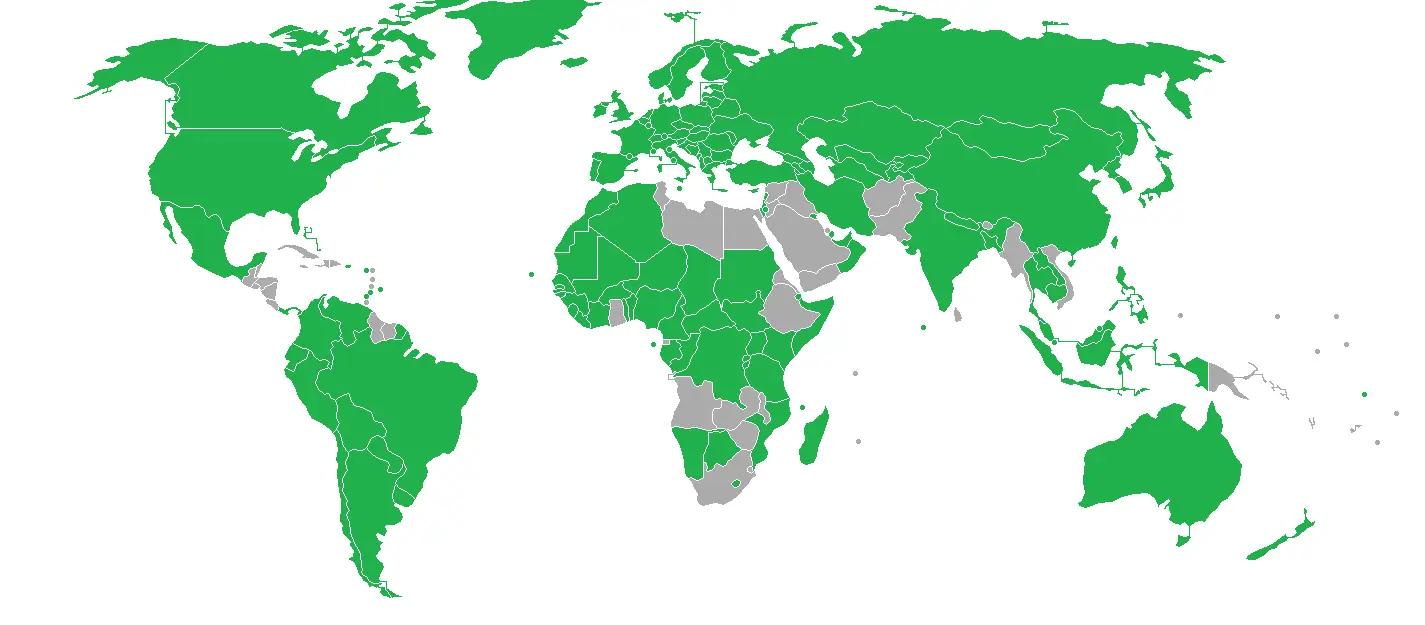
According to the latest Passport Index report, the Bulgarian passport ranks 19th in the global table. With a mobility score of 171 and 86.4% total access, the country is among the top 20 nations in the world, guaranteeing its citizens the opportunity to travel without a traditional visa to a vast majority of international destinations. It is important to note that the reciprocity index is a separate ranking from the mobility index.
An analysis of accessibility indicators reveals the following breakdown:
- 119 destinations are visited completely visa-free;
- 43 destinations apply simplified regimes or issue a visa on arrival;
- 9 destinations require prior electronic authorization;
- 27 destinations remain in the visa-required category (including some with an e-visa option).
Europe stands out with 100.0% access for Bulgarians. Within the region, which covers 44 destinations, the regime is entirely visa-free, with the exceptions being the United Kingdom (electronic authorization for up to 180 days) and Russia (e-visa for up to 30 days). Comparative data places our country 23rd among 47 European nations, 22nd out of 29 in Schengen, 19th among 32 NATO members, 27th out of 159 in the World Trade Organization, and 23rd out of 57 in the OSCE. In the groups of Eurozone countries and parliamentary republics, Bulgaria ranks 16th out of 27 and 11th out of 40, respectively.
A high degree of freedom of movement is recorded in the Americas and Oceania. North America provides 95.7% access, with the United States being the only destination in the region placed in the "visa required" category, while Canada requires electronic authorization for stays of up to 180 days. Mexico, Costa Rica, and El Salvador are among the destinations with visa-free stays of up to 180 days. In South America (91.7%), almost all countries are visa-free, with the exception of Guyana. The Caribbean achieves 93.8% access, with the Dominican Republic noted for an e-ticket and a stay of up to 30 days. In Oceania (92.9%), Australia and Papua New Guinea use eVisitor, New Zealand requires electronic authorization, Nauru remains the only destination requiring a visa, and Fiji and Vanuatu allow visa-free stays of up to 120 days.
The Asian region is characterized by 82.0% access. While the Persian Gulf countries report 100.0% coverage — including visa-free access to the United Arab Emirates and simplified entry with an e-visa for Bahrain, Saudi Arabia, Qatar, Oman, and Kuwait — the Middle East (82.4%) and Central Asia (80.0%) regions show varying levels of restrictions. In Central Asia, countries such as Kazakhstan, Kyrgyzstan, Uzbekistan, and Tajikistan are accessible visa-free for up to 30 days, while Turkmenistan requires a visa. The African continent has 72.2% access. South Africa and Mauritius allow visa-free stays of up to 90 days, Tunisia allows up to 60 days, and Cape Verde is visa-free with an EASE procedure for up to 30 days. The Seychelles, Kenya, and Côte d'Ivoire apply specialized procedures for up to 90 days.
Specific regulations also determine the duration of stay. The longest period is listed for Georgia (360 days), followed by Antigua and Barbuda, Dominica, El Salvador, Mexico, and Canada with up to 180 days. The report also highlights procedures for additional documents — such as tourist cards for Suriname or arrival cards for Malaysia, Singapore, and Thailand.
Regarding visa reciprocity, Bulgaria holds the 92nd position out of 199 countries in the hospitality ranking. Signals of visa reciprocity show systemic asymmetry: while the United States allows entry to Bulgarian citizens under a visa requirement, Bulgaria grants entry to American citizens under simplified regimes. There are also other discrepancies: countries such as Angola, Azerbaijan, China, Turkey, Saudi Arabia, Kenya, and Vietnam require a visa for entry into Bulgaria, while Bulgarian citizens travel to them under facilitated conditions.





Коментари (1)
171? Да видим дали ще стигнем и до 200 скоро 😂