
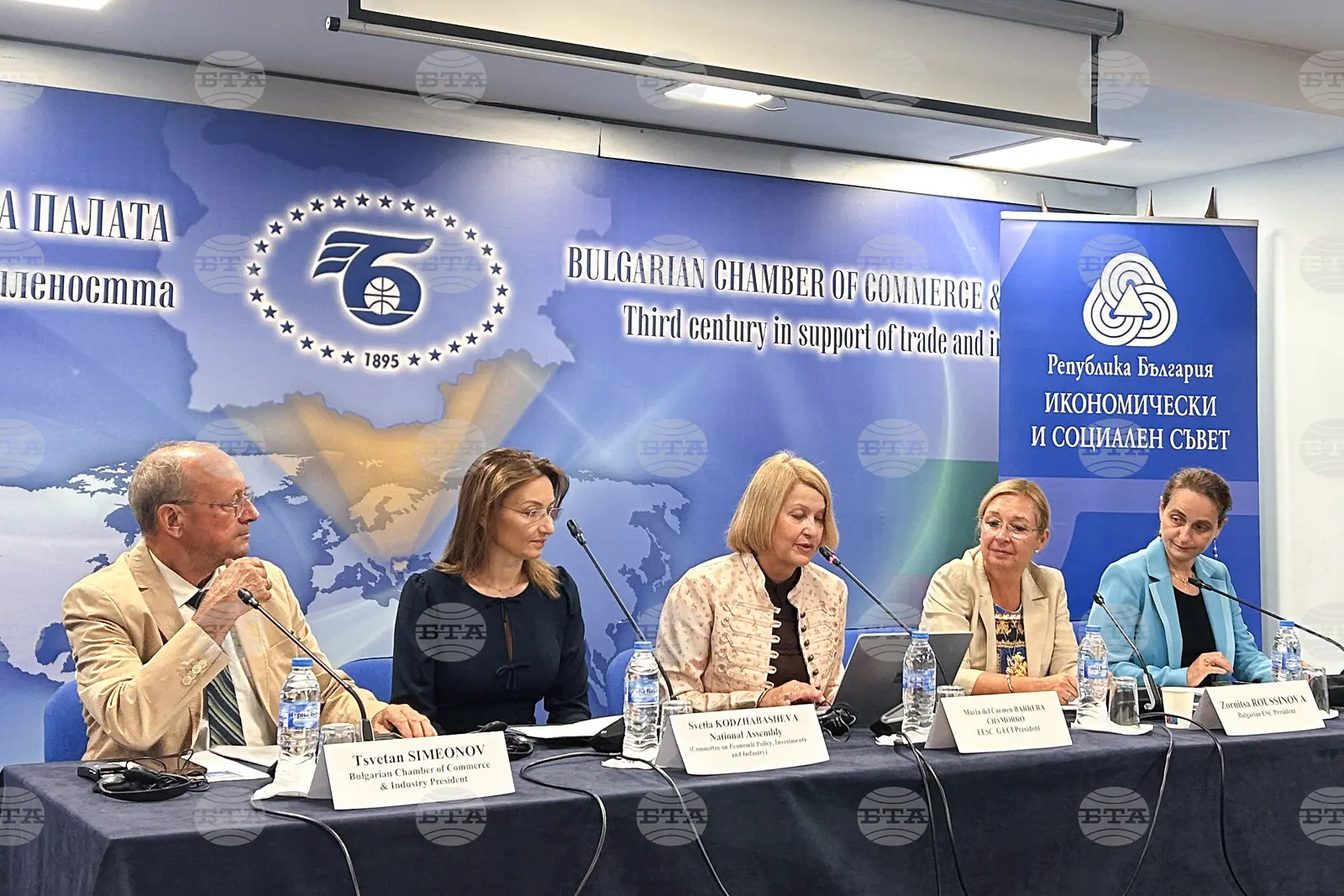
The "European Citizens' Initiative" group within the European Economic and Social Committee (EESC) is organizing a discussion in Sofia regarding the future and current state of the European Citizens' Initiative (ECI) in Bulgaria. The event was supported by the Bulgarian Chamber of Commerce and Industry (BCCI) and the Economic and Social Council of Bulgaria (ESC).
At the opening of the event, ESC Chairperson Zornitsa Rusinova admitted that Bulgaria's performance appears weak according to available data. She noted that only a small number of organizations are familiar with the parameters and procedures for organizing European citizens' initiatives at both national and European levels. According to Rusinova, representatives of institutions, universities, trade unions, employers, and civil society organizations must take an active role in disseminating information and inspiring confidence during campaigns.
To ensure more active public involvement in these processes, more accessible information and practical support are needed to show citizens where to start and how to find like-minded individuals, emphasized Svetla Kodzhabasheva, a Member of Parliament from the "Progressive Bulgaria" parliamentary group. She added that Bulgarian citizens possess the necessary experience and ideas that deserve to be part of collective decision-making. Kodzhabasheva highlighted the role of civil society organizations, universities, social partners, and institutions, as the ECI allows a cause to transcend national borders and reach European institutions through collective effort.
Maria del Carmen Barrera Chamorro, Chair of the EESC "European Citizens' Initiative" group, warned that democracy should not be taken for granted. She explained that in an environment of spreading disinformation and pressure on democratic institutions, citizens are seeking greater influence over the decisions that shape their lives. To maintain a healthy democracy, open dialogue and constant opportunities for participation in public policy are essential, with the ECI serving as the first transnational tool that allows EU citizens to unite and propose changes to the European Commission.
Yordanka Chobanova, Head of the European Commission Representation in Bulgaria, noted that the era of large-scale social consensus, characteristic of the 1990s, has ended both in Bulgaria and the EU. To preserve trust in institutions, direct dialogue is vital, and citizen participation should not be limited solely to the electoral process. Chobanova emphasized that although the ECI is an existing legal tool, it is not automatically effective if people are unfamiliar with it or perceive it as nothing more than a mechanism from Brussels. She raised the issue of increasing the visibility of the ECI in the country and including young people in the political agenda, reminding the audience that Bulgaria's contribution to successful signature collections is significant and comparable to that of Sweden and Austria.
According to BCCI President Tsvetan Simeonov, the event serves as a reason for civil society to engage more actively with events in the European Union. He noted that civil society is often patient with administrative actions and the introduction of new regulations, as it must comply with them. Simeonov pointed out that key tasks ahead of them include the development of civil society, achieving sustainability in society and the economy, and reducing corruption. He added that through the Association of European Chambers of Commerce and Industry, there has been a significant increase in activity and response to initiatives affecting the economy.
/TT/



Коментари (0)
Все още няма коментари.