

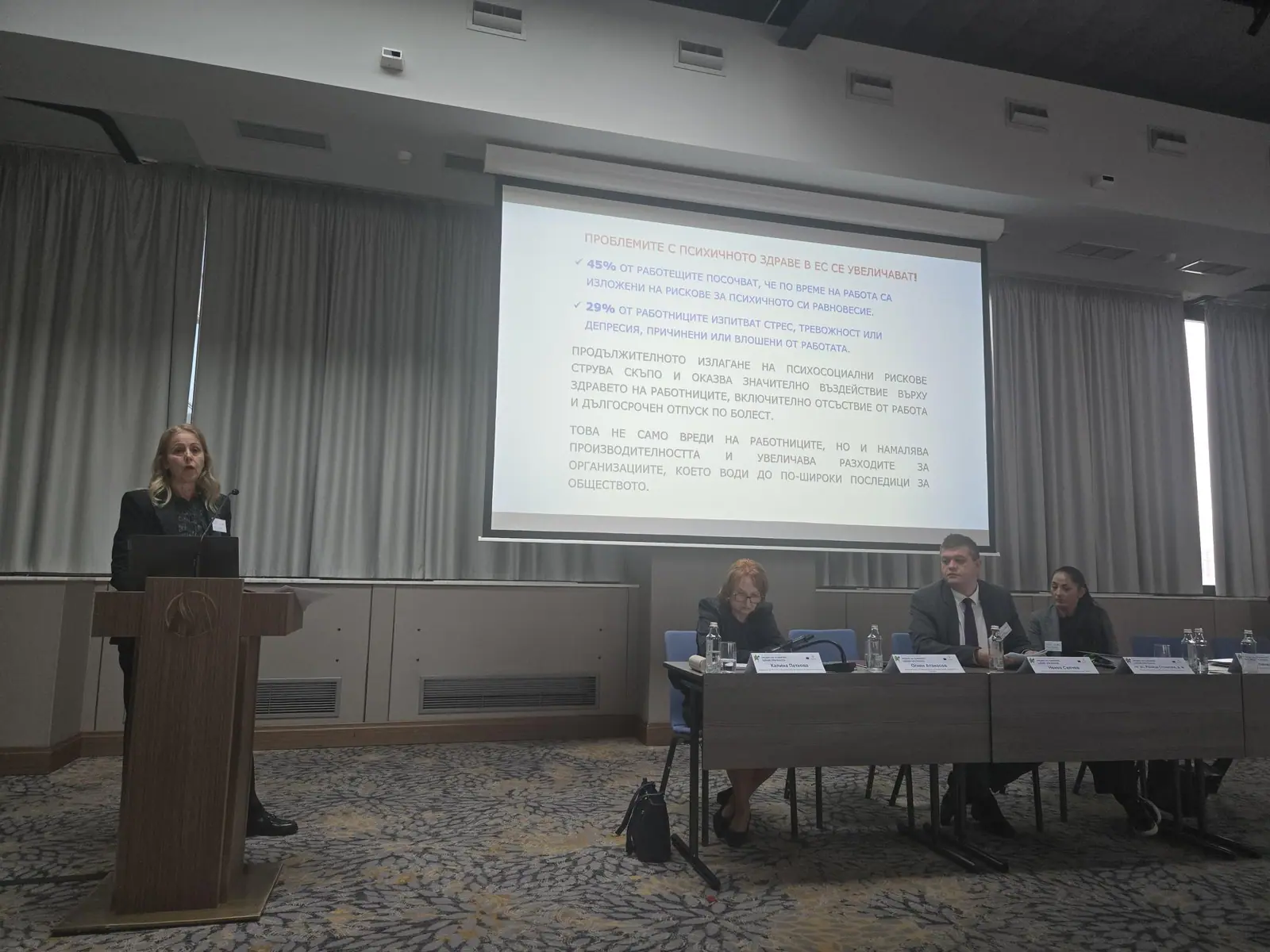
The state, employers and trade unions must actively defend workers' rights while the economy changes its model, according to the shared position of participants at an international conference in Sofia. The conference on social dialogue and collective bargaining was organised by the Podkrepa Confederation of Labour.
Representatives of the state and business attended, along with union officials from other countries. They spoke about fair pay, inequality and how new technology is changing work. They also discussed the experience of Bulgaria's neighbours.
Podkrepa president Dimitar Manolov said social dialogue is a tool that works. He said it first peaked after the First World War, when the International Labour Organization was set up so that conflicts would be settled by talks, not war. The second peak came after the Second World War.
"It worries me that we are again in a tense political situation in the EU," Manolov said. He warned that this could lead to serious social breakdowns.
Veselin Mitov, the union's vice-president and international secretary, said social inequality is growing at a dangerous rate and there are now more poor people in the world.
Andrey Kovatchev, an MEP from the European People's Party (GERB-SDS), said welfare systems are now being reviewed. He pointed to Germany, where the German employment agency reports 1 million vacancies, yet the welfare system does not encourage people to look for work. Kovatchev said the system must be fair and deliver results, and the EU must become more competitive.
Deputy labour and social policy minister Danail Rusev said Bulgaria has traditions of social dialogue. He named the National Council for Tripartite Cooperation as an example.
Smilev Valov, executive director of the Employment Agency, said collective bargaining sets the exact terms of work, pay and safety at the workplace. It also lets people take training and retrain. Valov added that there are projects to raise skills that aim to protect jobs.
Silvia Todorova of the Bulgarian Industrial Association said both employers and unions gain from social dialogue. She listed four main benefits for business: predictability, fair competition, human capital and better rules.
Zornitsa Rusinova, chair of the Economic and Social Council, called the debate on the next budget important. She said Bulgaria must make recommendations on how to keep the principle of economic cohesion.
The council is preparing an analysis of problems in the labour market. Rusinova said it will give Bulgaria a basis to review its long-term strategy on employment.




Comments (0)
No comments yet.