
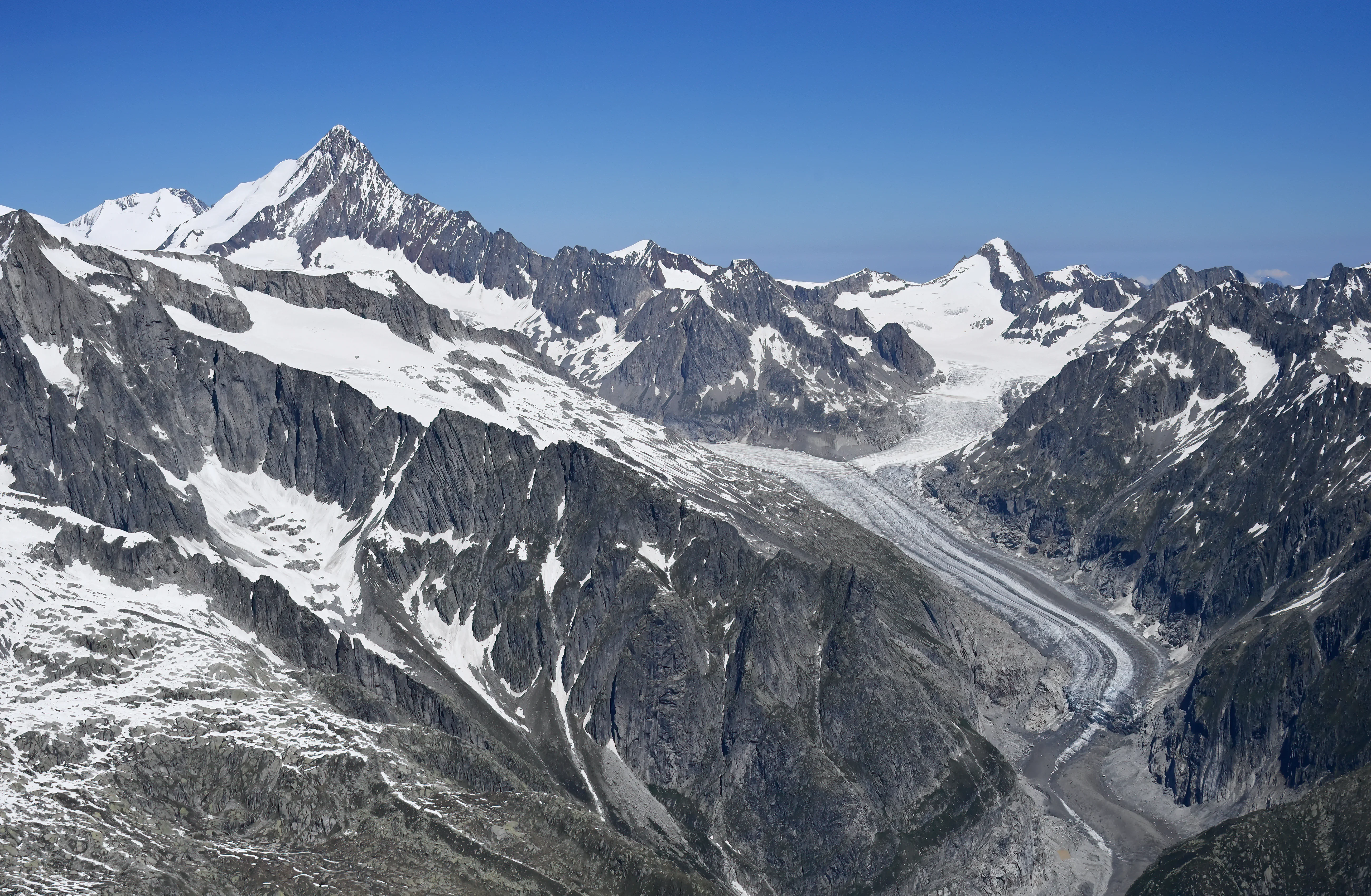
Swiss glaciers are approaching another alarming milestone in recorded history. It is expected that on Monday, June 29, they will have completely exhausted the snow reserves accumulated during the winter, reaching the so-called "glacier loss day" – the moment from which every drop of melting water directly reduces the glacial mass. This is the second-earliest occurrence ever recorded and signals highly accelerated ice melting in the Swiss Alps.
A year reminiscent of 2022
According to data from "ETH Zurich" and the Swiss Glacier Monitoring Network "GLAMOS", the date of June 29 marks the moment when the snow accumulated during the winter is completely offset by melting in the lower parts of the glaciers. The only instance when this critical point occurred earlier was in 2022, when the "glacier loss day" was recorded on June 26 – a year that the head of the GLAMOS network, "Matthias Huss", describes as "unquestionably the most extreme ever recorded in the Alps".
Huss points out that 2026 is "strikingly similar" to the record-breaking year of 2022. This winter, approximately 25% less fresh snow fell on the glaciers compared to the 2010–2020 average, and an unusually warm May accelerated the melting of the snow cover. A further complicating factor is the "Sahara dust" deposited on the glaciers in March, which darkened their surface and reduced their ability to reflect sunlight.
When the white snow disappears and the grey ice is exposed, it absorbs solar radiation much faster. This triggers a feedback loop: the darker surface absorbs more heat, accelerating melting, which leads to even faster exposure of glacial fields.
Europe in the grip of extreme heat
The early "glacier loss day" occurs in parallel with a deadly heatwave covering large parts of Europe. The "World Health Organization" reports over 1,300 excess deaths on the continent since June 21 linked to the heat. In "Germany", the absolute temperature record was broken with 41.3°C, and new records were also reported in "Belgium" and "the Netherlands".
Researchers from the "World Weather Attribution" initiative emphasize that such temperature extremes would have been "virtually impossible" without climate change caused by human activity. In other words, current conditions are not random anomalies, but part of a wider warming pattern that directly accelerates glacier melting.
Three months ahead of schedule
Matthias Huss, who recently visited the "Rhone" glacier, describes the situation as dramatic. He recounts having observed a loss of approximately one meter of ice vertically in just ten days. "We are three months ahead of the normal state," says Huss. According to him, on average for the current century, the "glacier loss day" usually occurs no earlier than mid-August.
This means that the season in which glaciers no longer have protective snow cover and begin to lose mass directly has shifted drastically forward in time. The earlier this moment occurs, the longer the period of intense melting becomes until the autumn.
Shrinking glaciers: numbers and trends
The volume of Swiss glaciers has decreased by about 38% between 2000 and 2024. Over the last 50 years, the country has lost approximately 1,200 glaciers – from about 2,500 to today's approximately 1,300. This dramatic change is visible not only in scientific data but also in the landscape: glacier tongues are retreating, new lakes are appearing, and entire ice masses are disappearing.
With the retreat of the glaciers, their role as reservoirs feeding major rivers like the "Rhine" and "Rhone" also diminishes. The water regime is becoming more seasonal and unstable, and researchers warn that with continued melting, this will have increasingly serious consequences – from irrigation and water supply to hydropower and ecosystems downstream.
The shrinking window of opportunity
The outlook outlined by experts is alarming. "If warming continues at the same pace as in recent decades, by 2100 only pitiful fragments of ice will remain of the glaciers," warns Matthias Huss. This means that the current generation is living in a period when the fate of Alpine glaciers is being decided in real-time.
The early arrival of "glacier loss day" in 2026 – the second earliest in history – is another signal that the window for effective climate action is narrowing rapidly. Every summer that begins with the premature exhaustion of snow reserves leaves the glaciers unprotected for longer, accelerating irreversible changes in the Alpine environment.
For scientists, this is further proof that the climate crisis is not an abstract concept, but a process that is literally visible in centimeters and meters of disappearing ice. And for society, it is a warning that decisions to reduce emissions and adapt to new conditions cannot be postponed without consequences.

Comments (6)
ебаси... сериозно ли юни? 🤦♂️ аз си мислех, че ще имаме време да се опомним малко. тоя климатичен апокалипсис идва все по-бързо! швейцария е супер държава, винаги съм харесвал швейцарците и как пазят природата си, ама това вече е яко... дано вземат мерки, да не се стопят изобщо ледниците. и ние тука трябва да се стегнем
ааа, ясно. юни... значи вече можем да почнем да търсим алпийски плаж
сериозно ли юни? 🤦♀️ то тая глобална промяна на климата наистина ли вече е тук?! кво ще стане с туризма там, а и с целия свят изобщо? трябва
абе, хора, вие го гледате ли тоя "ден на загубата" все по-рано? юни?! сериозно ли?! 🤯 аз си мислех, че ще имаме време да се замислим малко... все едно някой ни хвърля лед в лицето и казва: "ей, събудете се!".
Ей, хора! Видях новината за швейцарските ледници... наистина е тревожно. Юни за "ден на загубата" е много рано, както казват и другите. Това показва колко бързо се променя климатът и не можем да си позволяваме да го пренебрегваме.