
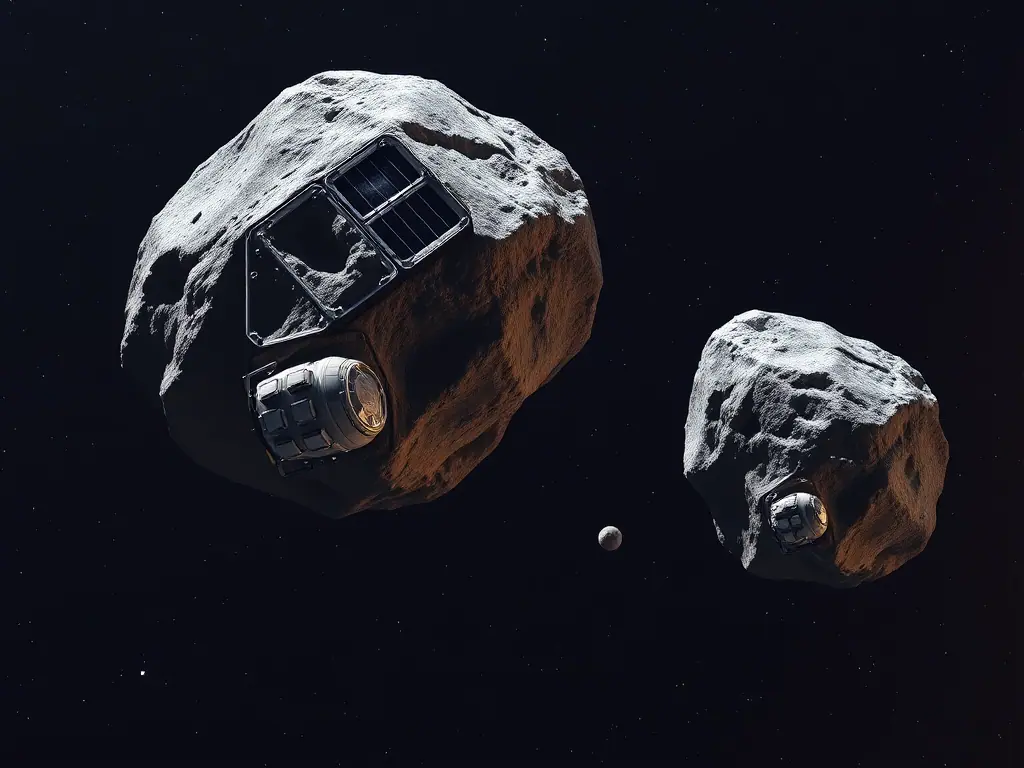
Europe's Hera probe has sent back its first close-up of the asteroid Didymos. It shows the side that NASA's camera failed to photograph before the 2022 impact. The photo was taken from about 60 km away. No one yet knows how much the smaller moon, Dimorphos, weighs or what is inside it.
Hera is a probe of the European Space Agency (ESA). It launched on 7 October 2024 from Cape Canaveral on a Falcon 9 rocket. It is to take a close look at the spot where the US spacecraft DART hit Dimorphos at about 6.6 km/s on 26 September 2022.
What the first image from 60 km shows
On 18 October 2026, the probe's camera saw the two asteroids as separate bodies for the first time, from about 1,280 km. Dimorphos was a single pixel. The close-up was taken on 5 November and shows Didymos, which is about 780 metres wide. Dimorphos, about 151 metres across, is in the lower left corner, almost fully in shadow.
Didymos is covered in boulders and craters, and may also have grooves or ridges. The ridge around its equator, which also showed up in DART's images, is visible here too. Science team leader Patrick Michel described the team's first reaction: "The first thing we said was: Wow!"
Mission scientist Michael Kueppers says some of the boulders may be debris from Dimorphos. In his view, the impact could have sent it about a kilometre across the gap between the two asteroids, and it landed on Didymos. This is a guess, not a confirmed fact. In this image, the impact site on Dimorphos is in shadow.
ESA plans to release detailed images of both bodies on 25 November 2026. They may also show the crater left by DART. According to one overview, the date is only a plan and could slip if any step of the approach has to be repeated.
What no one has measured yet
The planetary defence test is a simple experiment. NASA crashed a spacecraft into a small asteroid to see whether that could change its path. But the impact is only half the experiment. To know exactly how well it worked, scientists need to know how much the struck asteroid weighs.
The time Dimorphos takes to orbit Didymos got shorter by about 33 minutes. The minimum for success was 73 seconds, so the result was about 26 times larger. Part of the push came from debris thrown out by the impact, which seemed to shove the asteroid further. The factor showing how many times the debris boosted the impact is 3.61, but it ranges from 2.2 to 4.9, because the mass of Dimorphos has not been measured. Hera is to find it directly, using its radio link with Earth and the gravity of the two asteroids.
The probe's laser altimeter will measure the depth of the crater. Two small satellites, Milani and Juventas, will show what is inside. Juventas carries a radar that will look about 100 metres below the surface. Milani will use an optical instrument to study the makeup of the surface and the dust. According to Wikipedia, the radar is the first instrument to probe the inner layers of an asteroid.
The satellites are about the size of a suitcase, and each weighs about 12 kg. Milani comes from Italy's Tyvak, and Juventas from Luxembourg's GomSpace. For now they remain on board.
Sources differ on exactly when Hera arrived
One overview says Hera reached the system on 5 November 2026. Another source gives no exact day for the arrival. The only specific date it gives is 4 November, for the first manoeuvre of the approach, which was planned but not confirmed as carried out. And 5 November is the day ESA released the image. Back in 2025, ESA said only that the probe would arrive in November 2026, a month earlier than first planned.
The work at the asteroids is spread over about six months. The first six weeks are for an initial study of shape, mass and gravity. Then come two weeks to release the satellites, four for a more detailed study, six for close observation of the crater and six more for tests in which the satellites will try to land on Dimorphos. The sources do not say exactly when Milani and Juventas will be released. The main mission runs until at least June 2027, and could be extended.
The next step with a clear date is 25 November 2026, when ESA plans to show the detailed images of the two asteroids.

Comments (0)
No comments yet.