
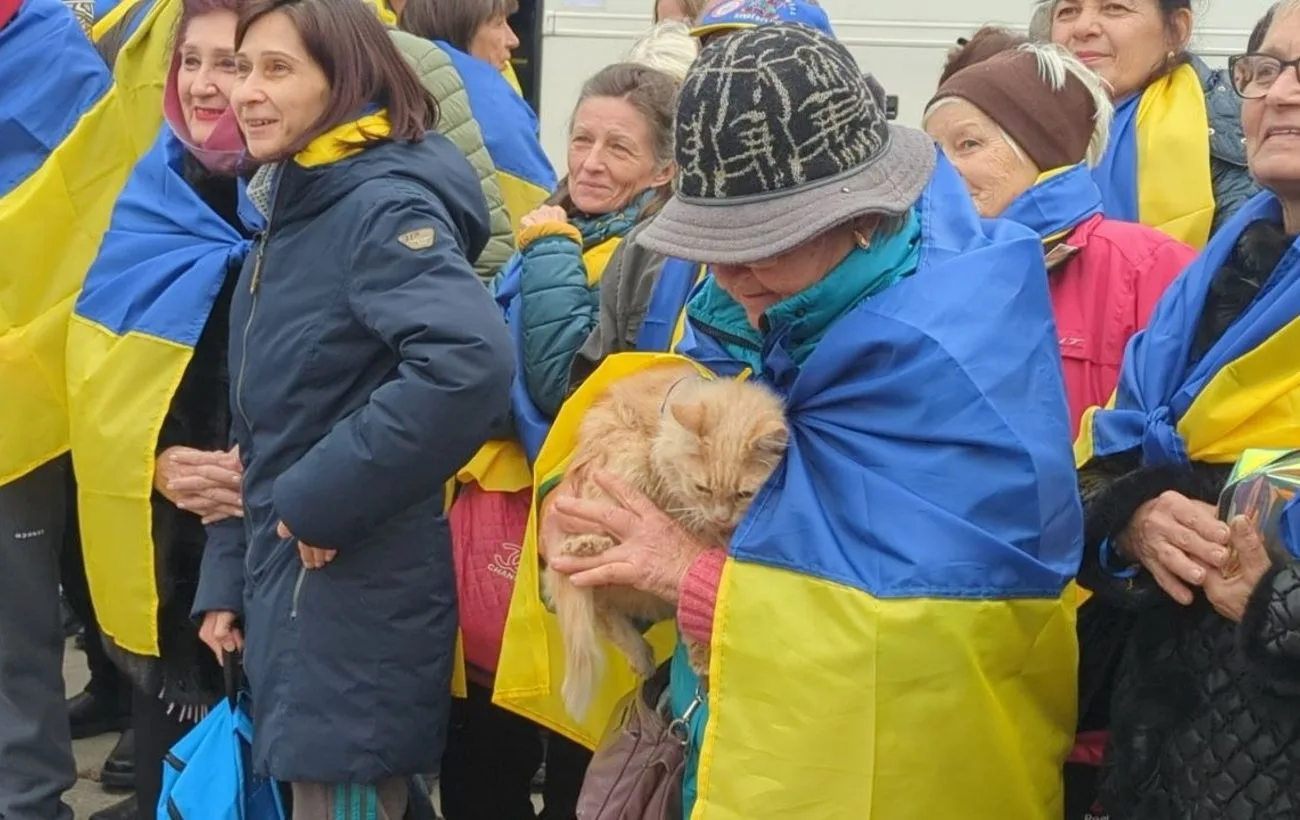
People from occupied Oleshky reached Chernihiv region after two days on the road. It is still not officially clear how many chose Ukraine and how many chose Russia.
Buses carrying residents of occupied Oleshky crossed the Nova Huta checkpoint into Chernihiv region on Saturday, 31 October. Relatives, Red Cross volunteers, Médecins Sans Frontières and World Central Kitchen were waiting at the border. "Ukrainian citizens from Oleshky have crossed the Ukrainian border in Chernihiv region," President Volodymyr Zelensky said, as quoted by Al Jazeera, citing AP. He promised that all of them would get the help they need.
The way home ran through occupied Crimea, the Russian city of Anapa and Gomel in Belarus. The youngest evacuee is just over a year old and the oldest is 94, ombudsman Dmytro Lubinets said. Pets went by truck from Belarus to the border, where they were moved to other transport.
Russia has been fighting a full-scale war against Ukraine since February 2022. Ukraine retook Kherson on 11 November 2022, but Oleshky stayed under occupation. It lies less than 10km from the opposite bank of the Dnipro and became a frontline town. In June 2023, the blast at the Kakhovka hydroelectric plant flooded about 90% of it. About 24,000 people lived there before the war. This autumn, between 1,700 and 2,000 remain, about 50 of them children. Ukrainian figures say about 6,000 more people live in the wider Oleshky community, 180 of them children.
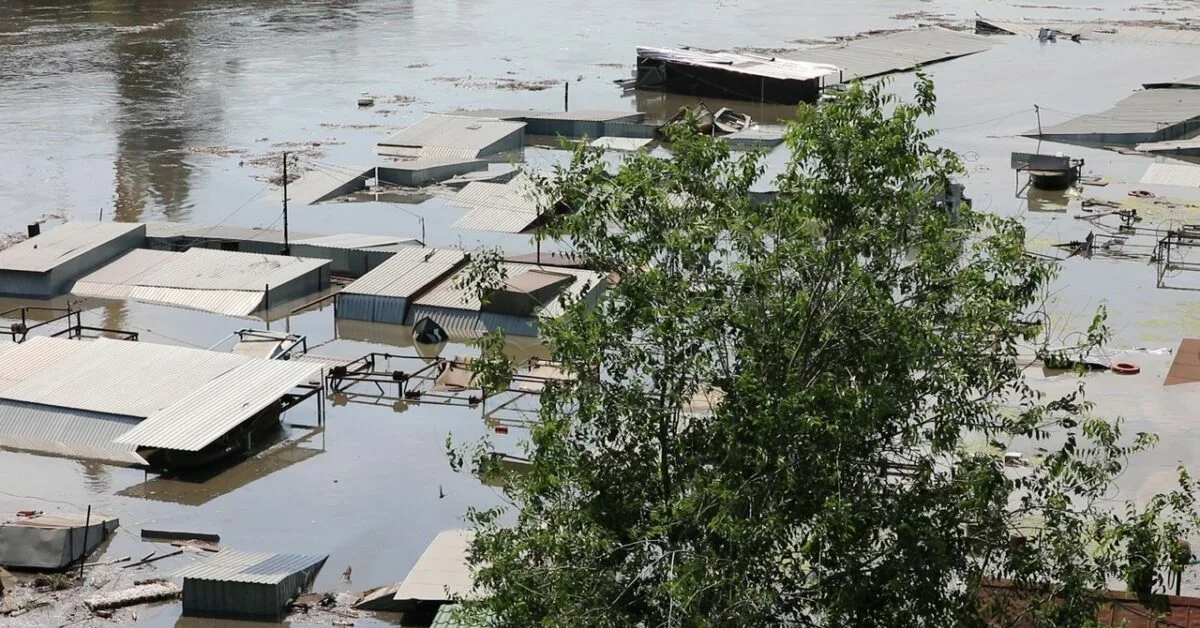
In March 2026, Lubinets asked for a humanitarian corridor for civilians. The town is not living, only surviving, Ukrinform wrote at the time. Lubinets called the blockade "deliberate terror by the Russian Federation against the civilian population". Kyiv holds Russia responsible for the blockade of the town, which Russian forces occupied in 2022.
The route: Oleshky, Armyansk, Anapa, Gomel, Nova Huta
On 23 October, the White House said Melania Trump had helped broker a local ceasefire. It called Oleshky a "frontline military town on the edge of disaster". Washington said the truce would let the roughly 2,000 remaining residents go wherever they want, to Russia or Ukraine. The White House promised that an "impartial American media organisation" would document everything, but did not say which one.
The truce began at 03:00 Kyiv time on 27 October and is due to last until 22:59 on 1 November. On 29 October, officials said the routes had been cleared of mines. The same day, one person was wounded by a mine.
The Ukrainian delegation arrived in Oleshky at about 11:30 on 30 October. The mission papers come in two language versions. Lubinets signed the Ukrainian one and Russian ombudsman Yana Lantratova signed the Russian one, LIGA.net reports.
The two ombudsmen say 25 buses with 750 seats in all were prepared. Nine ambulances and 50 medics travelled with the convoy. The people heading for Ukraine were not screened, Lubinets said. "There was no screening at all," he said. LIGA.net reports that nobody checked their phones or documents, and people who had lost their documents also set off.
Along the way, the buses stopped and picked up residents who were not on the original lists. They were waiting by the road with signs saying they wanted to be evacuated. Lubinets spoke with Lantratova and they were allowed to go. "We did not talk for long and we took everyone," he said.
The route looked like this:
- Oleshky, 30 October: people board the buses and the convoy sets off for Armyansk in Crimea.
- Armyansk: the convoy splits in two. One part goes on to Russia, the other to Ukraine. Those who chose Russia are housed in a temporary centre in Simferopol, Lantratova said.
- Anapa: the convoy bound for Ukraine reaches this point by bus, about 400km in a straight line from Oleshky.
- Anapa to Gomel, 30–31 October: four Russian defence ministry military transport planes fly the people to Belarus. In Gomel, Belarusian rescuers, medics and Red Cross volunteers meet them.
- Nova Huta, 31 October: the buses enter Chernihiv region.
"We are completing our humanitarian mission in Oleshky," Lantratova said. She said everything went without incident. Zelensky thanked the US, Melania Trump and Lubinets. Lubinets proposed making such missions regular.
There is another account. Volunteer Ksenia Arkhipova says Russia broke the agreement and began the evacuation earlier than agreed. An anonymous source told the Kyiv Independent that patients in the hospital were registered and warned that leaving meant "filtration". People who cannot move were not told at all, and residents of nearby villages received threats. So far there is no independent confirmation of this.
Media report that people feared forced checks and interrogations, and some feared "concentration camps", which Ukrainians usually pass through to enter or leave occupied areas via Russian territory. So far there are no reports of such cases during the current evacuation.
By preliminary unofficial estimates, more than 500 people have set off for Ukraine and about 100 for Russia. Older people find it hard to leave their homes. One evacuee, a 71-year-old woman, spoke through tears about Ukrainian soldiers: "We love them, we love them". A 48-year-old man said that "many people stayed and did not want to leave".
17 buses against 4
The figure most talked about comes from Russian military blogger Vladimir Romanov.
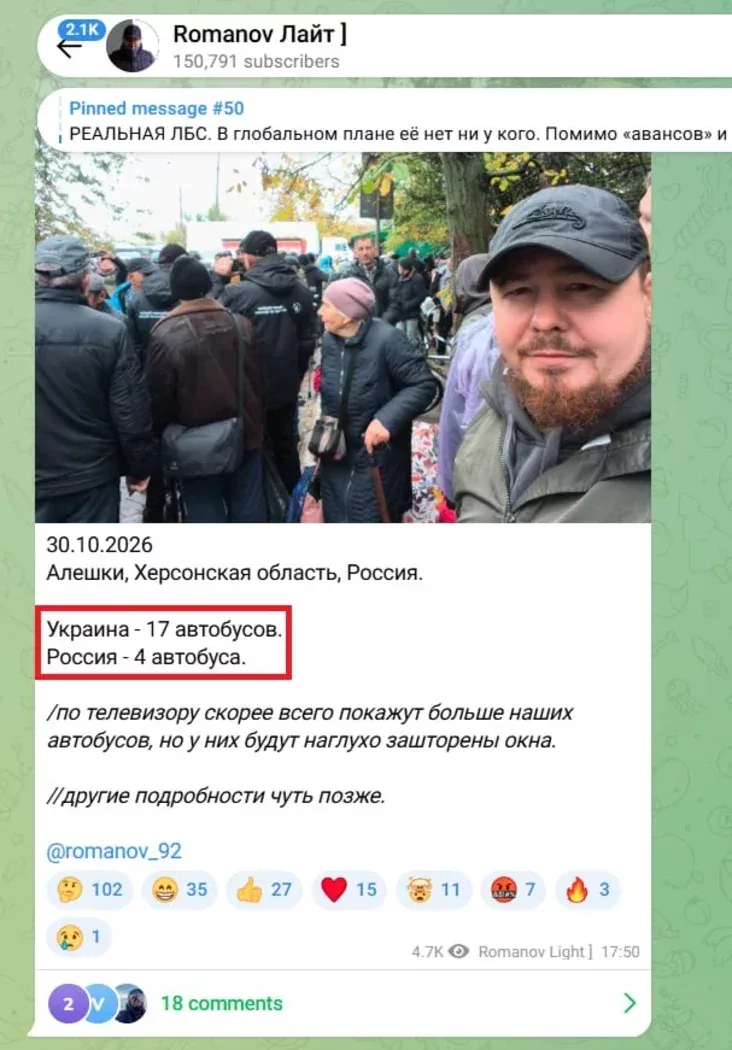
We cannot confirm the 17-to-4 split. Neither Kyiv nor Moscow has said how many buses went in which direction. The numbers now differ. Officially, about 25 buses were prepared. Romanov, writing from the scene, reports 21 buses in all. One Ukrainian outlet reports 11 buses to Ukraine and 4 to Russia, or 15 in all.
The truce around Oleshky ends at 22:59 on 1 November. On 2 November, the Ukrainian negotiating team will hold a press conference. The exact number of evacuees has not yet been announced.
Comments (1)
Седемнадесет автобуса... доста са! Чудя се какви хора са били в тях.