
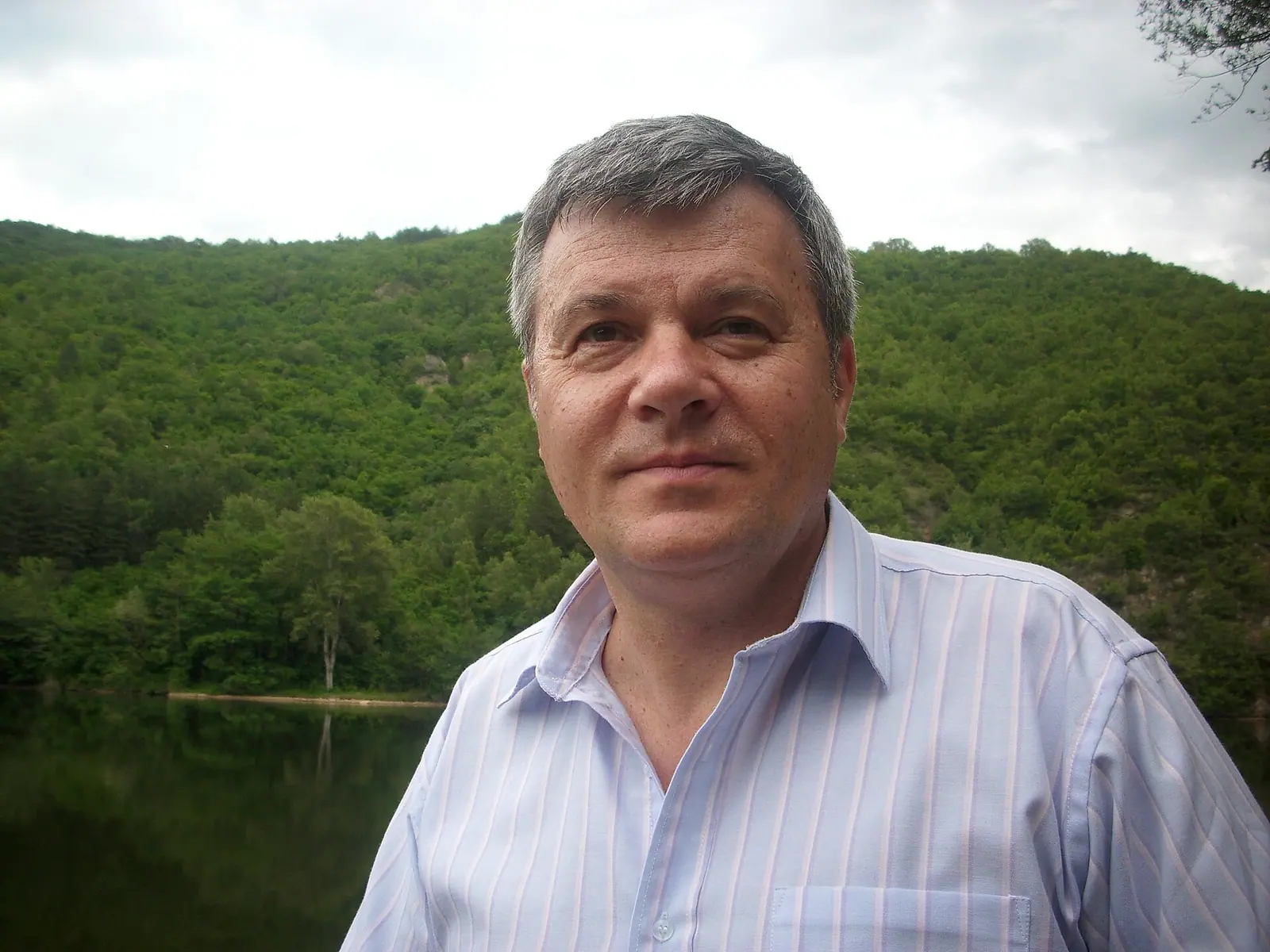
Assoc. Prof. Dimitar Hristov presented his monograph "Metropolitan Simeon and the Bulgarian Revival" at the Regional History Museum in Burgas. The book is about Simeon of Varna and Preslav, a metropolitan born in Burgas. The author says Simeon often stood by his principles, even against people he was on good terms with.
The museum and the Bulgarian Academy of Sciences announced the event on Wednesday, 28 October. It took place on Thursday, 5 November, at 5:30pm. The Academy's Institute for Historical Studies published the book. Dr Ivanka Deleva, deputy director of the Burgas museum, also took part in the presentation.
Background: Book about Metropolitan Simeon of Varna and Preslav to be presented in Burgas
The monograph follows the life and public work of Simeon, who witnessed and took part in major moments of the Revival and of the building of the Bulgarian state. Hristov said he came across the subject while studying prominent figures in the history of the Bulgarian Orthodox Church. Simeon's name kept turning up in documents and accounts of important events, and the author decided to look at him in more detail.
"History is made by people," Hristov said. He said that to understand a historical figure, public positions and actions are not enough. You also need the motives, personal relations and choices behind them.
Little is known about Simeon's work, partly because the metropolitan did not seek fame for his good deeds. The author therefore rebuilt his life by comparing accounts and documents, including those from people close to him.
Hristov began by looking for information about the metropolitan's family. He thanked the museum, the State Archive and the library in Burgas for their help, including with documents and photos. With their help, details came to light about Simeon's family background and early years.
Simeon was born in Burgas in February 1840 as Odysseus Nikolov Popov. He was one of seven children of Nikola and Elena, whose family came from the village of Fakiya. His brother Niko Popov is known as the first mayor of Burgas after the Liberation. Another brother, Nayden, spent much of his life in Bucharest, where he worked with Evlogi and Hristo Georgiev.
While working as a teacher in Burgas, Simeon taught his nephew Nikola Aleksandrov to read and write. Another nephew, the historian Petar Nikov, received his letters and inherited his personal papers.
Hristov said the family story shows Burgas as a birthplace, but also as a place where personal ties, public interests and a sense of national identity met. The book also looks at how the town grew in the 19th century, with new schools and chitalishte community centres, wider trade links and hopes for a transport link to the interior.
At the Theological School on the island of Halki, Simeon was a very good student but did not get a diploma. To get it, he would have had to take holy orders in the Patriarchate of Constantinople. He was a Bulgarian who disagreed with its principles, and he refused. He remained a well-trained theologian and an excellent Greek scholar, and later helped translate the Scriptures into modern Bulgarian.
He was a close aide of Metropolitan Anthim and took part in the events around the creation of the Bulgarian Exarchate. He was chosen as metropolitan of Shumen, and then of Sliven, but turned down the Sliven diocese, which included Burgas. Hristov called the refusal an interesting moment. He suggested that Simeon wanted to serve where his personal and family ties to Burgas would not sway his decisions.
At the Constituent Assembly in Veliko Tarnovo, which drew up the Tarnovo Constitution, the metropolitan took an active part in the talks. He criticised the way some of the debates were run. He and 12 other deputies did not sign the final text.
Simeon repeatedly clashed with Prince Ferdinand over the ruler's policies and actions, but their bond lasted even after Ferdinand abdicated. Their last letter dates from 1937, when Ferdinand's grandson, the future Tsar Simeon II, was born. The metropolitan sent his congratulations and, at the christening, gave the child a gold cross.
"In many cases, as a statesman, Metropolitan Simeon chose to be right," Hristov said. He said Simeon's principles sometimes set him against friends, but he could separate a dispute over principle or a political decision from his personal feelings toward his opponent.
Hristov said that with age the metropolitan grew more critical of idealised views of the Revival and of the heroic story that pushes aside the complexity of real events. In a letter to Petar Nikov, he saw part of the cause of the national disasters in Bulgaria's unrealistic view of its own strength and in its underestimating of neighbouring peoples.
The author thinks this view still matters today, because society keeps swinging between very negative and overly glorifying views of the past. History, he says, should be told through real people, with their choices, contradictions and relationships, not as a series of mythologised images. That gives a fuller picture of both the person and the era.
The monograph has an introduction reviewing sources and literature, eight chapters, a conclusion, a summary in English, four appendices, a bibliography and indexes. The first seven chapters follow Simeon's life in order, from his family roots to the Liberation. The last is about his attitude to the Revival. The author used a wide range of archive and published sources.
The metropolitan's personal papers were left to Petar Nikov. After Nikov died, his wife kept them. They later passed to the Academy's Scientific Archive, where they were sorted into collections. Part of the archive is in Varna.
Hristov said the documents on the metropolitan and his family give a base for new research. The life of his brother Nayden is still to be studied.

Comments (0)
No comments yet.