
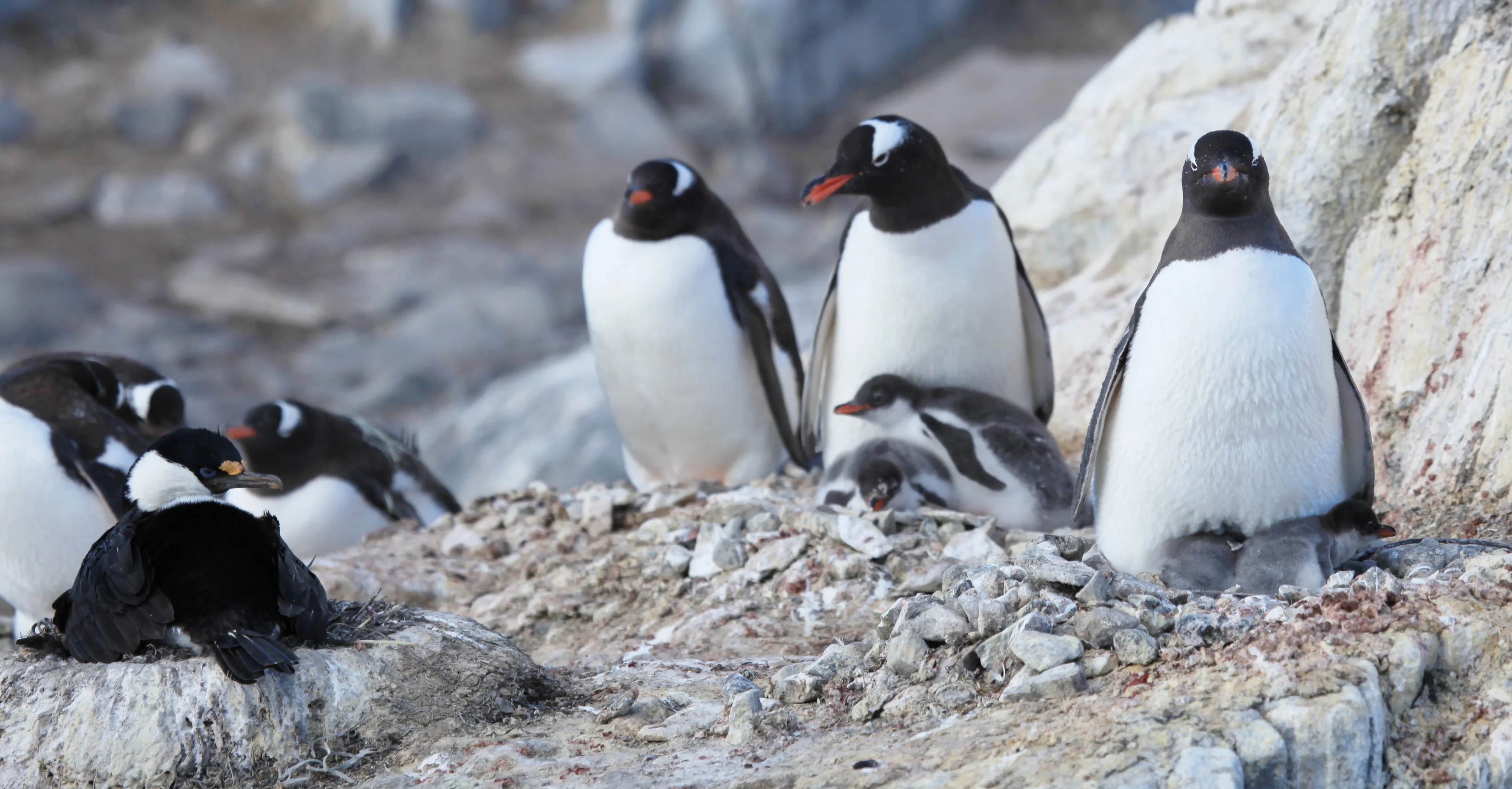
Antarctic penguins are already starting their breeding season several weeks earlier than they did a decade ago - and this is happening at a pace that scientists define as the fastest such shift ever recorded in birds and probably in any vertebrate species. The occasion for the new study is the marking of World Penguin Awareness Day, but its findings are anything but celebratory: the zone these colonies inhabit is warming about four times faster than the continental average.
The ten-year study, published Tuesday in the "Journal of Animal Ecology", shows that three species of penguins on the Antarctic Peninsula are starting their reproductive cycle an average of about two weeks earlier than a decade ago, with some colonies shifting by almost a whole month. This means earlier arrival in nesting areas, earlier laying and hatching - a whole chain of changes that are directly linked to the climate.
The study was conducted by the "Penguin Watch" team at the University of Oxford and Oxford Brookes University. Scientists monitor breeding behavior in 37 colonies, using 77 stationary cameras that capture footage at set intervals between 2012 and 2022. This builds a detailed "chronology" of arrival, courtship, laying, brooding and rearing of chicks in different species and in different places.
The greatest shift is shown by subantarctic penguins (gentoo). For them, the beginning of the breeding season shifts on average by 13 days forward over a decade, and in individual colonies scientists report up to 24 days difference. For Adélie and chinstrap penguins, the average shift is about 10 days. At first glance, this is "only" a few days, but in a harsh environment like this one, every week can decide whether food will be enough and whether the chicks will survive.
"Our results show that among these penguin species there will likely be "winners and losers due to climate change"," says lead author of the study Dr. Ignacio Juarez Martinez of the University of Oxford and Oxford Brookes University. According to him, the intensifying subpolar conditions of the Antarctic Peninsula favor "universalists" such as subantarctic penguins, at the expense of "polar specialists" - Antarctic penguins, which rely heavily on krill, and Adélie penguins, which have evolved to live in icy conditions.
Accelerated warming is not just an inconvenience, but a direct threat to two of the three tracked groups. According to Martinez, Antarctic penguins are already "experiencing a global decline in numbers" and "could completely disappear by the end of the century at current rates." Adélie penguins "are having serious difficulties on the Antarctic Peninsula" and are most likely to disappear from this area by 2100, although they will survive in other parts of the continent.
Until recently, the three species coexisted, minimizing competition among themselves - they bred at different times and searched for food in different patterns. Thus, the pressure for the same resources was lower. Now, however, the seasons are increasingly overlapping. Subantarctic penguins migrate shorter distances, feed on a more diverse range of organisms, and are often more aggressive in the fight for nesting sites and food.
This puts Adélie penguins and Antarctic penguins at a disadvantage. They are highly specialized - for example, they rely mainly on krill and specific ice conditions. When the ice melts earlier, and the temperature of the water and air rises, their entire "schedule" clashes with the availability of food. At the same time, the more flexible subantarctic penguins manage to adapt faster and "grab" a larger share of the resources.
Scientists emphasize that the observed shift in the start of the breeding season is the fastest ever recorded in birds, and probably in all vertebrates. It is a direct signal of how quickly the climate is changing ecosystems, even in places that seem distant and "stable" like Antarctica. For penguins, this change is no longer an abstract topic, but a matter of survival.
According to the authors of the study, the fate of these colonies will depend not only on local adaptations, but also on global action to limit climate change. The changed seasons, the shifting of food chains, and the competition between species show that the climate does not change nature "equally" - it creates new "winners" and many potential losers.


Comments (12)
Ех... Сериозно ли? Пингвини си сменят календара, а ние още се бъбрим кой на кого бил прав. Малко страшно е, да ти кажа честно. Надявам се да няма беля. И
Брух, яко е, ама малко притеснително... Сега и пингвините почват да си местят сезона? 😬 Дано се оправиха някак, че
Абе, пич, яко е... ама малко плашещо. Дано успеят да се
Абе, хора, вие си го представяте ли?! Пингвини! Антарктида! Гнезда по-рано! 🤯 Това вече е яко откачено, наистина. Честно казано, малко ме настръхнаха косите като прочетох за риска от изчезване... все пак говорим за пингвини, не са някакви вредни насекоми!
ебати! пингвини ли ще се оправят от глобалното затопляне?! сериозно, какво да става все по-напред с времето, бе хора? дано не е твърде късно за тях... 🥺