
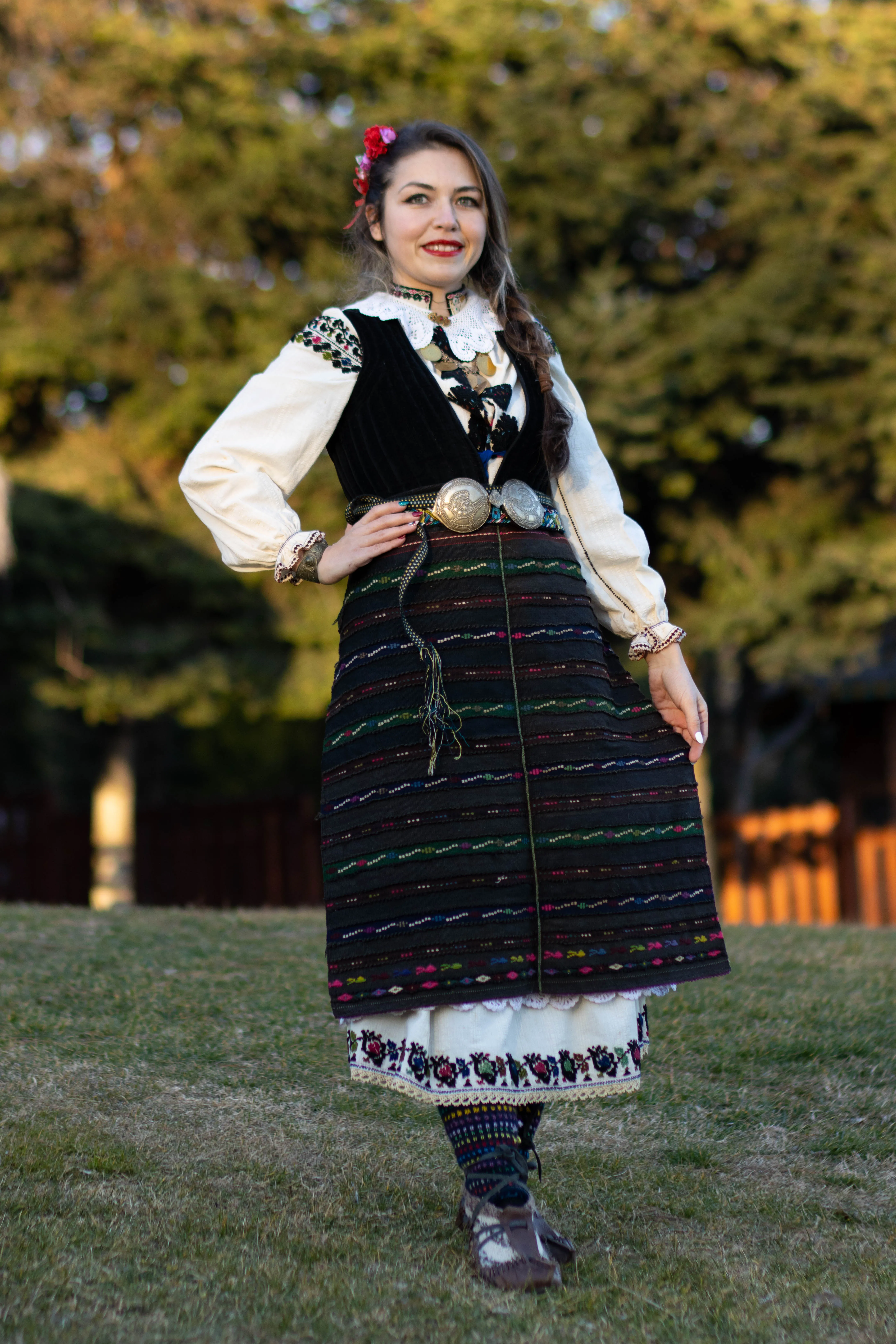
After they “go through” Lazaruvane (the Lazar ritual), girls can go to seidenki (evening gatherings) and be asked in marriage, Assoc. Prof. Veselka Toncheva, ethnomusicologist at the Institute of Ethnology and Folklore Studies with Ethnographic Museum at the Bulgarian Academy of Sciences (BAS), told BTA. The specialist, who has researched the musical folklore of various Bulgarian communities, explained the social significance of Lazaruvane and its connection with the Christian holiday of Lazarus Saturday.
The main ritual action in Lazaruvane is going around the houses by groups of girls, called “druzhini” (companies), who perform special ritual songs with a well-wishing character, she explained. The preparations begin as early as “sredi posti” or “na sredopostnitsa” – in the middle of Lent. After participating in the rite, the girls acquire a new status – they can now fully participate in pre-marital life.
FIRST TESTIMONIES
The first information we have about Lazaruvane as a rite is relatively late – from the period of the first ethnographic documentations in the 19th century, more actively in the second half of the century, the specialist explained. It was then that the systematic collection, recording and publication of Bulgarian folk songs, above all, began on the part of teachers, enlighteners and revivalist figures. Among these records are Lazar songs as part of the local song repertoire. The systematic publication of such materials developed within the framework of publications such as the series “Collection of Folk Creations, Science and Literature”, created by Ivan Shishmanov, whose first book was published in 1889.
THE CUSTOM AND LAZARUS SATURDAY
On Lazarus Saturday, as well as in a number of other rites and customs in Bulgarian traditional culture, there is an overlap and mixing between the older folklore layer and the later Christian one, which researchers call “folk Christianity”, “folklore Christianity”, etc., explained Assoc. Prof. Veselka Toncheva. And she noted that in the Orthodox calendar this is the day dedicated to the resurrection of the righteous Lazarus – an event that foreshadows the Resurrection of Christ and affirms the idea of the victory over death. In traditional culture, this day is called Lazarus Saturday, Lazaritsa, Lazar, Lazarus Saturday, etc., and the ritual is associated with the spring revival of nature after the “dead” winter season and the activation of the social life of young people of pre-marital age.
RITUALS AND SYMBOLISM
According to the expert, the main ritual action is going around the houses by groups of girls, called “druzhini” (companies), who perform special ritual songs with a well-wishing character. The preparation begins as early as “sredi posti” or “na sredopostnitsa” – in the middle of Lent. The girls gather to learn the songs from the older ones – from a girl or a bride who has already gone as a Lazarinka (a girl participating in the Lazar ritual) and knows the Lazar songs, or from an experienced older woman. They study both the songs and the dances that they will perform on the holiday, because in addition to the Lazar songs, in some regions the Lazarinki also perform specific steps and movements. Such is, for example, “shetaneto” (walking) in Shopluk.
On the holiday, they wear special costumes, often with bridal elements – in Eastern Thrace even bridal clothes, and in Western Bulgaria they decorate their heads with “silky” grass and a peacock feather. The Lazarinki go around the houses, sing for each member of the family – for a girl, for a bride, for the host, for a shepherd, etc. – and send well-wishes for health, fertility and marriage. Somewhere songs are also sung for domestic animals, fields and gardens, a song can even be sung “na trendafila” (to the rose).
The performance of the ritual songs is in two groups – one group “sings”, the other “answers”. This is a sign of the ancient ritual character of the singing, a way to master space, a kind of ritual behavior, explained Assoc. Prof. Toncheva. And she added that this way of performing the Lazar songs is such a regularity that some of the singers are not able to perform the whole song if there is no one to “answer” them. In their movement between the houses, the Lazarinki sing a song “for the road.”
SOCIAL SIGNIFICANCE
Lazaruvane has a clearly expressed social function as a rite of dedication. After participating in it, the girls acquire a new status – they can now fully participate in pre-marital life. This transition is also reflected in their appearance – they can comb their hair like older women, wear a “kosichnik” (a special headdress), wear an embroidered shirt, adorn themselves with necklaces, rings and bracelets, wear a wreath or a bouquet on their head. After they “go through” Lazaruvane, the girls begin to go to seidenka, can “libyat libovnik” (love their beloved) and be asked in marriage. It is believed that a girl who has not been a Lazarinka will not get married. In addition to this, the visit of the Lazarinki is seen as a blessing for every home.
THE TRADITION TODAY
Today Lazaruvane exists, but to a large extent in the form of a reconstruction, pointed out Assoc. Prof. Veselka Toncheva. The custom can be seen in different parts of Bulgaria, although in a changed form, she noted. In the 30s of the 20th century, the practice of the so-called “school” Lazaruvane was known, and today the tradition is mainly maintained by the community centers. There, children learn local songs, wear costumes and recreate the rite, but as a consciously preserved memory. Although as a reconstruction, the holiday continues to bring a sense of community, festivity and connection with the past.
A specific regional variant of Lazaruvane is preserved in Northeastern Bulgaria, where the central ritual character is the so-called buènets or boènets. At the same time, the games and songs, taken together, bear the same name. Boenets is also the name given to the unfolded, ungrabbed horo (a traditional Bulgarian dance), which is performed during Lent. Thus, with buenek, buienets, is meant both the dance of the Lazarinki, but also the leader of the Lazar group.
In the village of Yuper, Razgrad region, for example, together with the buienets there is always a little girl dressed as a bride, explained Assoc. Prof. Toncheva. Such is her ritual role – buienets and bride are the main ritual characters in the Lazar group. After the houses are circled, in the evening, on the village square, a competition of the buienets is held, because each neighborhood has its own group and its own buienets. In the ritual dance, the buienets symbolically “fight” with their sticks, which are decorated with scarves and are called “varbii”. One of them wins. A typical ritual song for this moment is “Two Buents Have Met”.
Assoc. Prof. Dr. Veselka Toncheva is an ethnomusicologist at the Institute of Ethnology and Folklore Studies with the Ethnographic Museum at BAS. She has researched the musical folklore of various communities – Bulgarian Muslims in Teteveno and Bulgarians abroad – in Romania, Austria, Albania. She is the author of a monograph on the folklorist Nikolai Kaufman, as well as three books. She is the compiler of two collections dedicated to the traditional music and culture of Bulgarians in Albania. She has published over 150 articles and studies on various aspects of folk music from different regions of Bulgaria and the Balkans.
Коментари (9)
Е, традиция си е традиция... важното е да помним корените си. 😏
Ей, здравейте! 😃 Четох коментарите под статията... добре е да се помнят обичаите, наистина. Аз лично си спомням как като малък ходех с баба на Лазаровден по къщите - мъже да пеят, девойки да играят! Забавно беше, даже и за нас хлапетата.
Ааа, пак за стари работи... добре де, хубави са обичаите, ама дано не забравят да пише и за нещо друго, че все едно си гледаме по стар албум с
Абе, добре де, хубаво е, че се пише за тия неща, ама чакай малко... Защо винаги трябва да е "пак за стари работи"? Значи ли това, че нямаме други проблеми? Добре е, че Тончева си върши работата и документира, ама някаква по-голяма перспектива няма ли? Все едно гле 👍
абе наистина ли? все едно се връщаме във времето... добре