
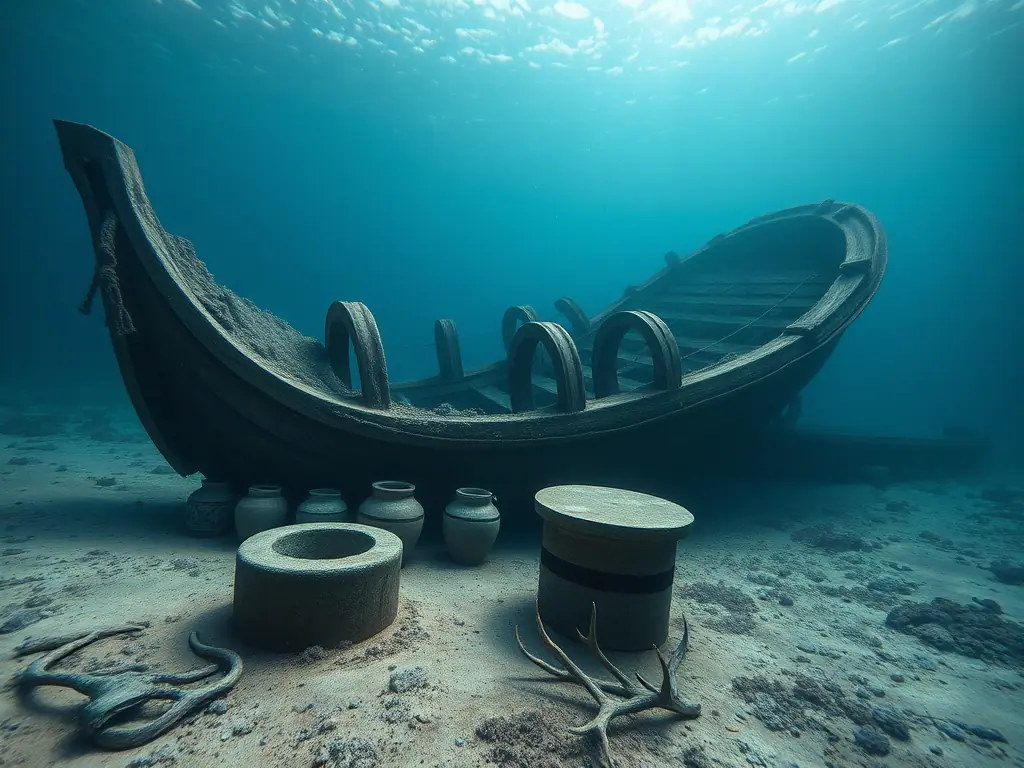
A small ship with much of its wooden hull intact lies about 2 metres deep, some 100 metres off the coast of Mallorca. If the early dating holds up, it is the first shipwreck from the Islamic era found in the Balearic Islands. So far, experts have only confirmed that the ship is old and that its cargo points to the Islamic period. They do not yet know its century, when it sank, where it sailed from or where it was going.
The wreck was found in July 2026. Swimmers spotted pieces of wood in the sea and alerted the Island Council (Consell) of Mallorca. A first inspection showed only a few exposed structural parts, not enough to date the ship. A second inspection, at the end of August, brought up objects that give archaeologists grounds for a preliminary date. The news appeared in Última Hora on 18 November 2026.
What is in the ship
The ship is small, but the surviving hull includes cross and lengthwise timbers. Underwater archaeologist Sebastià Munar, who took part in the first inspections, calls the find interesting not for any single object but for the fact itself: "No es que haya algo espectacular, lo espectacular es que sea un pecio islámico". In other words, the objects are not spectacular; what is spectacular is that the wreck is Islamic. He says "there are no other Islamic ships in the Balearics", so there is nothing to compare it with.
Reports differ on what the cargo includes. In its first article, Última Hora mentioned only pottery and deer antlers that were brought up. In a second piece, it also lists millstones, large jars, pottery fragments and wooden structural parts seen during the second inspection. Arkeonews also mentions millstones, large jars and a large amount of deer antler. The antlers may have been goods, as people made items from horn and bone in the Middle Ages. But the type, origin and destination of the antlers are not known. Only part of the pottery and part of the antlers were taken out. The rest was left in place.
How the cargo helps date the ship
The ship has no inscription with a year, so archaeologists look at what it carried. Roman ships most often carried amphorae, which pile up in heaps and protect the wreck, so they are easy to find. That is the case with the Roman ship Ses Fontanelles, which sank about 1,700 years ago and is linked to the 4th century AD. About 300 amphorae were taken from it. Later, trade shifted to goods in cloth sacks and wooden barrels, which survive poorly. That is why ships from the Islamic era are hard to find, and pottery is one of the few clues for dating.
In this case, the pottery from the second inspection points to the Islamic period. This is a preliminary view. Mallorca was under Muslim rule from 902 until James I conquered it in 1229, a span of more than three centuries. So "Islamic era" is not yet an exact date. Only the ship's location and the fact that its structure survived are confirmed. Everything else is preliminary: the Islamic link, the age and the purpose of the antlers.
Why the location is secret
The Island Council does not say exactly where the ship lies and gives few details, to avoid drawing treasure hunters. After recording the site and lifting the most exposed objects, the council covered the wreck with sand to protect it from looting and damage. According to Xataka, there is an agreement with the Civil Guard and Ports IB to monitor the site. The council has the final say on the site. Munar says "we have practically not been able to do anything yet". Neither a full recovery nor a conservation programme has been announced. The priority is to leave the wreck in place until there is a more detailed study.
The council has already raised a whole Roman ship, Ses Fontanelles. It is now in a specially built pool at San Carlos castle, and its cargo will go on display.




Comments (0)
No comments yet.