
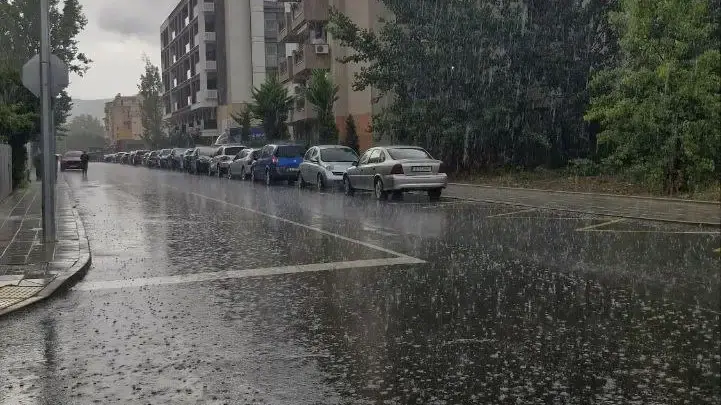
The weather over the next few days will hinge on two atmospheric systems, and in the worst case, Bulgaria's southern Black Sea coast could see heavy flooding rain. That's the warning from climatologist Simeon Matev. Some forecast models point to a cyclone moving from the Black Sea straight toward the Bulgarian coast. The heaviest rain is expected south of Burgas.
The shift comes after a fairly warm first half of September. Matev says that until recently the month was tracking close to the warmest Septembers on record, in 1987 and 1994. The cooldown around the start of astronomical autumn has already cut the temperature anomaly to about 2 degrees above normal, and it's expected to drop further by the end of the month.
Cold air is already moving into the Balkans today. Rain will be stronger across the western half of the peninsula, while it eases further east. Western Bulgaria will see showers in the afternoon and overnight, but not heavy amounts.
In the mountains, the shift toward autumn is already showing. Snow above 2,500 metres is sticking around, and more snow is expected there during the day. Matev calls this the start of a gradual slide into winter conditions, where for now snow keeps appearing and melting in fits and starts.
The bigger change is still to come, starting next week. A strong high-pressure system will build over European Russia, while a low forms over the Black Sea. Together, the two systems will push colder air into the Balkans from the northeast.
Saturday looks gloomy, with a few light showers, while Sunday should see clouds thin out and temperatures rise briefly. Monday should also stay fairly mild.
The real turn comes from Tuesday, when cold air from the northeast will gradually spread across the country. That's when the path of the Black Sea cyclone will become key to how much rain Bulgaria gets. Four different forecast models show rain over Bulgaria next week, but their estimates on amounts vary widely.
The biggest unknown right now is exactly where the cyclone will head. If it stays further out at sea, rain here will be limited. But if it moves in close to the Bulgarian coast, the chances of prolonged, heavy rain rise sharply.
It's under that worse-case scenario that the southern Black Sea coast, including the areas south of Burgas, would be hit hardest. Matev says every model he's looked at points to a wet spell on the way. The exact amounts, though, won't become clear until closer to the week itself, once the cyclone's path is more defined.



Коментари (0)
Все още няма коментари.