
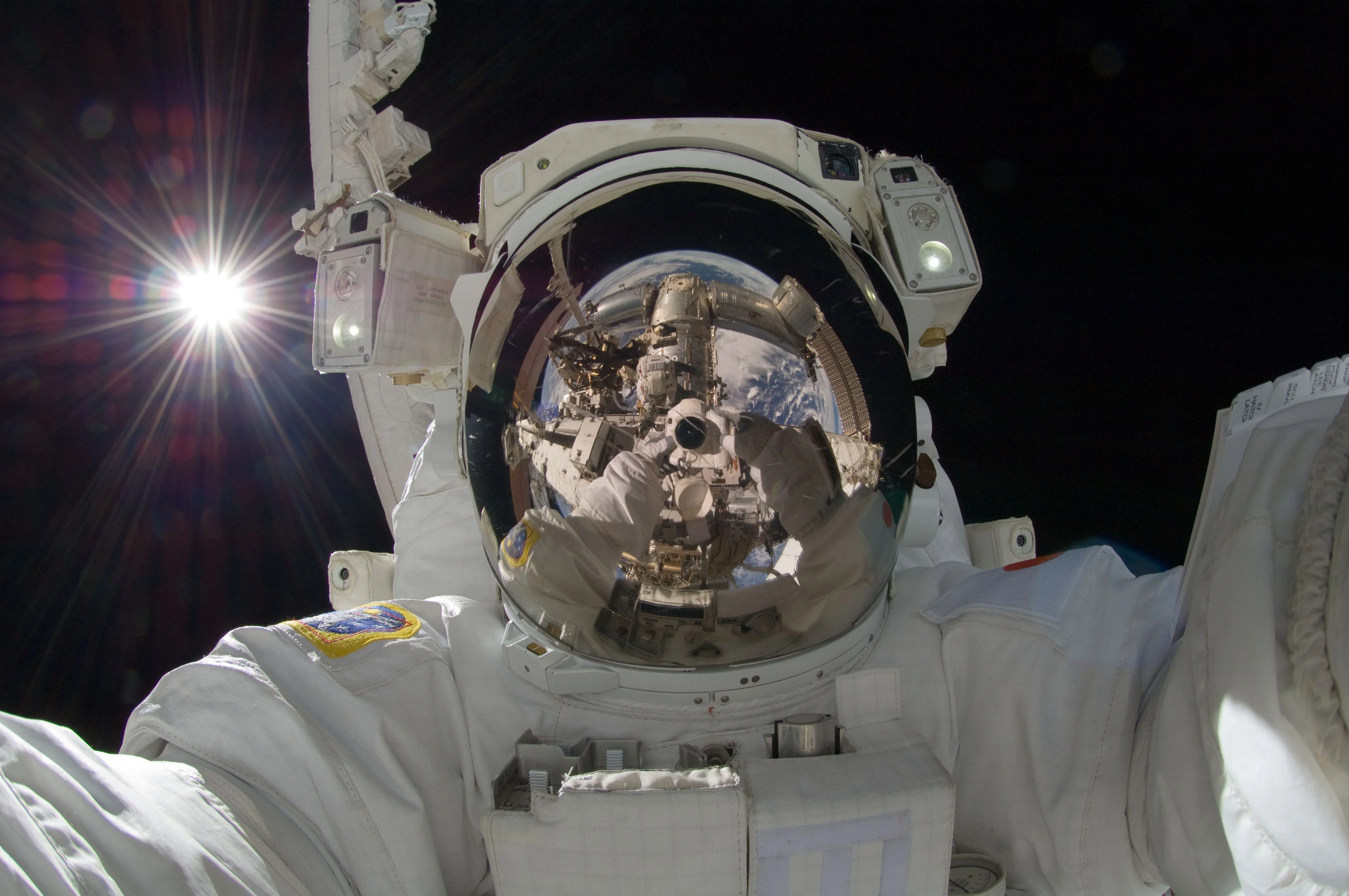
Two weeks after its release in cinemas, the film "Project "Hail Mary"" with Ryan Gosling continues to provoke comments among the scientific community. The adaptation of Andy Weir's bestseller, which already enjoys 95% approval on "Rotten Tomatoes", is rated as a production that largely presents scientific details correctly – albeit with a few clearly recognizable exceptions. The film follows the story of a molecular biologist sent on a one-way mission to the Tau Ceti star system to find out why the Sun is weakening due to an imaginary microorganism called "astrophage". In a review in the "New York Times", experts define the film as serious "hard sci-fi", which "overachieves in science, but not without omissions".
Where the film steps firmly on science
Astrophysicist Jacqueline McCleary, Associate Professor of Physics at Northeastern University, emphasizes that in the film, astrophysics, orbital mechanics, and space engineering are "presented surprisingly correctly". The rotating spacecraft, which creates artificial gravity through centrifugal force, according to her, is based on "completely classical, generally accepted physics". The presentation of time dilation – the effect by which an astronaut moving at high speed experiences time differently from people on Earth – also receives high marks for scientific accuracy.
Astronomer Wendy Freedman of the University of Chicago, a recipient of the National Medal of Science, shares with "Science" magazine that she is impressed "how well the film shows how science is actually done". She notes: "He works in a team, and science is a deeply collective endeavor, so I really liked how the scientific work was shown in the film". According to her, the image of the scientific environment, with discussions, doubts and the verification of hypotheses, is much closer to reality than typical Hollywood clichés.
The border where fiction replaces facts
The biggest scientific assumption in the story is the astrophage itself – the imaginary microorganism that "sucks" energy from the stars. McCleary points to a "discrepancy of several orders of magnitude" between the amount of energy that a real microbe could accumulate and the giant power of the Sun's radiation, on the order of 10^26 joules per second. In other words – the scale to which the astrophage affects the star far exceeds known biological possibilities.
Molecular biologist Tina Hessman Sey in an article for "ScienceNews" reminds that single-celled organisms can indeed survive in extreme conditions – highly acidic environments, radiation, deep ocean openings. But she emphasizes that she does not "know of any organism that can withstand both extreme heat and severe cold, let alone survive in the vacuum of space". From this point of view, the biochemistry of the astrophage is more of a convenient plot tool than a realistic hypothesis.
Earth science specialist Carolyn Grmling also draws attention to the speed at which the astrophage darkens the Sun – about a 10% drop in luminosity in 30 years. In real astrophysics, a similar change would naturally take approximately a billion years. "But science fiction loves to accelerate processes for dramatic effect," she admits, stressing that otherwise the dramaturgy would be impossible.
NASA also finds cause for clarification when the film implies that the team is waiting for instructions from the "Deep Space Network" (Deep Space Network). The agency reminds that the real DSN provides an almost continuous connection with its spacecraft and does not work on the principle of "periodic windows", as shown on the screen.
A story about scientific thinking that scientists recognize as their own
Despite the creative liberties around the astrophage, many specialists recognize a deeper truth in the way the film shows the scientific approach itself. McCleary notes that the partnership between the character Grace and his alien ally Rocky captures something key in the work of researchers: "You are ready to overcome huge barriers – of language, culture, even biology – to work together on an essentially intellectual problem". This, according to her, is very reminiscent of real international scientific collaborations.
Freedman elaborates on this idea, emphasizing that Gosling's character approaches tasks "extremely thoughtfully and methodically". "Here's an idea, here's a hypothesis – let's check it" – it is this logic, and not the image of the "genius loner", that dominates much of the plot. For many scientists, this is exactly what makes the film particularly valuable: not the perfect physics in every detail, but the respect for the real process of searching for answers.





Comments (7)
Мамка му! Сега и във филмите ще ни учат? Да си гледам попкорна 🇧🇬
Аха, значи сега трябва да се правя на учен, за да разбера дали Гаслинг наистина може да яде звезди? 😅 Все едно имахме нещо по-интересно за губене на време... Но 🤷♂️
Аби, хора, к'во става? 😂 Все едно си мислех, че ще гледам просто един филм с Райън Гослинг... Сега трябва
Хмм, интересно. Винаги ме е кефило, когато филмите правят усилие ДА бъдат достоверни, макар че разбирам - винаги има компромиси заради историята. Важно
Евала на хората, дето са се постарали с науката! Ама пък после