
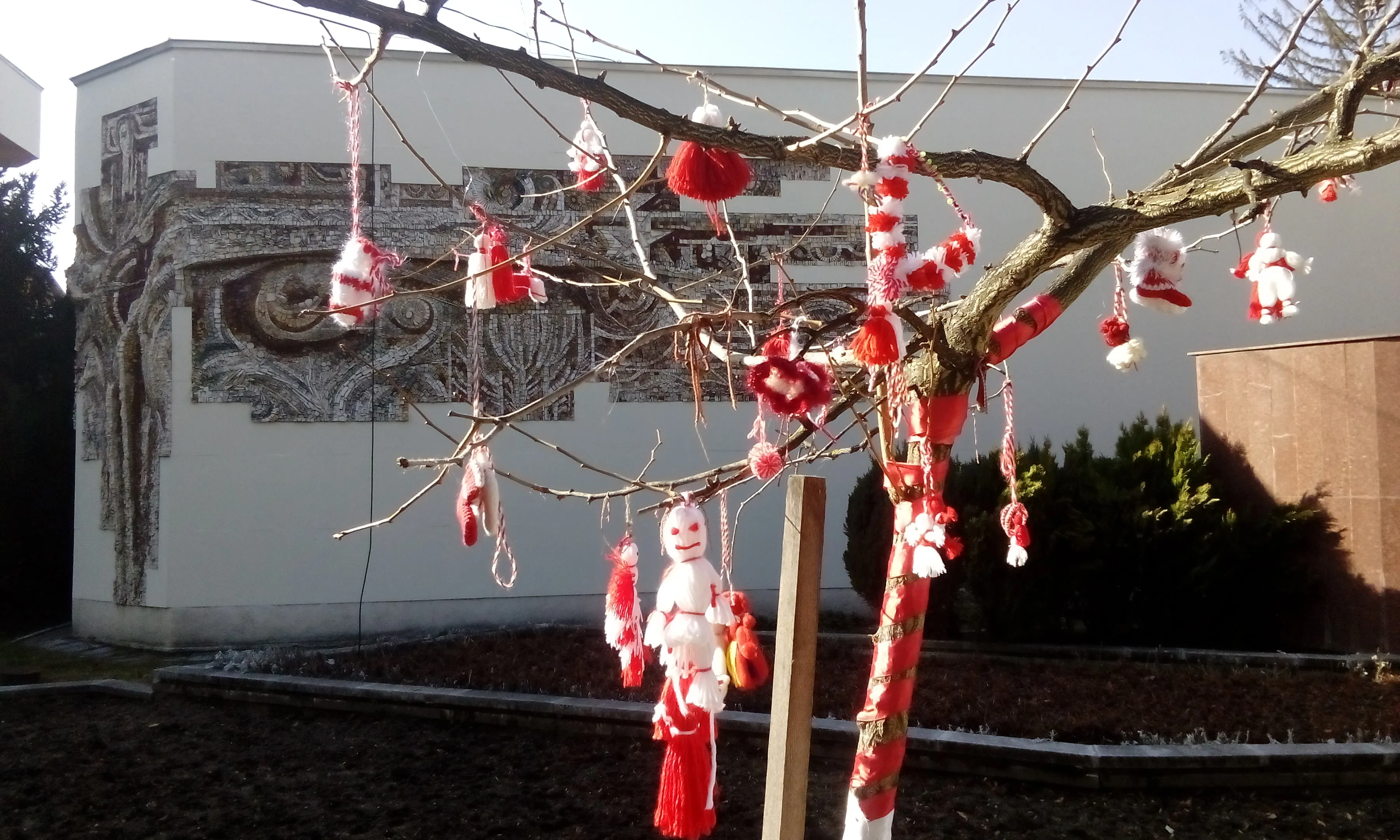
Today, Bulgarians celebrate the Baba Marta custom, which has a millennia-old tradition. On this holiday, everyone gives their loved ones a special amulet called a “martenitsa” for health and strength in the coming year. Martenitsi are made only for March 1st, when, according to the Bulgarian people, the new economic year begins.
On March 1st, people, trees, and animals are adorned with martenitsi made of twisted white and red threads for health and success. They are worn either until March 9th – the church holiday of the Holy 40 Martyrs, or until March 25th – Annunciation. The martenitsa can also be removed upon first seeing a stork, a swallow, a cuckoo, or a blossoming tree.
Martenitsi are necessarily made of two twisted threads – red and white. In some regions of the country, the threads are only red, while in others they are multicolored, but with predominantly red. According to popular belief, this color has the power of the sun and gives vitality to every being. The white color symbolizes purity, innocence, and joy. In Bulgarian traditions, white is also a sign of beauty, and red is the color of vitality, health and love, victory, life and bravery, light, the rising and setting sun.
According to legends, the first martenitsa was made by Ahinora, the wife of Khan Asparuh, in the second half of the seventh century, when Asparuh crossed the Danube and discovered the lands around the Balkans for the Bulgarians. Ahinora waited a long time for her beloved and finally tied a twisted white and red thread to the leg of a swallow and released the bird to convey her message of health and love.
This ancient, most likely pagan custom is considered a unique Bulgarian tradition, although it is present in a slightly modified form in Romania. There, the martenitsa is called “martisor” and is worn only by women, while in Northern Greece, only children wear it as a bracelet made of twisted white and red thread. The custom is also preserved in the neighboring countries where Bulgarians have migrated over the centuries – it is celebrated in the southern parts of Moldova, where ethnic Bulgarians live.
The custom of adorning with a martenitsa is widespread not only in Bulgaria, but also in other Balkan countries. In 2017, it was included in the UNESCO list of intangible cultural heritage of humanity as a joint nomination from Bulgaria, Romania, Moldova and the Republic of North Macedonia. On the Bulgarian side, Prof. Dr. Albena Georgieva – an expert from the Institute of Ethnology, Ethnography and Folklore Studies with the Ethnographic Museum at BAS, took part in the preparation of the application.
Also interesting are the customs in our country related to martenitsi. In the Razgrad region, in the morning at sunrise, every housewife throws a red cloth on one of the fruit trees in the garden, “to make Baba Marta laugh.” In Troyan, on March 1st before sunrise, the housewives of each house tie red wool on the keyholes of the doors, on the fruit trees, on the horns of the livestock. In Haskovo, the grandmother, who early before dawn ties martenitsi on the children of the family, dresses entirely in red upper garments.



Comments (13)
абе хора, баси! юнеско ни признаха мартеницата… честна дума, малко ме е смешно да го кажа. все едно до вчера си мислеха, че си играем на вързане на конци и сега: "ооо, това е културно наследство!" 🤣
абе хора, к'ви сте се разпалили всички! юнеско признали мартеницата... да, добре де, радвам се разбира се, че нещо българско получава такова внимание, ама някак си ми се струва... не знам, малко изкуствено. все едно чакахме тях да ни кажат дали баба е добра или лоша, ами ние сами трябва да пазим традициите си, нали? важното е хората да си подаряват
Еее, Юнеско! Сега ще ни учат на български традиции ли? 🙄 Добре де, че го признаха, ама все едно
Ебати! ЮНЕСКО ни признали... дааа, хубаво е разбира се, че една такава световна организация оценява българските традиции. Сериозно! Но все пак… малко ми е странно усещането. Все едно чакахме някакъв знак отвън
Абе, хора, вие се хванахте за ЮНЕСКО сякаш ни подариха остров! Добре де, хубаво е, че мартеницата е в списъка им... ама да не се заблуждаваме, все едно си купихме сертификат "Официално Български"!