
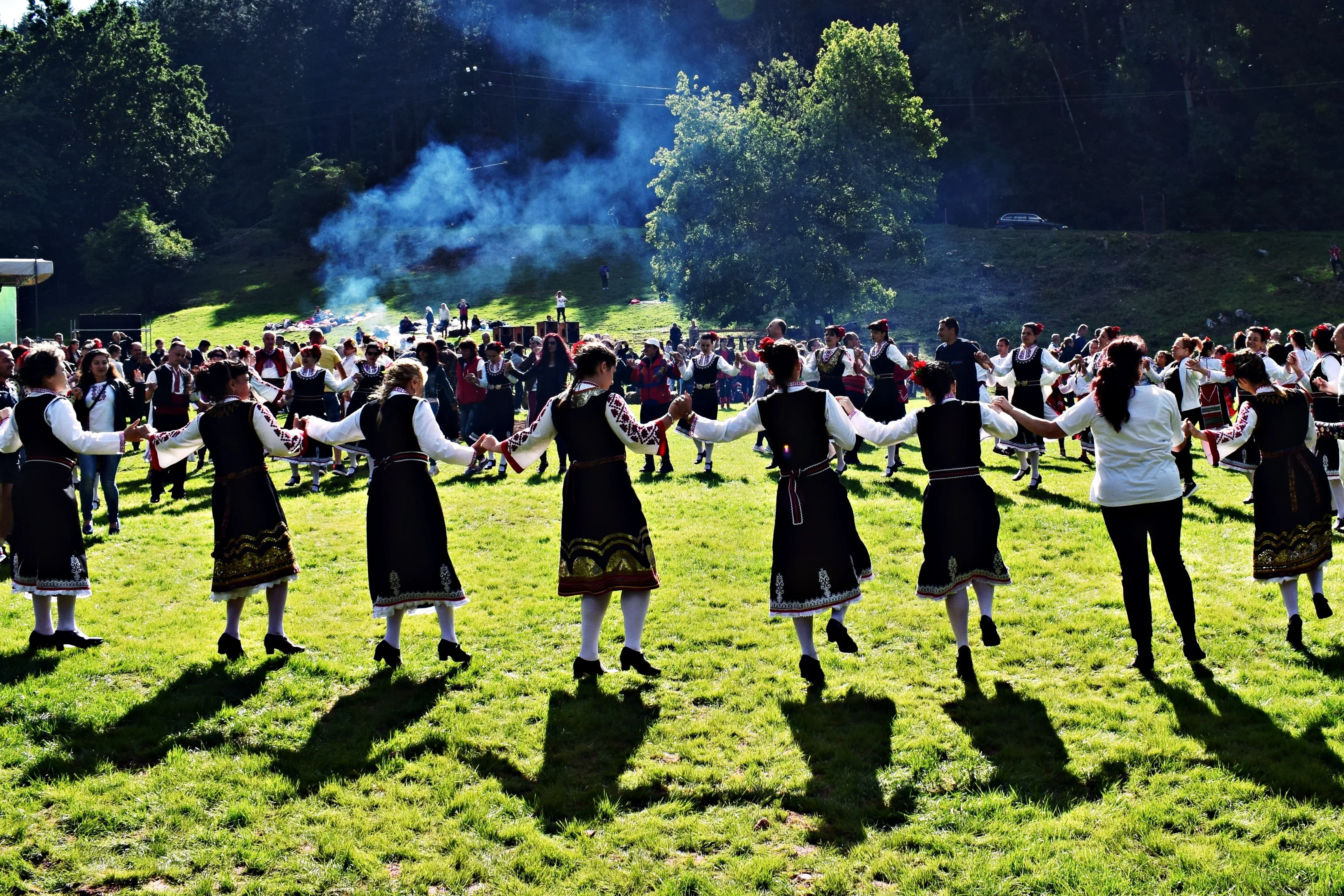
There is no Bulgarian who has not once taken a guest from abroad to a "folklore evening" - with folk dances, bagpipes, lush costumes and a rich table. Everything looks impressive in the pictures, but the question remains: is this the living folklore or a well-arranged "stage performance" for tourists? And where exactly does the thin line between the authentic experience and the cliché pass.
What we call authentic folklore
When we talk about authentic folklore, we often mean something "pure", "old", "true" – songs, dances, rituals and stories born in the daily life of the community, not for the stage, but for the people who live with them. These are the songs that grandmothers sing without a microphone, the people who play on the square, and the customs that are done because "that's the tradition", and not because there is an audience with cameras in the hall.
Authenticity does not mean a frozen museum. It lives in the way the community uses folklore today – in family celebrations, villages where there are still living ritual practices, and groups that preserve the old songs, costumes and dialect not for the sake of competition, but for the feeling that this is "ours". It is this layer – connected with identity, memory and real life – that is missing when folklore turns into just a beautiful show.
How folklore enters the tourist package
With the development of cultural tourism, folklore naturally becomes part of the "offer" of a destination. Hotels and complexes include folklore evenings, festivals, demonstrations of traditional crafts and culinary rituals in their program. The idea is good: guests to touch the local culture, and local communities to earn additional income.
From here, however, the risk begins. When folklore turns into a product, it is easy to reach "packaging" – long rituals are shortened, dances are accelerated, costumes are "tuned" for a greater effect, and songs are selected on the principle of "what tourists like the most". And at one point, what we see on stage begins to resemble more a folklore musical than a living heritage.
"Stage authenticity" – when the real is played as a theater
Sociologists and tourism researchers have long used expressions such as "stage authenticity" and "staged authenticity" to explain this duality. At first glance, the tourist "attends" a custom – for example, a Kukeri dance or a reconstruction of a ritual. In fact, however, the setting, the time, the duration, even the lines and "spontaneous" moments are carefully directed.
The paradox is that even in such a performance there are often real elements – authentic costumes, real bearers of tradition, real songs. However, the audience sees the "face" of culture – selected shots, without the "backyard" of preparation, everyday life, conflicts and change. In this sense, folklore becomes a stage in which locals play "themselves", but according to the expectations of the guests.
When folklore enriches the tourist experience
Folklore can be a huge wealth for tourism when used with respect and measure. This happens when:
- local communities participate actively and have a say in what and how to show;
- the meaning of the customs is explained, and not just the "effective" parts are shown;
- guests have a chance to ask questions, to get involved in a non-violent way – to learn steps, to try to sing a chorus, to understand the history of the costume;
- real elements are preserved – authentic songs, regional features, local language, instead of everything being smoothed out to a "common Balkan style".
In such cases, visitors do not leave only with beautiful photos, but with the feeling that they have learned something real – about the past, about the people, about the way tradition still lives. And for the locals, this means recognition that their culture is important today, and not just as an "attraction".
When folklore turns into a cliché for tourists
On the other side stands the well-known cliché: the same dances, costumes "in bulk", music from playback and a "photo pause" with a folk ensemble. It doesn't matter whether we are in the Rhodopes, Dobrudzha or Pirin – the music and choreography sound almost the same, and the dialect is lost in the desire "everyone to understand".
Here folklore is reduced to a background decoration – something that is turned on "for color" during dinner, while the main attention is on the menu and selfies. At first glance, everyone is happy: tourists get a "show", and the organizers – applause. But there remains the feeling that we have seen a postcard rather than a living heritage.
Can the "performance" be honest
It is important to admit that completely "pure" folklore in a tourist environment hardly exists. The very fact that something is shown to the public changes it – makes it shorter, clearer, more "easy to understand". The question is not whether there is stage presence, but whether it is honest.
An honest performance does not pretend to be something it is not. She can clearly say: "Now you will see a shortened form of this custom", to explain what it looks like in a real environment and why it is important for the community. Thus, the tourist knows that he is attending a version adapted for him, and not a "mysterious ritual" staged solely for photos.
How to recognize the authentic when we travel
As tourists, we can try to "read" the context, not just the scene. Several simple signs often help:
- are there locals in the audience or only tourists;
- is the meaning of the custom being talked about, or is everything left unexplained;
- do the costumes look "alive" – with traces of use, details, characteristic of a specific region;
- is there a possibility to talk to the performers after the end, or does everything end with a photo and applause.
The authentic is not always "perfect" – it may be more imperfect, quieter, sometimes even more uncomfortable to watch. But it is in these imperfections that the living human layer lies, which is missing in the polished performances.
The balance – folklore as a bridge, not as a mask
Ideally, folklore in tourism is neither a museum showcase nor a background show, but a bridge between people. Locals have the right to adapt their traditions to new audiences, but tourists also have the right to an honest experience – to know when they are watching a living practice and when – its stage version.
The balance comes when there is respect in both directions: communities do not feel obliged to "play themselves" according to a foreign scenario, and guests are ready to listen, ask and accept that real culture rarely resembles a brochure. Thus, folklore ceases to be a cliché and again becomes what it has always been – a living language with which people tell who they are.




Comments (11)
Бух ти! Бяси, то верно, че става тъпо като го правят само за пари. Ама к'во да праим? Трябва
Абе хора, к'во става тука?! Сериозно ли говореме за тъпотиите с фолклора? Тъжно ми е да гледам как ни го продават на чужденците, а ние сами си се правим на глупаци! Да, туризмът е важен, ясно е. Но като видя някакви мазнинки в народни носии, дето пеят фалшиво и танцуват за бакшиш... ми става ло
Абе, наистина ли някой си прави труда да се замисля? 🤣 Като гледам колко "традиционни" хора се появиха насам-натам с платени усмивки... Къде е исти
Абе, верно е тва дето пишат... Лесно е да си направиш шоу от фолклора, ама тогава губи смисъл. Трябва да се па
Хм, ясно е, че комерсиализацията винаги осакатява автентичността