
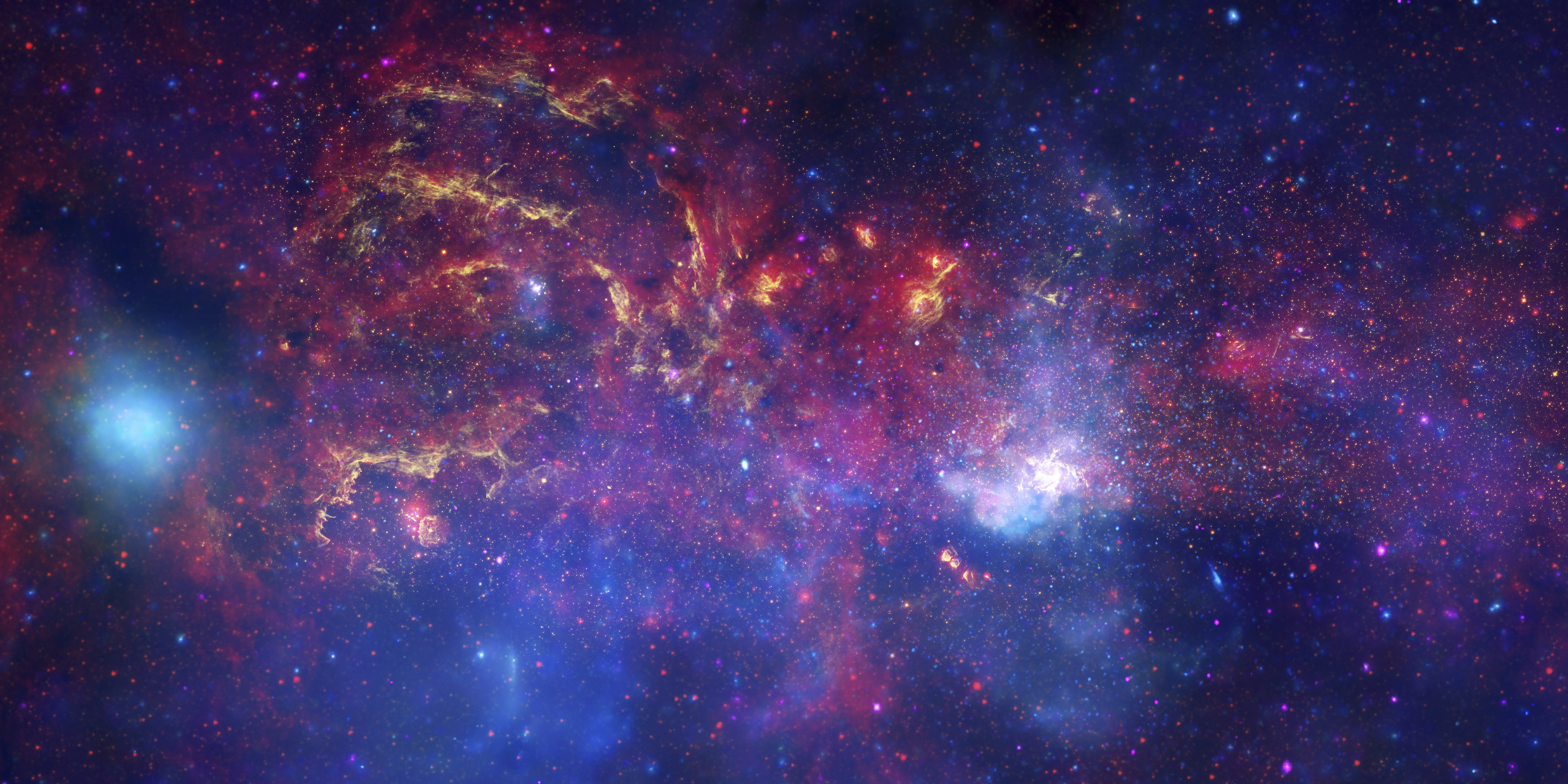
Astronomers have discovered the fastest known star in the Milky Way—a faint object called S301 that orbits the supermassive black hole at the center of our galaxy. At its closest approach to Sagittarius A*, the star reaches approximately 25,000 kilometers per second, or just over 8% of the speed of light.
The discovery is presented in the journal "Nature". Scientists believe that S301's unusually close orbit may for the first time allow for a direct measurement of the spin of Sagittarius A*—a black hole with a mass about 4 million times that of the Sun.
The tightest known orbit
S301 completes a full orbit around Sagittarius A* in 8.7 years. This is the shortest known orbital period for a star around the Milky Way's central black hole.
Its orbit is highly elongated. At its closest point, the star approaches about 11.5–12 times the distance between the Earth and the Sun. This is approximately the distance from the Sun to Saturn and about ten times closer than the previous key star for such observations, S2.
At this moment, S301 is traveling at a speed of about 25,000 km/s. That is over 100,000 times the typical cruising speed of a passenger jet.
"We found a star that immediately caught our attention because its orbit passes incredibly close to Sagittarius A*. This is the star that gets the closest to Sagittarius A* of any known so far," said study co-author Stefan Gillessen of the Max Planck Institute for Extraterrestrial Physics.
Observations with the VLT in Chile
The team detected S301 in 2023 with the "GRAVITY" instrument on the Very Large Telescope Interferometer of the European Southern Observatory in Chile. The system combines light from four telescopes with 8.2-meter mirrors, allowing for extremely precise observations of the center of the Milky Way at a distance of about 27,000 light-years from Earth.
After nearly two years of additional observations, the astronomers confirmed the orbit. Archival data allowed them to track the star's position back to 2017.
How S301 can measure spin
Black holes warp spacetime with their gravity. If a black hole is spinning, it further drags the spacetime around it—a phenomenon known as "frame-dragging" or the Lense-Thirring effect.
Because S301 passes very deep into the gravitational field of Sagittarius A*, the black hole's spin should gradually shift its orbit. This small but measurable deviation will provide the opportunity to calculate the rotation speed.
"For the first time, we will be able to truly directly measure the spin of a massive black hole, which will be a key test of Einstein's theory," Gillessen said.
Astrophysicist Erin Kara of the Massachusetts Institute of Technology, who was not involved in the study, described the result as "truly exciting" and stated that it "lays the foundation for such unprecedented measurements of black holes over the next decade".
The next key moment is 2031
The next closest approach of S301 to Sagittarius A* is expected at the end of 2031. The team's models show that about ten years of regular observations could allow for a precise enough measurement to distinguish between a fast-spinning and a nearly non-spinning black hole.
In the longer term, scientists hope to measure the quadrupole moment of Sagittarius A*. This would allow a test of the so-called "no-hair theorem"—the idea that an uncharged black hole is described entirely by its mass and its spin.
"We will continue to observe the movement of this object around the black hole, and in another ten or fifteen years, we will probably understand how the black hole spins," Gillessen said.



Comments (3)
Еее, браво! Много яко откритие, наистина! 8% от скоростта на светлината... уму непостижимо! Честно казано, малко ми се завива главата като си го представям. Аз не съм нито астроном, нито
Абе наистина ли е възможно да се движи толкова бързо? И какво точно ни показва това всъщност? 🤔 🤬
Абе, вие сериозно ли сте с тия звездички и дупки?! 8% от скоростта на светлината... супер яко, наистина. Да си знаете, че има и други проблеми по света, а? Не да го правят за слава и лайкове.