
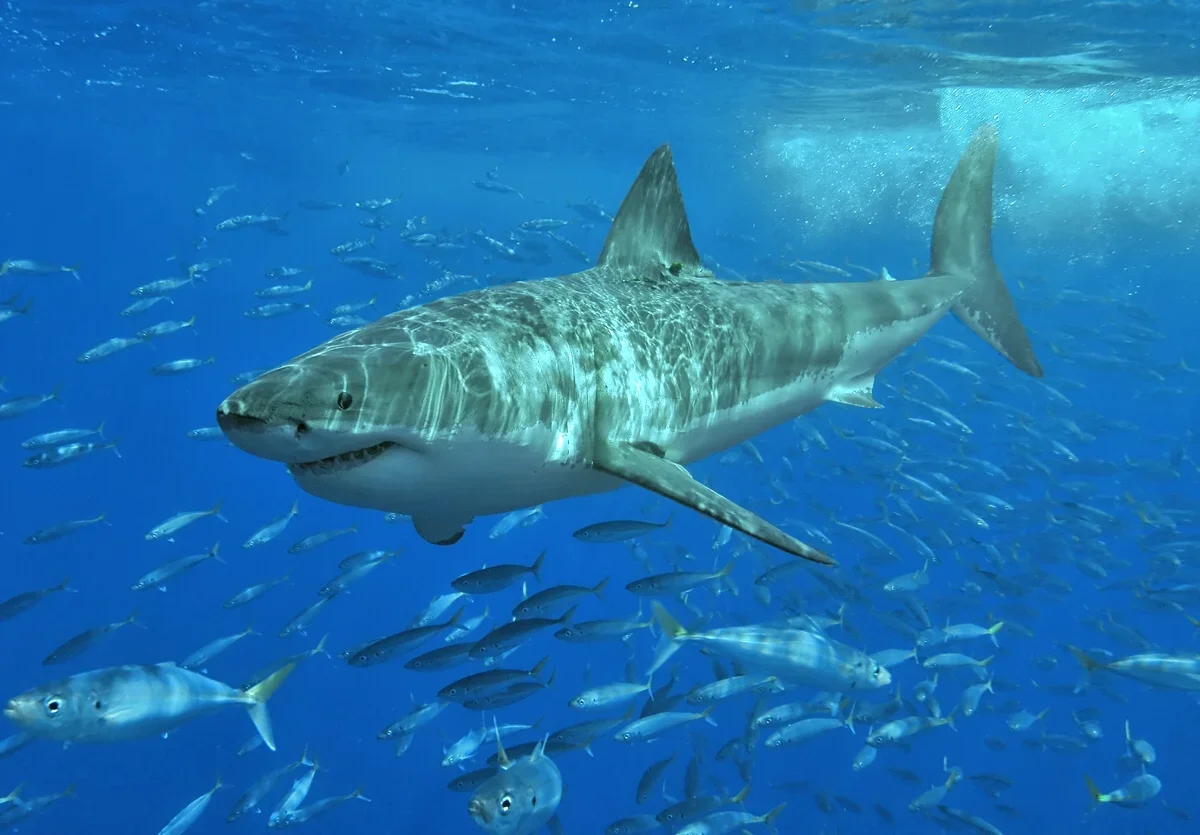
The ancestors of the great white shark once roamed the waters of northern Europe, attacking whales and feeding on their carcasses around five million years ago. Today, as ocean temperatures rise, scientists warn that modern great white sharks could follow the warmer currents back into the North Sea – even though the very warming that opens this route for them may at the same time push these apex predators to the limits of their physiological capabilities.
"Ancient teeth" reveal a brutal past
The link between the ancient past and a possible future is drawn by John Stewart, a professor at Bournemouth University, in an essay published in "The Conversation". He is among the researchers who took part in a recent study of two fossilised whale skulls from the early Pliocene – a period roughly 4–5 million years ago – found in Belgium.
Computed tomography of these skulls revealed fragments of shark teeth embedded in the bone: one belonged to a bluntnose sixgill shark, and the other – to "Carcharodon plicatilis", an extinct relative of the modern great white shark. The results, published in the journal "Acta Palaeontologica Polonica", provide rare direct evidence of shark feeding behaviour in the ancient seas of northern Europe.
On one of the skulls – from an extinct small right whale – bite marks were found on the upper surface, typical of feeding on an already dead whale whose carcass was drifting belly-up. All indications are that the second whale was the victim of a much more aggressive attack: the marks show that the shark tried to bite its head, which points to active hunting rather than simple scavenging.
Ocean warming changes the outlook
Stewart’s argument is based on a simple hypothesis: if the relatives of the great white shark thrived in the North Sea during the warmer Pliocene, then today’s rising temperatures could recreate conditions suitable for their return. At present, more than 40 shark species inhabit the North Sea, including catsharks, spiny dogfish and salmon sharks.
The picture, however, is complicated by a separate study, according to which warm-bodied predators such as the great white shark expend almost four times more energy than cold-blooded fish of similar size. As the oceans warm, these "mesothermic" species face what researchers describe as a "double threat": the risk of overheating combined with a shrinking food supply.
Pushed towards the poles – and towards their own limits
A team from Trinity College Dublin and the University of Pretoria has calculated that a one-tonne warm-bodied shark can barely survive in waters warmer than about 17 degrees Celsius, unless it dives deeper or sharply reduces its activity. "These species are increasingly approaching the boundaries of their physiological capabilities, which may change where they are able to live and how they survive," notes Dr Emily Snelling of the University of Pretoria.
The conclusion is paradoxical: ocean warming may force great white sharks to shift northwards – for example into the North Sea – while at the same time shrinking the total area of ocean habitat where they can actually function. If temperatures continue to rise, some of their traditional ranges may become too warm for large individuals, driving them towards more polar regions.
The open question is whether such a migration would ensure the long-term viability of their populations or rather mark the outer edge of a shrinking range. The fossil teeth tell us how ancient sharks hunted, but they cannot answer whether their modern descendants will manage to adapt to a rapidly changing climate.





Коментари (11)
Абе, чакай малко... Акули в Северното море? Сериозно ли някой си играе на "Парк Юрсик" сега
Абе, наистина ли ще има акули в Северното море? 🦈 Няма ли да е яко да хванеш
ей, здравейте на всички! четох новината за белите акули и северното море... наистина е доста интересно, а може би и малко стряскащо като си го представиш.
Ахах, значи ще ни се метнат акули от студа? 🥶 Браво
Абе хора, кво става тука бе?! Четох за акулите... Ясно е, че с тия климатични промени всичко се обърква. Дано да не стане голям цирк. Все пак, ако дойдат в Северното море, ще трябва 🤷♂️