
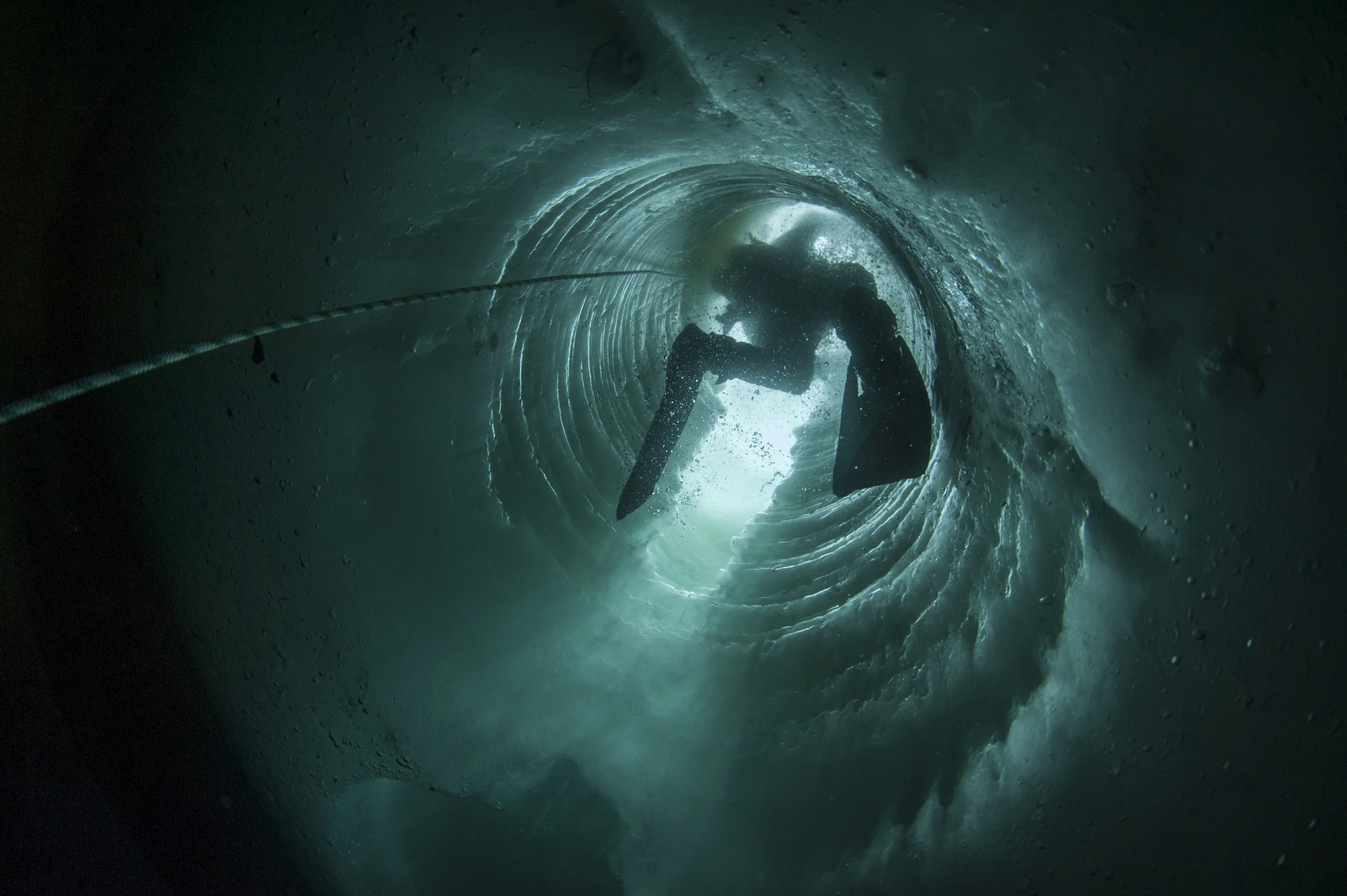
In the far north of Finland, diver Daan Jacobs surfaces through a hole in the thick ice of a frozen lake, trying to catch his breath after a 45-minute dive to a depth of about eight meters. "The view is breathtaking," shares Jacobs – a biodiversity consultant from the Netherlands – after descending at the beginning of the month to a remote biological station beyond the Arctic Circle.
He is part of a growing group of scientists and researchers enrolled in a polar scientific diving course organized by the Finnish Academy of Scientific Diving at the "Kilpisjärvi" biological station of the University of Helsinki. The program, which started in 2024, trains already experienced divers to work under Arctic and Antarctic ice – skills that, according to experts, are currently mastered by only a few hundred people in the world.
Race against time against the background of melting ice
The urgency of the initiative is obvious. Arctic sea ice reached its annual maximum on March 15 – 14.29 million sq. km – a value that equals the record low maximum for the last 48 years of satellite observations, on par with that of 2025, according to data from NASA and the National Snow and Ice Data Center. The total volume of Arctic sea ice in March 2026 is the lowest in the history of measurements – approximately 15% below the levels of mid-March 2024.
The Arctic is warming about four times faster than the global average, which disrupts climate models and shrinks sea ice areas – vital for polar bears and entire marine ecosystems. "As the ice melts so quickly, we have to send more people there, conduct more scientific research to better understand what is happening," says marine biologist Eric Wurtz, one of the instructors on the course. "We must do more and we must do it quickly to save this unique ecosystem in the Arctic, as well as in Antarctica."
Why robots cannot replace divers
Despite advances in robotics, human divers remain indispensable under the polar ice, emphasizes Simon Morley, a marine biologist from the British Antarctic Survey. Trawling the seabed would destroy fragile habitats, and remotely operated underwater vehicles can usually collect only one sample at a time.
"A diver can go down, collect 12 sea urchins, put them in a net, and not damage the rest of the system," Morley explains. According to him, it is the ability of a person on the spot to assess the situation and act precisely that makes scientific diving such a valuable tool that cannot be completely replaced by machines.
Intensive training in extreme conditions
Each 10-day session of the academy trains about a dozen divers, and strong interest has prompted the organizers to add a second annual session. Participants come from different fields – from marine biology and ecology to scientific photography and documentary filmmaking. During the course this month, the group dives under ice about 80 centimeters thick in water, just above freezing, while ground crews battle winds that can cause frostbite in minutes.
Caroline Chen – a scientific diver and assistant from Germany – tells how she stopped underwater to observe the sunlight breaking through the ice. "From the bottom up it looks incredible," she says. "It is constantly changing, like the northern lights." For Chen and her colleagues, it is these moments that remind them why it is important to invest time, risk, and effort in understanding and protecting the rapidly changing polar world.



Comments (10)
Абе хора, луда работа! 😳 Четях за Арктиката и ледниците отдавна, ама водолази под леда... това вече е яко! Иначе, да си призная честно, малко ме е страх да не се окаже някаква драма. Топенето на ледовете е супер притеснително, ясно е, че климатичните промени ни готвят нещо лошо.
Хм, интересно начинание. Важно е да се проучва какво става под леда, наистина. Дано успеят и да ни донесат ценна информация за състоянието на тези екосистеми. Малко ме притеснява топенето
Абе, пичове, сериозно ли? 🤣 То като гледам как ни топлят, май скоро ще можем да си плуваме под лед без гмуркане! Шегувам се, разбира се… малко тъпо стана, ама какво да я правим.
Ехх... Мдааа... 😔 Топенето си върви, няма спор. Важно е да знаят кво става там долу, ама все едно да
абе хора, какво става тука бе? да разбирам ли, че ни казват да се тревожим за ледовете в арктика, докато все едно си правят някакви тренировки там на финландците под тях? не казвам, че не е важно да знаят кво става, ама все пак...