

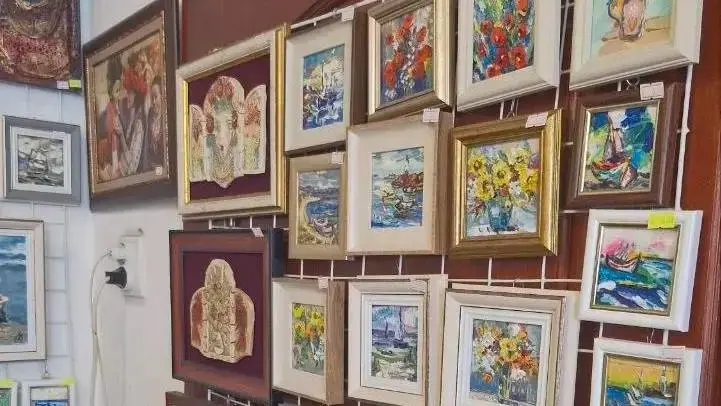
All 15 paintings in artist Milko Bozhkov's new solo show at the Prolet gallery in Burgas sold before the official opening, he told BTA.
The show opened yesterday, 19 November, from 5pm to 7pm, and runs until 14 December.
On 19 November, the Prolet gallery announced the exhibition, noting that Bozhkov's works are held by the Library of Congress in Washington.
The landscapes are based on views Bozhkov photographed over the past two years near the village where he lives. Each painting is titled with the exact day, hour and minute the photo was taken.
For him, nature is both a subject and a reason to think about time, memory and the human presence in the world. "There is no greater creator than nature," the artist said. He added that he cannot compete with it and can only record and interpret what he sees.
Bozhkov adds embroidery and details that were not in the photographed view. They disturb the calm of the picture and hint at other readings, but he offers no single explanation for them. He says they must connect with the image and take the viewer beyond a first impression of a pretty field, grass, tree or sunset. Some of the additions come from the subconscious, and reason cannot explain them. Sometimes a line simply has to be there. Bozhkov sees a likeness to Alfred Hitchcock's methods in the film "The Birds", where tension comes from waiting and delay. In the same way, his details hint that there is more behind what is seen, without fully revealing it.
He points to the Italian artist Lucio Fontana, who cut his canvases, as an example. Bozhkov does not go that far, but the embroidery helps him break up the structure of the canvas and stops him taking his work too seriously. For him, life, death, children, his mother and his parents matter more.
The title of each painting marks his meeting with the view, and the canvas is an attempt to recreate it through his own feeling. Bozhkov quotes his close friend Stoyan Tsanev, who says a painting should speak for itself, and if it does not, the artist has not done his job.
The poet Boris Hristov also steers him toward using fewer words. Hristov turned away from vanity and moved to a village to be alone with himself. He has quoted Lao Tzu as saying that when a person is alone, the world comes to him and he does not need to strain for it.
The artist links this attitude to the wisdom of age and a wish to be as silent as possible. His work ends with the framing, and then the paintings go their own way. He does not accept without question the buying of a painting before it has been seen in person, because then the buyer chooses the artist's name, not the work itself. A buyer should first meet the canvas and be moved by it as much as the artist was moved by the subject. If the subject does not stir him, Bozhkov sees no point in painting it, and he expects the same of the viewer.
Even when someone buys a painting as an investment, what matters to him is the aesthetic pleasure and sharing what the artist felt. Bozhkov says this is the natural relationship between artist, viewer and buyer.
The most beautiful views are not always the best to paint. Perfect ones do not need to be put on canvas, he says, while modest ones leave more room for searching and depth. An artist should not repeat what he has learned, but should challenge himself and look for new possibilities without changing radically. "In some way I like to be different without changing, without turning 190 degrees," Bozhkov said.
He does not think he has to be constantly caught up in the noise of events to be sensitive to the world. Bozhkov is not indifferent to the war in Ukraine, conflicts around the world or events in Bulgaria, but they do not push him to paint. He admits these things stir and anger him, but he sees them as part of life, not of his painting. Engaged art is not his direction, though he names the important engaged works of Francisco Goya as an example.
Comments (0)
No comments yet.