
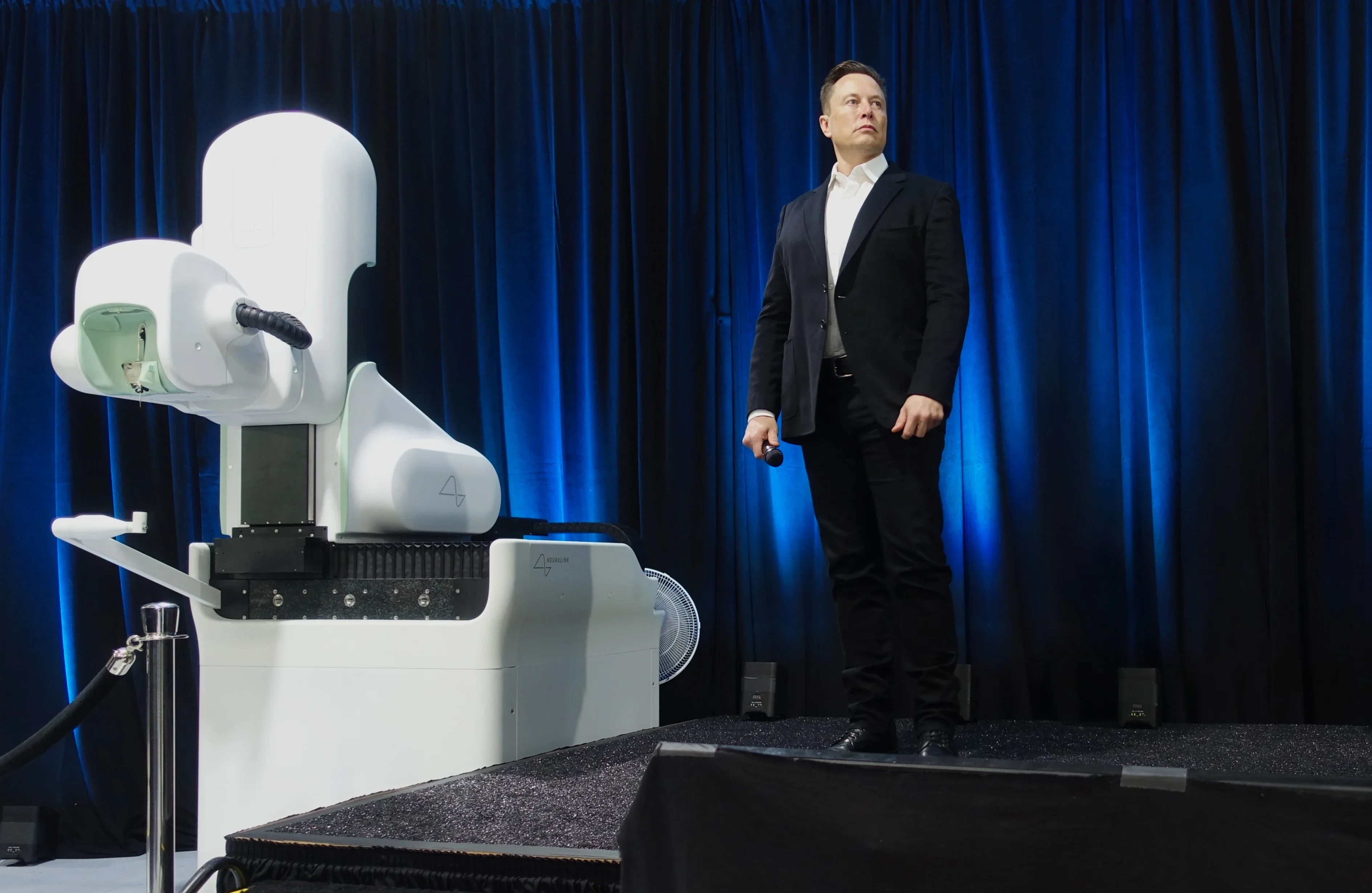
Elon Musk once again provoked a wave of reactions after stating that his company's "Neuralink" brain implants will be able to restore hearing to deaf people in the future. According to him, the technology, which is currently being tested mainly for controlling a computer with thought in paralyzed patients, will in the long term allow "restoration of senses such as hearing and vision". Such promises put "Neuralink" on the border between revolutionary medicine and overexpectations.
What is "Neuralink" and how the implant works
Neuralink is developing an invasive brain-computer interface – a miniature chip implanted in the cerebral cortex, connected to ultra-thin electrodes. The device records neural activity and transmits it wirelessly to an external computer, and in the more distant plans – it will also be able to "stimulate" specific brain areas with electrical impulses. The first publicly announced Neuralink patient has already demonstrated control of the cursor and games with just thought – an important step, but still at a very early stage.
In order to achieve hearing restoration, the implant must do an even more complex task: to send electrical signals to the auditory cortex of the brain, which are perceived as "sound" by the person. This implies not only recording, but also extremely precise "feeding" of information to the brain tissue, which in practice means artificially creating a neural code for sound.
Why the idea is not fantasy: a parallel with cochlear implants
Musk's statement does not come from nowhere – modern medicine already has a successful example of "electronic" hearing restoration: cochlear implants. They bypass the damaged hair cells in the inner ear and directly stimulate the auditory nerve with electrical signals, which the brain gradually learns to interpret as sound. For many hard-of-hearing and deaf patients, it is these devices that allow them to hear speech and sounds from the environment.
The difference is that the cochlear implant works at the level of the ear and nerve, while Neuralink targets the cerebral cortex. In theory, if the auditory nerve is destroyed or completely absent, in order to restore hearing, the only possible "input" is direct stimulation of the brain area responsible for processing sound. This is where Musk sees the prospect of Neuralink to upgrade existing technologies – by "bypassing" damaged peripheral structures.
What does "restore hearing" mean: different scenarios
When Musk talks about "restoring hearing", he does not specify what type of deafness he means. In medicine, several main forms are distinguished – conductive (problem in the outer/middle ear), neurosensory (damaged hair cells and/or auditory nerve) and central (damaged brain structures). In the first two categories, cochlear implants and future gene/cell therapies will probably remain a simpler and less invasive option than a brain chip.
The most radical scenario for Neuralink would be to offer a solution in cases where neither the ear nor the nerve can be used – for example, after severe trauma, tumors or congenital anomalies. But in these cases, the task is the most difficult: the brain may never have "heard" sound and the corresponding areas may not have developed in a typical way. Then "restoring hearing" would mean not just sending a signal, but learning the brain from scratch to work with a completely artificial auditory code.
Technological obstacles: from the laboratory to the real clinic
Although Neuralink is a media-recognizable project, the scientific community notes that so far the information about the details of the technology comes mainly from presentations, patents and a limited number of demonstrations, and not from long-term, peer-reviewed clinical trials. Most successful brain-computer interfaces that allow control of a cursor, robotic arm or writing with thought, are developed in academic and medical centers with similar principles – implantation of electrodes and decoding of brain signals.
Going from recording a signal to high-quality "inputting" of sensory information is much more difficult. It requires: a sufficiently dense grid of electrodes in the auditory cortex, safe long-term functioning of the implant (without rejection, inflammation and damage), stable wireless transmission of large volumes of data and complex algorithms that transform the sound wave into patterns of electrical impulses understandable to the brain. All this in real time and without serious side effects.
Ethical and medical risks: brain surgery is not a cochlear implant
Another big difference between Neuralink and established technologies is the degree of invasiveness. Cochlear implants require a complex but well-standardized ear surgery, while a brain chip involves microsurgical intervention on the cerebral cortex itself. This carries risks – bleeding, infection, neurological damage – that must be carefully balanced against the potential benefit.
In deaf patients, especially in children, ethical issues are even more acute. Treatment decisions are often made by parents, and the deaf community around the world has repeatedly expressed concern that the aggressive imposition of technological solutions may treat deafness only as a "defect", and not as a specific cultural and linguistic identity. With a brain implant that requires major surgery and long-term dependencies on the supplier company, these debates will become even more intense.
Regulations and real horizon: when "may" does not mean "is in the hospital"
Even if Neuralink shows experimental success in several patients, the path to mass-accessible therapy is long. Phases of clinical trials, proving safety and efficacy, approvals from regulators such as the US FDA and European agencies, clarity from whom will pay – the state, insurers or the patients themselves are needed. The history of medical devices shows that between the first "successful experiment" and routine clinical practice, 10–15 years often stand.
An additional question is accessibility: even if approved, such an implant will likely cost tens of thousands of dollars, and the expert teams able to implant and maintain it will be limited. This means that in the foreseeable future, the potential "restoration of hearing" through Neuralink, if realized, will be available to a very small portion of people and most likely first in the richest countries.
Marketing, vision or real medicine?
Elon Musk's statements about "restoring hearing" through Neuralink should be read on several levels. From a scientific point of view, the idea is not absurd – neuroscience has long shown that the brain can adapt to artificial stimuli, and the success of cochlear implants proves that electricity can replace damaged parts of the sensory pathway. From an engineering and clinical point of view, however, the path is much longer and more complex than it sounds in a short public statement.
For patients with deafness, this means that at the moment the most realistic options remain the existing medical solutions – hearing aids, cochlear implants, rehabilitation – and Neuralink is more of a vision for a more distant future than tomorrow's service in the hospital. If we ever see brain implants that really restore hearing in people for whom all other methods are exhausted, it will be a huge breakthrough. Until then, it is important to distinguish ambitious promises from really proven therapies – and to carefully monitor whether the "revolution" is happening in scientific journals and hospitals, and not just in presentations.
Comments (5)
Евала на Мъск! 🚀 Каква идея - да върне слуха на хората! Все пак, нека видим дали наистина ще стане нещо, а не само реклама. Важно е да има развитие
Бате, пичове, вие сички сте прав! 🤯 Neuralink наистина е нещо огромно, ама да сме реалисти - все още сме в началото на пътя. Илон Мъск е гений, няма спор, прави неща, които преди са звучали като научна фантастика, но трябва да гледаме и на двете – на възможностите и на рисковете.
Абе, хора, пичове! Четох новината за Neuralink-а на Мъск и аз съм яко впечатлен, ама сериозно! 🤯 Това да можеш да върнеш слуха на хората – все едно чудо! Представяте ли си?
Ей, здравейте! Четох коментарите и аз... Илон пак нещо готви, а? 😂 Хубаво е, че се опитва да решава проблеми, наистина. Само дето винаги има някакви уловки, нали така? Да не очакваме да стане като магия за един ден, а? Виж сега, технологиите вър
Абе, Мъск си прави каквото иска, ясно е. Дано не се окаже голям хаос в кра