

The extreme heat in 2026 is no longer a local phenomenon, but a global reality. Data from the "World Meteorological Organization" and national weather services show that average global temperatures during the 2026–2030 period are highly likely to remain at or above the 1.5°C threshold above pre-industrial levels. According to a forecast by the British "Met Office", the average global temperature in 2026 alone is expected to be about 1.46°C above 1850–1900 levels, with a range between 1.34°C and 1.58°C – the fourth consecutive year above 1.4°C.
Where the heat is most extreme in summer 2026
Europe is among the most affected regions. At the end of June 2026, "Western Europe" is in the grip of an intense heatwave, with thermometers exceeding 40°C in many places. According to "Météo-France", June 24 was the hottest day in France in the entire history of observations: the country's average temperature reached 29.97°C, with local values of up to 43.8°C recorded in Palluau (Vendée department). A day earlier, a record 44.3°C was measured in Pissos (Landes department).
In "Spain", the Spanish weather agency "AEMET" reports that June 22 and 23 are the hottest June days since at least 1950. In Andalusia – Andújar and Montoro – temperatures reached 45.1°C. In "Italy", a red danger level was announced for 17 major cities, and in the "United Kingdom", the June record was broken on June 24 – 36.1°C in Gosport (Hampshire).
Outside Europe, extreme heat is expected in the southern and western parts of "North America", "Central America", the "Caribbean", large parts of "North Africa", and "Asia". Analyses by climatologists, cited by international media, show that the most significant warming is likely occurring in the northern part of "South America", while widespread temperatures above normal are forecast in "Southern Africa".
The role of the "super El Niño" and the "heat dome"
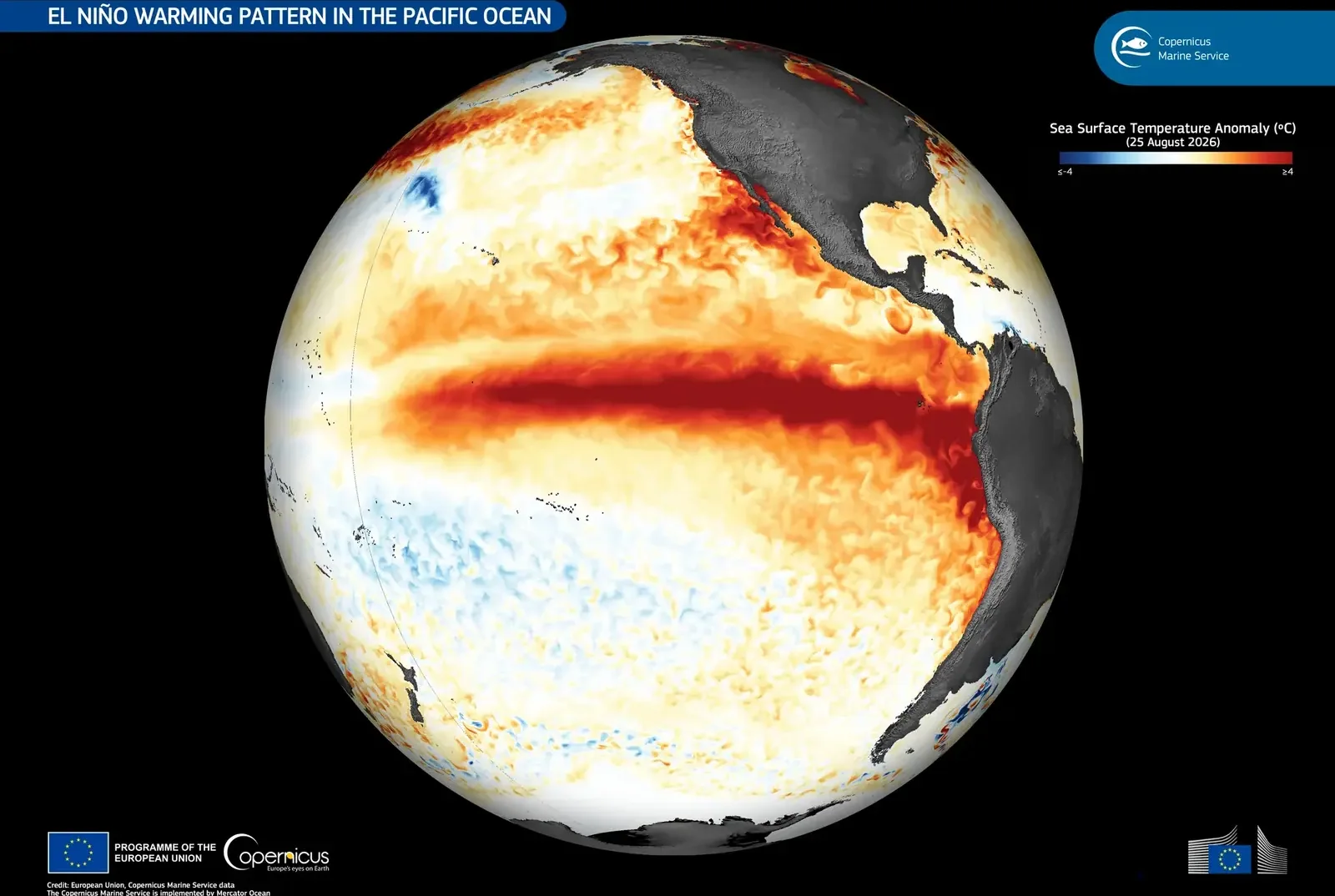
Climatologists link much of the extreme heat in 2026 to the "super El Niño" phenomenon – an especially strong phase of the natural climate cycle in the Pacific Ocean. Experts, cited by British and American publications, warn that the current occurrence could be one of the most powerful in recorded history. According to model calculations, the planet's summer average temperature could temporarily rise by up to 3°C above the climate baseline.
In Europe, the risk of forming a persistent "heat dome" is added to this – a strong anticyclone that traps hot air over a region for a long period. Seasonal models for summer 2026 show the probability of such a dome over Central, Southern, and Eastern Europe, with prolonged heatwaves, record temperatures, and drought. Bulgarian climatologists note that if this scenario materializes, "Bulgaria" could experience abnormally hot periods as early as June, with peaks in July and August.
When to expect the heat to ease
Regarding the specific question of "when the heat will ease", scientists are cautious. The "World Meteorological Organization" warns that it is "very likely" that average global temperatures will remain at or near record levels not only in 2026, but at least for the next four years. There is about a 75% probability that the average global temperature for the 2026–2030 period will exceed the 1.5°C threshold above pre-industrial levels and an 86% probability that at least one of the years between 2026 and 2030 will surpass 2024 as the hottest on record.
On a regional level, heatwaves are generally interrupted by the passage of atmospheric fronts that bring cooler air and precipitation. For Europe, meteorologists expect short-term cooling after every major wave – intervals of a few days to a week with lower temperatures, before the cycle repeats. Globally, however, permanent "relief" – meaning a return to significantly lower average temperatures – is not forecast within the current decade at current greenhouse emission levels.
Health and social consequences
Extreme heat has direct health consequences. European health agencies and the "World Health Organization" report hundreds to thousands of "excess deaths" during every major heatwave – primarily among the elderly, children, and people with cardiovascular and respiratory diseases. The heat leads to an increased risk of heatstroke, dehydration, heart attacks, and the aggravation of chronic conditions.
The heat also places a serious strain on infrastructure. In large cities, high temperatures combined with concrete and asphalt create "urban heat islands", where nighttime temperatures remain dangerously high. This increases electricity consumption for air conditioning, strains the grids, and raises the risk of power failures. In the agricultural sector, prolonged heat and droughts threaten harvests, especially in areas with limited water resources.
Forest fires are another direct consequence. Data from previous extremely hot years (2021–2023) show that in the Mediterranean and other sensitive regions, the areas affected by fires increase significantly, and the fire season lengthens. Although current data for 2026 is still being collected, climate models and the already recorded heat suggest that the risk of fires and drought will be high in large parts of Europe, North America, and Australia.
What this means for the future of humanity
Climate experts emphasize that the current extreme heat is not a one-time "anomaly", but part of a lasting trend of global warming linked to human activity. Analyses by international scientific consortia such as "World Weather Attribution" show that the majority of warming in recent decades is the result of greenhouse gas emissions – and that many of today's extreme heatwaves would have been "practically impossible" without this anthropogenic factor.
For humanity, this means a need for adaptation and damage mitigation. Cities must develop "heat action plans" – cooling centers, warnings, changes to work schedules, green spaces. Health systems must be prepared for surges in patients with heat-related problems. Energy and water systems need strengthening to withstand peak loads.
At the same time, scientists and international organizations continue to emphasize that without deep reductions in greenhouse gas emissions, extreme heat will continue to intensify. UN and national agency forecasts indicate that if warming continues at the current rate, periods like summer 2026 will become the "new normal", and the hottest years will continue to set new records. To avoid the worst-case scenarios, actions over the coming decades will be decisive – in energy, transport, agriculture, and urban planning.
In summary, the extreme heat in 2026 is both a warning and a test of societies' readiness to adapt. While scientists clearly state that rapid and permanent "cooling" is not expected, the question remains whether people and institutions will manage to change in time the way we live, work, and use the planet's resources.


Comments (13)
ааа, 2026... ама тва вече стана малко притеснително. добре де, да видим к'во ше стане. важното е да си па
Ебати, 2026... Ясно е, че глобалното затопляне си върви натам. Трябва да се подготвим за най-лошото, ама с надежда за
Бре хора, 2026?! Да бе, пак ли жеги? Тц тц... ама какво друго да очакваме след всичко това, а? Ясно е, че климата се променя, но все едно ни го казват за първи път. Важното е да си гледаме градиничките и да не се паник
Еее, ужас! 2026... Дано все пак се справят учените
Пич, 2026 ли? Сериозно ли?! Ама какво