
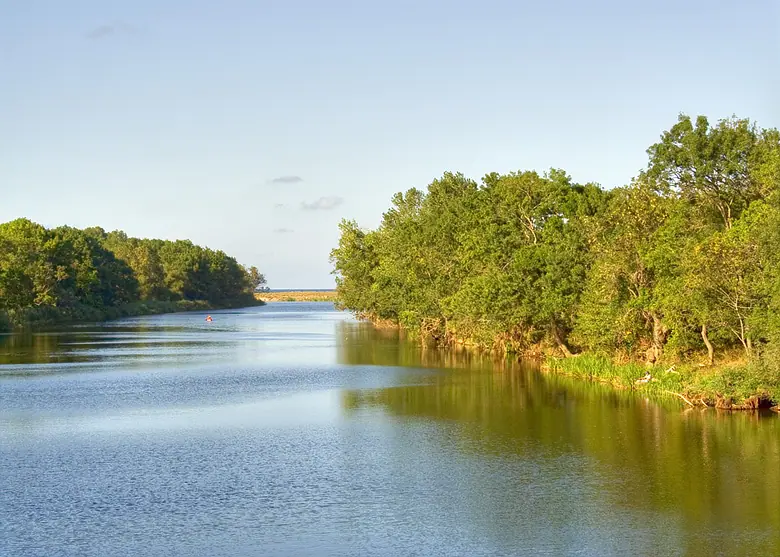
The Bulgarian Biodiversity Foundation (BBF) has found 52 possible river barriers on the Veleka and its tributaries and picked four to deal with first, the organisation said. The results were discussed at a workshop in the Business Incubator in Burgas.
The four sites are a weir near the village of Brodilovo in Tsarevo municipality, a threshold at the Kachul site, a weir near Moryane in Malko Tarnovo municipality, and a former mining structure on the Aydere river. Experts chose them after a full assessment.
Experts, officials and others affected talked about how to let water, sediment and aquatic life move freely along the river again. Spas Uzunov of the BBF presented the results of the project "Veleka Without Barriers: Identification and Assessment of River Barriers", backed by the Open Rivers programme.
The team checked 48 of the 52 sites on the ground and found 11 more possible barriers during field trips. So far, 26 structures have been mapped and assessed. Experts gathered data on their condition and on how they affect fish, sediment and the flow of the river. Local people and institutions also gave information.
The Brodilovo weir is a serious obstacle for migrating fish, and locals also go there to relax. The Kachul threshold is partly passable, and it is not clear whether it is linked to nearby water supply structures. The Aydere weir is about 4.5 m high and its fish pass does not work, so fish can hardly get over it. For the Moryane weir, experts note a strong effect on the river connection, as do earlier hydromorphological studies.
Uzunov said the choice does not automatically mean the structures will be removed. He said there are enough grounds for the next step to focus on these sites. It must first be clarified who owns them, what they are for and what condition they are in. Their legal status and how to restore the river connection also matter.
"When we talk about removing a river barrier, we are not simply talking about demolishing a concrete structure," Uzunov told BTA. He said every removal must be well studied and agreed, follow the law and take local people's interests into account.
In May, the foundation assessed 25 barriers on the Veleka and its tributaries Katun and Aydere after a three-day expedition. The team said then that many barriers were old, partly broken down or no longer in real use, but still disrupt the river's natural processes. The worst was the barrier under the bridge over the Aydere, on the Malko Tarnovo–Burgas road, where the fish pass is completely destroyed.
The BBF says experience on the Yantra, Arda, Lom and Struma shows that rivers can be freed. It takes a sound scientific basis, coordination between institutions, and talks with local people and those who use the rivers. The work on the Veleka is part of a European effort to have at least 25,000 km of rivers flowing freely.
The foundation will now update the data in the registers of the Black Sea Region Basin Directorate and look for the institutions responsible. If conditions allow, technical solutions will be discussed under current laws, with experts and with people who live and work along the Veleka.

Comments (0)
Все още няма коментари.