
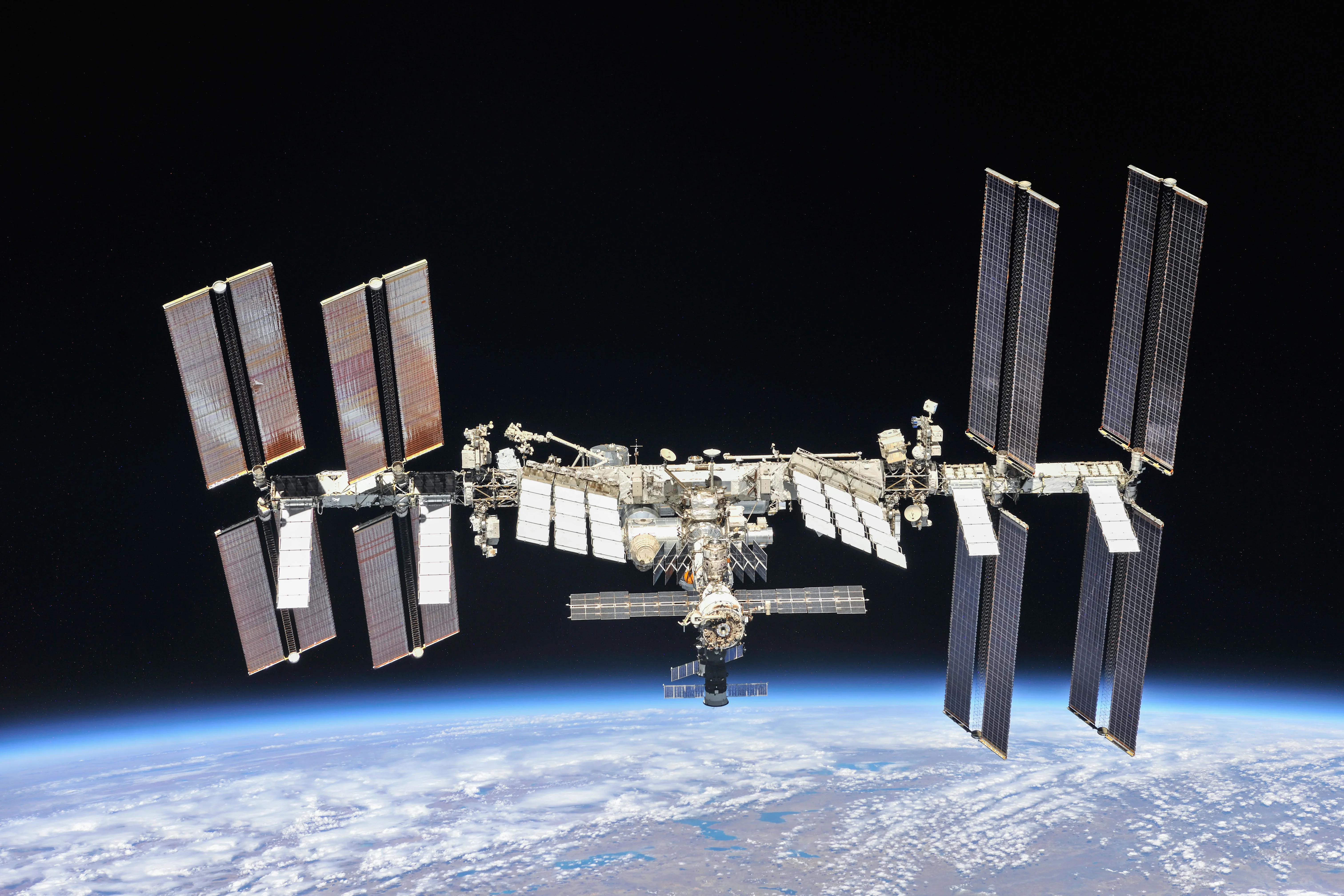
When we imagine life in space, we think of rockets, robots and spacesuits. We rarely think of the miniature "citizens" of each space mission - bacteria and fungi. And they do not travel alone, but in complex communities called biofilms - mini-cities of microorganisms, wrapped in their own protective "slimy" matrix. It is these biofilms that turn out to be some of the most interesting and at the same time problematic "passengers" of the International Space Station.
What the experiments in microgravity show
In recent years, a series of experiments have been carried out on the ISS and in ground models, which track how biofilms behave under microgravity conditions - real in orbit and simulated in laboratories. Projects are investigating how the density, thickness, structure and gene expression of these microscopic "colonies" change when gravity practically disappears.
The results are becoming clearer: in weightlessness, biofilms are not just a "copy" of the terrestrial ones, but often show a different architecture, a different growth rate and altered activity of genes associated with stress resistance and even antimicrobial agents. In some cases, they form thicker and healthier layers on surfaces, and in others - the structure becomes looser and more fragile.
Risk and opportunity: biofilms as a problem and as a tool
In a closed environment like the ISS, biofilms are a double-edged sword. On the one hand, their uncontrolled growth can damage vital systems - pipes, filters, surfaces in air and water control systems. Corrosion, blockages and microscopic "colonies" in the wrong place are a real technical risk. Some species can also become a health problem for the weakened immune system of astronauts.
On the other hand, biofilms are also a natural protective barrier - they can retain water and nutrients around the roots of plants, "push out" pathogenic microbes and help food crops survive with limited resources. Studies with so-called "endophytes" - beneficial bacteria and fungi in plants - show that such microscopic partners can help crops grow better even with less nitrogen and phosphorus, including in experiments on the ISS.
How weightlessness rewrites the genes of microbes
One of the most interesting discoveries is that in microgravity not only the shape of the biofilms changes, but also which genes are turned on and off. Analyses of gene expression show that in space, microorganisms often activate a set of genes associated with stress, resistance and interaction with the surface. In some experiments, a more active horizontal transfer of genes is also observed - exchange of DNA between microbes, including genes for resistance to antibiotics.
This means that in a closed environment, far from Earth, microbial communities can evolve differently than on the planet's surface. Not necessarily "more dangerous" in every case, but definitely more unpredictable if not carefully monitored. That is why the new missions rely heavily on metagenomics, transcriptomics and other modern approaches to monitor in real time what is happening at the genetic level in these mini-ecosystems.
The next step: purposeful "construction" of biofilms
Once it became clear that biofilms will exist in space anyway, some scientists began to look at them not only as a threat, but also as a resource. The idea is simple, but ambitious: instead of fighting chaotic microbial communities, we start "designing" them - selecting species and combinations that are safer for the crew and more useful for the ship's systems and plants.
This includes several directions:
- the choice of materials and surfaces that either limit harmful biofilms (e.g. specially treated metals), or support the desired microbial communities;
- creating "useful" biofilms to protect water and air systems from aggressive microbes;
- development of microbial consortia for plant roots to help improve crop growth in microgravity.
In some experiments, it is already being tested how different materials - from stainless steel to special antimicrobial surfaces - affect which biofilms develop and how. The data helps to choose more suitable materials for future stations and ships.
Why this is important for future missions to the Moon and Mars
The longer the missions become - to the Moon, Mars or deep space - the less "luxury" there will be for mistakes. We cannot endlessly replace damaged equipment or rely on constant supplies from Earth. At the same time, astronauts will need fresh food, a stable water and air system, and an environment in which the risk of infection is minimal.
Biofilms - if left uncontrolled - can undermine all of this. But if well understood and "tamed", they can become invisible allies: to retain moisture around the roots of plants, to release nutrients more slowly, to block pathogens and to protect key surfaces from corrosion and contamination.
Micro-worlds that decide the fate of major missions
At first glance, the topic of biofilms sounds like something distant and purely scientific. But behind it lies a very human question: how to make people live long and safely far from Earth? The answer lies in the recognition that we will never travel alone - we will always carry microscopic companions with us.
Today, scientists are learning not just to endure them, but to manage them. To observe how microgravity changes the structure, genes and resistance of biofilms - and step by step to start "constructing" micro-worlds that will work for us, not against us. Ultimately, the future of spaceflight may depend not only on the big rockets, but also on the invisible cities of bacteria that we build together with them.

Comments (3)
абе, интересно звучи, разбира се... ама наистина ли са толкова напреднали нещата? честно казано, малко ми се струва твърде оптимистично да си "дизайнират" микрообщности за защита. как гарантираме, че тези биофилми няма да станат проблем сами по себе си в дългосрочен план? и как ще се справят с
Ахахаха, да бе, "преконструират" микросвета... Все едно си играем на Minecraft в космоса! 🤣 Наистина е интересно, ама аз се замислих - а ако тези биофилми мускулисат и решат да си прават собствен свят там горе? Представям си един сценарий: астронавтите са си мислели, че ги пазят, а те – микробите – вече са си построили космическа цивилизация! 👽
Абе, хоря, чудесна новина, наистина! Ама виж сега – всички се кефим как ще "дизайнираме" микросветче в космоса... да пазят астронавтите и растенията. Ясно, науката е яко нещо, ама не мислите ли, че малко прекаляваме с терминологията? "Преконструират"? Звучи като някой да строи небостъргач от бактерии!