
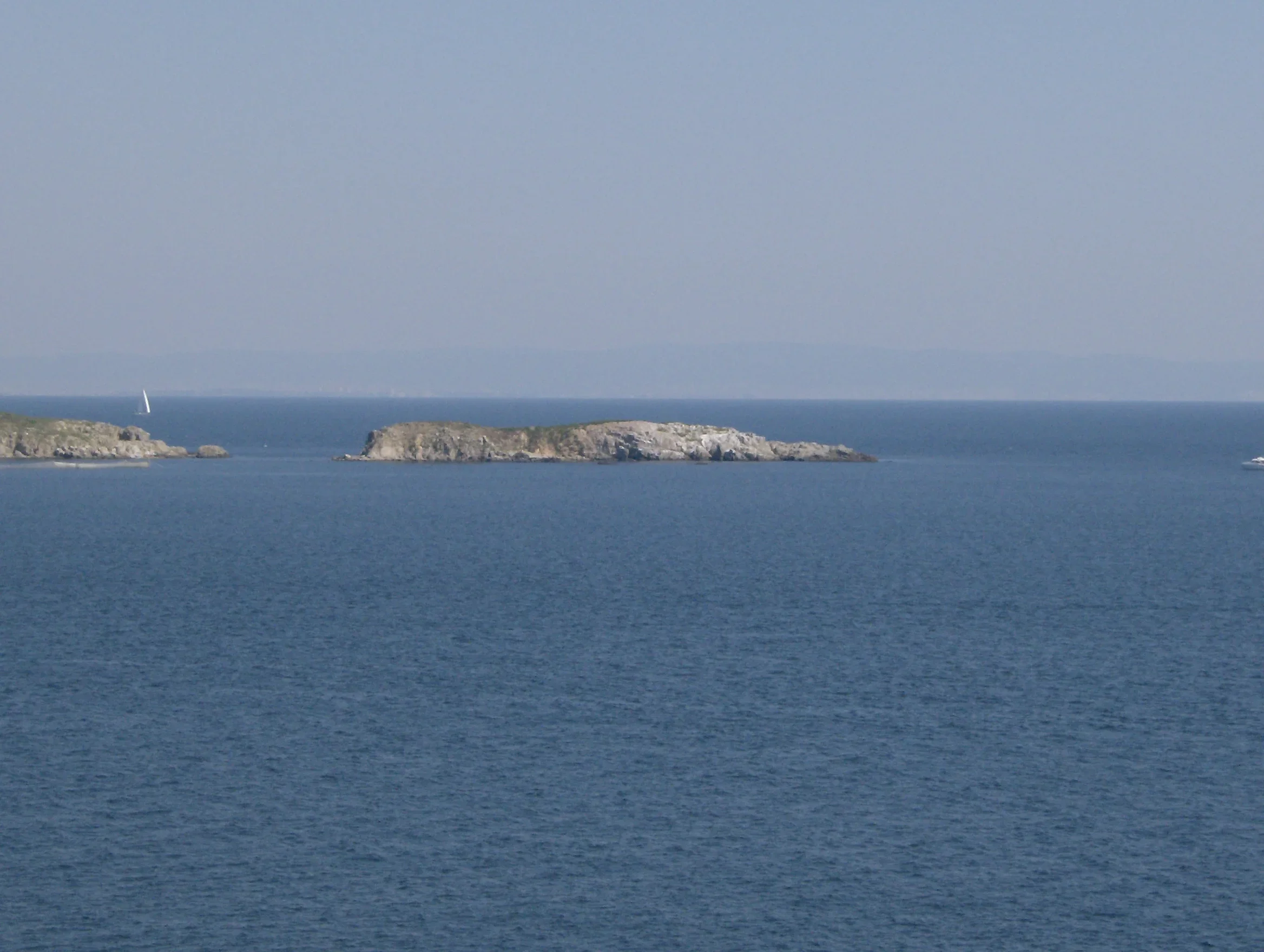
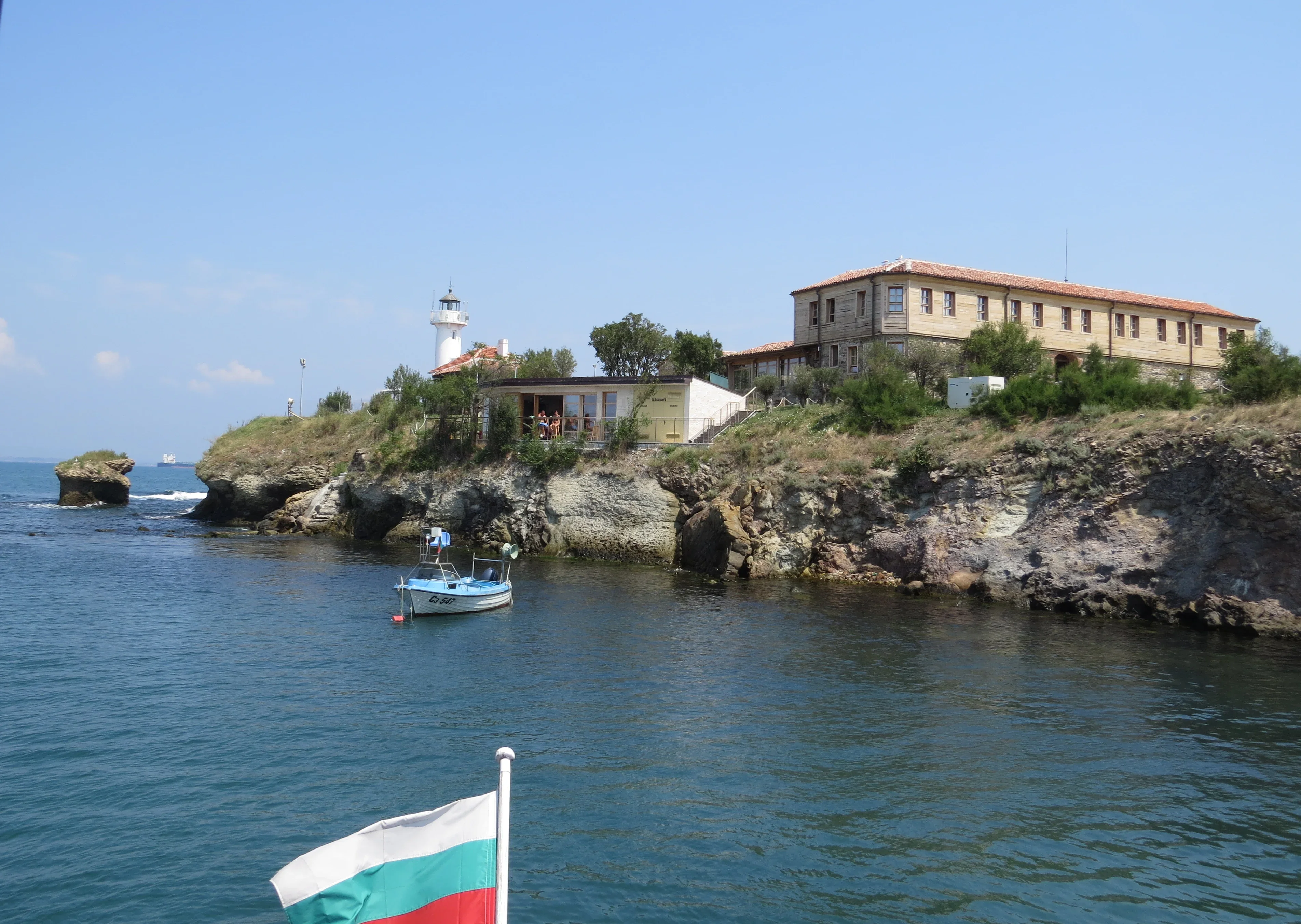
St. Peter Island is one of the smallest yet most colorful islands in the Bulgarian territorial waters of the Black Sea. Located in the Sozopol bay, in immediate proximity to the larger St. Ivan Island and the Stolec peninsula (the old town), it impresses with an area of only about 15 decares, an altitude of up to 9 meters, and the nickname "island of the birds," which it owes to its numerous feathered inhabitants and the white rocks colored by them.
Geographic location and status
St. Peter Island is located in the southern part of the Bulgarian Black Sea coast, within the borders of the Sozopol bay, about 2 kilometers from the city center and approximately 50 meters east of St. Ivan Island. This makes it part of the small "archipelago" of three nearby islands – St. Ivan, St. Peter, and the more distant St. Toma.
According to international legal criteria, the island falls entirely within the Bulgarian territorial waters – the 12-mile zone, in which Bulgaria exercises full sovereignty over the waters, the seabed, the subsoil, and the airspace. Although small and uninhabited, St. Peter participates in defining the base lines and maritime spaces of the country, along with the other Black Sea islands.
The "Island of the Birds" and the white rocks
The most distinctive visual characteristic of the island is the whitish color of the rocks, which brings it the figurative name "island of the birds." The reason is not a special mineral composition, but the fact that thousands of birds – seagulls and other marine species – use the island for rest and nesting, and their droppings cover the rock masses with a characteristic white layer.
Due to its uninhabited nature and limited access, the island serves as a natural sanctuary for birds in the area. This makes it an interesting object for both ornithologists and wildlife enthusiasts, although there is currently no developed permanent tourist infrastructure on the rock itself.
Origin: separated from St. Ivan after a natural disaster
An interesting feature of St. Peter is that it is not mentioned in written sources until the second half of the 19th century. This leads scientists to assume that in the past it was part of the larger St. Ivan Island and separated as a result of geological processes and rising sea levels over the last two millennia.
Geological studies indicate that about 2,500 years ago, today's St. Ivan and St. Peter islands formed a single common island, which was eventually "severed" by the sea. This also explains the fact that archaeological finds on St. Peter are concentrated in relatively narrow areas, while the rock itself is relatively "young" as an independent island.
Archaeological discoveries: a coastal sanctuary from the 5th century BC
Until 2020, practically no systematic archaeological studies were conducted on St. Peter. The situation changed at the end of the same year, when a team of archaeologists carried out several drillings on an area of 66 square meters in the eastern part of the island and, for the first time, revealed structures of a cult nature.
The results show the presence of a coastal sanctuary, dated to the end of the 5th century BC. The ritual established by the researchers includes the accumulation of small mounds of imported soil, covered with small stones – a typical sign of cult practices in the coastal areas of ancient poleis. The ceramic fragments found and the lack of later layers suggest that the sanctuary functioned in a relatively narrow chronological interval.
No traces of a temple, chapel, or church
Despite legends and assumptions, archaeologists have not found any remains of stone masonry that could be linked to a temple, chapel, or larger church on the island. This distinguishes St. Peter from neighboring St. Ivan, where there are well-documented monastic complexes and temple architecture.
The lack of such structures supports the thesis that the island served more as an "open" sacred territory – a coastal sanctuary with ritual mounds – rather than as a place for a permanent cult center with monumental buildings. This makes it an important element in the mosaic of religious sites located around ancient Apollonia.
Uninhabited island with limited access
Today, St. Peter is uninhabited, without permanent buildings, electrification, or water supply. There is also no official port infrastructure – small boats can only approach in calm seas, and docking is hindered by the rocky shore and poor protection from swell.
This, on one hand, limits mass tourism, and on the other – creates natural protection for nature and archaeological structures. Visits are usually carried out within the framework of scientific expeditions or as short boat trips, without long stays on the island.
Part of the "family" of Bulgarian Black Sea islands
There are a total of seven Black Sea islands in Bulgarian territorial waters, and none of them is permanently inhabited. St. Peter is among the smallest by area, but along with St. Ivan, St. Toma (Snake Island), and St. St. Kirik and Julita, it forms a core of island objects with high cultural and natural value.
This group of islands is important not only for national identity and tourism but also for delineating maritime borders, defining the exclusive economic zone, and managing marine resources. In this sense, even small rocks like St. Peter participate in the large geopolitical and ecological picture of the Black Sea.
Potential for scientific and specialized tourism
Although St. Peter is not suitable for mass beach tourism, the island has serious potential for the development of scientific, educational, and specialized tourism – ornithological observations, archaeological practices, geological and ecological studies.
Carefully planned access – with a limited number of visitors, clear rules, and minimal interference in the natural environment – could turn the small island into a kind of "living laboratory" for the Black Sea. Thus, St. Peter can preserve its wild character, but also become a place where science and curiosity about history and nature go hand in hand.
Comments (0)
No comments yet.