
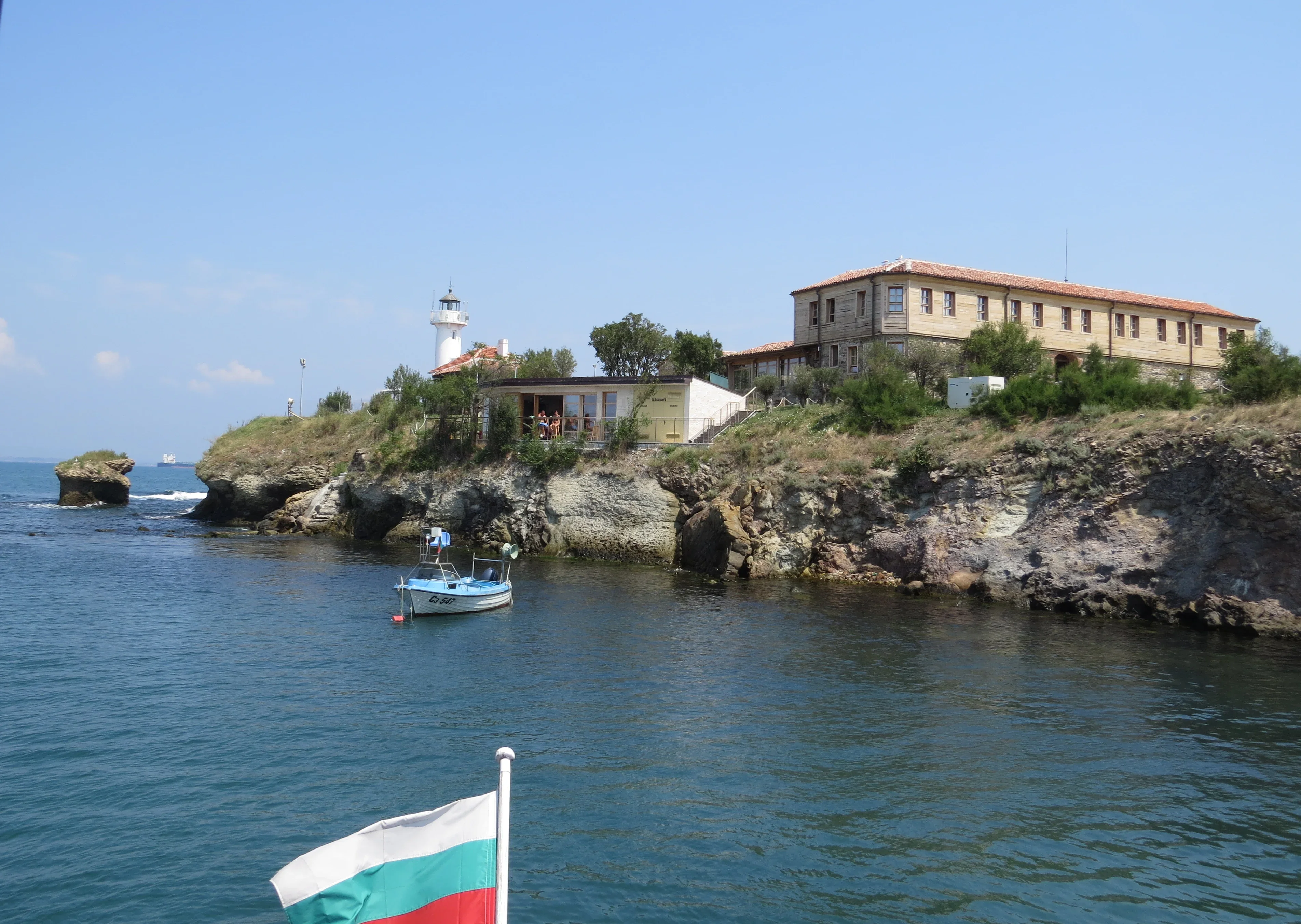
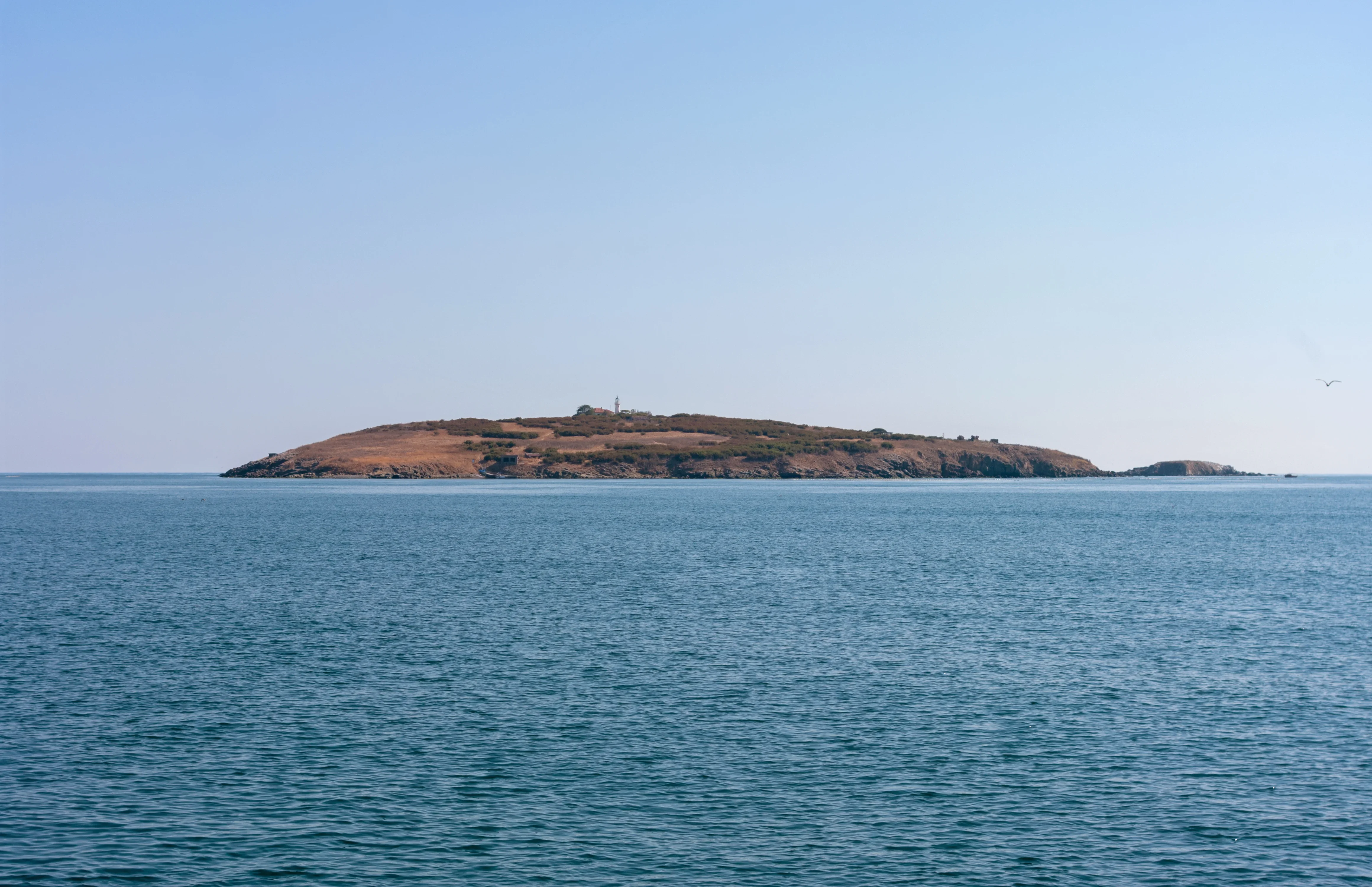
St. Anastasia Island is one of the most recognizable symbols of the Bay of Burgas and a unique site for the Bulgarian Black Sea coast. Located about 6–7 kilometers southeast of Burgas, it is the only officially inhabited sea island in Bulgaria – a compact volcanic rock with an area of about 9 decares, a height of up to 12–17 meters, and a densely saturated history that combines a monastery, a prison, legends of pirates, and a modern cultural and tourist center.
Geography and natural features of the island
"St. Anastasia" is located in the central part of the Bay of Burgas – the largest bay on the Bulgarian Black Sea coast, between Cape Atiya and Cape Chukalyata. The area of the island is about 0.022 sq. km (approximately 8.5–9 decares), and its average altitude is about 12 meters, reaching up to 17 meters in some places.
The island is made of volcanic rocks, modeled by the sea into whimsical shapes. Several characteristic rock phenomena with folk names have formed along its shores – "The Mushroom", "The Dragon", and "The Petrified Ship". These natural "sculptures" are among the most photographed objects by tourists and contribute to the specific, almost fairy-tale atmosphere of the island.
Historical layers: from late antiquity to modern times
The earliest human presence on St. Anastasia Island is attested as early as late antiquity – around the 4th–6th century. Archaeological finds from this period show that the rock was used as a strategic point in the bay's water area, likely in connection with maritime routes and the defense of the region.
During the Middle Ages, a monastery complex dedicated to "St. Anastasia Pharmakolytria" – "the deliverer from suffering" – was formed on the island. The monastery became a spiritual center for the area, and the name of the saint remains as the main toponym to this day. During the Ottoman period and after the Liberation, the monastery was repeatedly expanded and rebuilt, with some of these structures preserved and used to this day.
Island-prison: the "Bolshevik" period
One of the darkest periods in the island's history is associated with the years after 1923. In the 1920s, part of the monastery buildings were converted into a prison for political opponents of the government. In 1924, a concentration camp was officially established, where oppositionists and communists were sent.
Later, after World War II, between 1945 and 1990, the island bore the name "Bolshevik" – a symbolic reflection of the political change. Stories about the harsh regime, escape attempts, and repressions from this period are now part of museum exhibitions and tours dedicated to the "island-prison".
Legends and the "petrified pirate ship"
Like many maritime places, "St. Anastasia" is overgrown with legends. One of the most popular tells of a pirate ship that attacked the island in search of gold treasure guarded by the monks. According to the tradition, when the pirates invaded, the monks locked themselves in the church and prayed to the saint to save them.
The legend says that "St. Anastasia" sent a terrifying storm that sank the pirate ship, and its remains "petrified" into the rocks near the shore. Thus, the rock phenomenon "The Petrified Ship" was born, which is still pointed out by tour guides today as "proof" of the miracle. Legends of dungeons and hidden passages under the monastery complete the mystical image of the island.
The only inhabited sea island in Bulgaria
Today, "St. Anastasia" has a unique status – it is the only inhabited island in Bulgarian sea waters. Its territory includes a small complex with restored buildings: a church, former monastery cells turned into a guest house, a restaurant with seafood, an herbalist shop (apothecary), and a museum exhibition.
Officially, the island is a cultural and historical landmark, and its management is carried out in partnership between the Municipality of Burgas and the Bulgarian Orthodox Church. Part of the monastery complex functions as an interactive museum dedicated to the island's history, the prison, and the maritime traditions of the region.
How to get to "St. Anastasia" and how much the trip costs
The island can only be reached by sea – with the municipal ship "Anastasia" or with licensed private vessels. The sailing from the Port of Burgas to the island takes about 30 minutes, and the route starts from the tourist center near "Magazia 1" or from the "Bridge" in the Sea Garden, depending on the season and schedule.
Traditionally, the price of a round-trip ticket for adults is in the range of about 15–20 BGN, and discounts are offered for children and groups. During the summer season, regular lines operate several times a day, and advance reservations are recommended due to the limited number of seats and high interest, especially on weekends.
Tourist infrastructure and services on the island
Despite its small area, "St. Anastasia" has well-developed tourist infrastructure. The island has a "bistro" style restaurant with a menu based on fish and traditional Burgas dishes, a cafe, a small shop for souvenirs and herbs, as well as a guest house where tourists can stay overnight in adapted monastery cells.
The monastery church is active and welcomes worshippers and visitors, and the museum section offers exhibitions about the various historical periods of the island. Thematic events are organized – literary readings, concerts, theatrical performances, and festivals that turn "St. Anastasia" into an active cultural center, and not just an "open-air museum".
Nature, ecology, and an "island with a mission"
The island is extremely sensitive to stress due to its limited area and specific ecosystem. The vegetation is typical for dry rocky habitats – low shrubs, wild herbs, fig trees, and grass formations adapted to sea winds and salty air.
Local authorities and environmental organizations emphasize that an excessive number of tourists can lead to erosion, pollution, and damage to plant and animal species. Therefore, work is being done on a concept for sustainable tourism – with limited groups, clear tourist routes, a ban on camping, and waste control. "St. Anastasia" is often cited as an example of how nature and tourism can coexist if rules are followed.
Cultural and economic effect for Burgas and the region
The transformation of "St. Anastasia" into a tourist and cultural site over the last decade has had a tangible effect on the tourist profile of Burgas. The island attracts tens of thousands of visitors annually – both Bulgarian and foreign tourists, who combine their stay in the city with a day or half-day excursion by sea.
This leads to additional revenue for local businesses – from restaurants and hotels to travel agencies and cultural initiatives. At the same time, "St. Anastasia" strengthens the identity of Burgas as a seaside city with a characteristic cultural face, and not just as a transport and industrial center on the coast.
The island as a "visiting card" of the Bay of Burgas
Today, "St. Anastasia" is much more than a geographical point in the Bay of Burgas. It is a kind of visiting card of the city – a place where the history of the monastery, memories of the prison, pirate legends, the seascape, and modern tourism intertwine into a single narrative.
The challenge for the coming years will be to preserve this balance – between the growing interest of tourists, the need for economic development, and the fragile nature of the small volcanic island. If this balance is maintained, "St. Anastasia" will continue to be not just an attraction, but living proof that even 9 decares of rock can carry great history and meaning.
Comments (0)
No comments yet.