
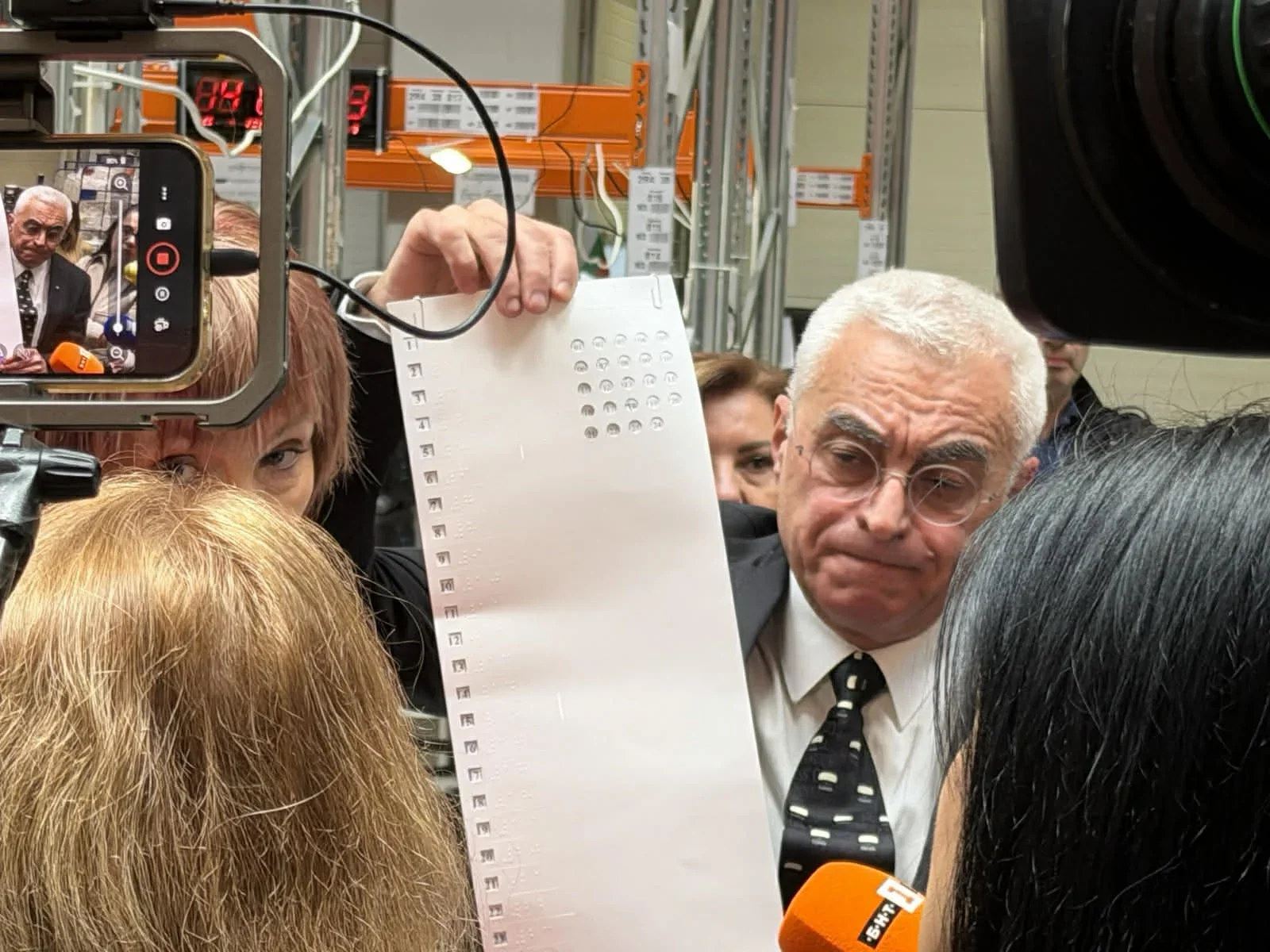
At a media event in the warehouse where the voting machines are being prepared for the early parliamentary vote on April 19, 2026, the Deputy Chairman of the Central Election Commission, Rositsa Mateva, and the Minister of Electronic Governance, Assoc. Prof. Georgi Sharkov, presented the new tactile template for visually impaired voters, which will be used in these elections.
The template was developed by the Ministry of Electronic Governance at the direction of the CEC, after the department already provided QR codes for visually impaired voters, through which they can get acquainted with the candidate lists in advance.
"We managed to move the accessibility of the electoral process more in less than a month than in the previous 20 years," said Minister Sharkov. "We want to show that we are thinking about people with disabilities and are taking real steps to help them exercise their constitutional right to vote informed, independently, confidentially and with dignity. It is wonderful that the CEC and I were of the same opinion on this issue and managed to prepare not one, but two solutions for the visually impaired in an extremely short time."
Pilot introduction in five districts
Tactile templates will be provided on a pilot basis for five electoral districts – the three districts in Sofia-city, Plovdiv-city and Blagoevgrad. Due to the short production deadlines, a total of 400 templates will be delivered – one for each section in these districts. The templates are reusable, do not represent securities and are not treated and stored as ballots.
What the Braille template looks like
The Braille templates are made of thicker glossy paper based on the sample of paper ballots. They completely cover the ballot, and after voting, it is separated from the template, folded by the visually impaired voter and put into the ballot box independently, without the template.
At the top of the Braille template, the number of the electoral district is written. In the middle, a relief vertical line passes, which logically divides the part with the candidate lists of the parties from the one with the candidates for preferential vote – as it is on the paper ballot.
On the left vertical, squares are cut out that exactly match the squares with the numbers of the parties and coalitions in the ballot. Next to each square on Braille, only the number of the party or coalition is marked, as there is not enough space to write the names. The last square, as in the paper version, is for "I do not support anyone" and is written entirely in Braille.
On the right is the segment for the preferential vote. As in the ballot, here, too, the candidates are represented with circles in which the visually impaired can mark their choice. There are a maximum of five circles on each line, and on the left of the line, the number of the first circle is indicated – for example, if the circles are 101, 102, 103…, the Braille text next to the line is "101".
Different variants of the template were tested with visually impaired citizens both during production and after the design was finalized.
Logistics and distribution by place
No later than Saturday, April 18, the printing house will provide transport of the finished templates to the respective regional governors. From there, they will be handed over to the district election commissions, which will distribute them to the section commissions in the five included districts.


Comments (6)
Хм... Ето сега видях новината. Наистина радващо нещо. Макар че 400 секции са малко, това е началото. Важно е да показваме, че България се развива
Абе, сериозно ли? Най-накрая нещо свестно от тия нашите политици! 400 секции обаче... наистина ли толкова ли е всичко? Дали
абе, хора, мн ми хареса новината, наистина! всеки трябва да има възможност да гласува свободно и независимо, а за хората с увреждания е още по-важно. браво на всички, които са се заели с това!
Хм, добре де… Макар и малко, пак е стъпка напред
Абе пичовееее, тва вече си е яко!!! 🤩 Не мога да повярвам, че най-накрая правим нещо наистина полезно за хората с увреждания! 400 секции?! Дааа, ама трябва още! Искам навсякъде да има тактилни шаблони и QR кодове – всеки трябва да може да гласува свободно и да се чувства уважаван! ❤️