
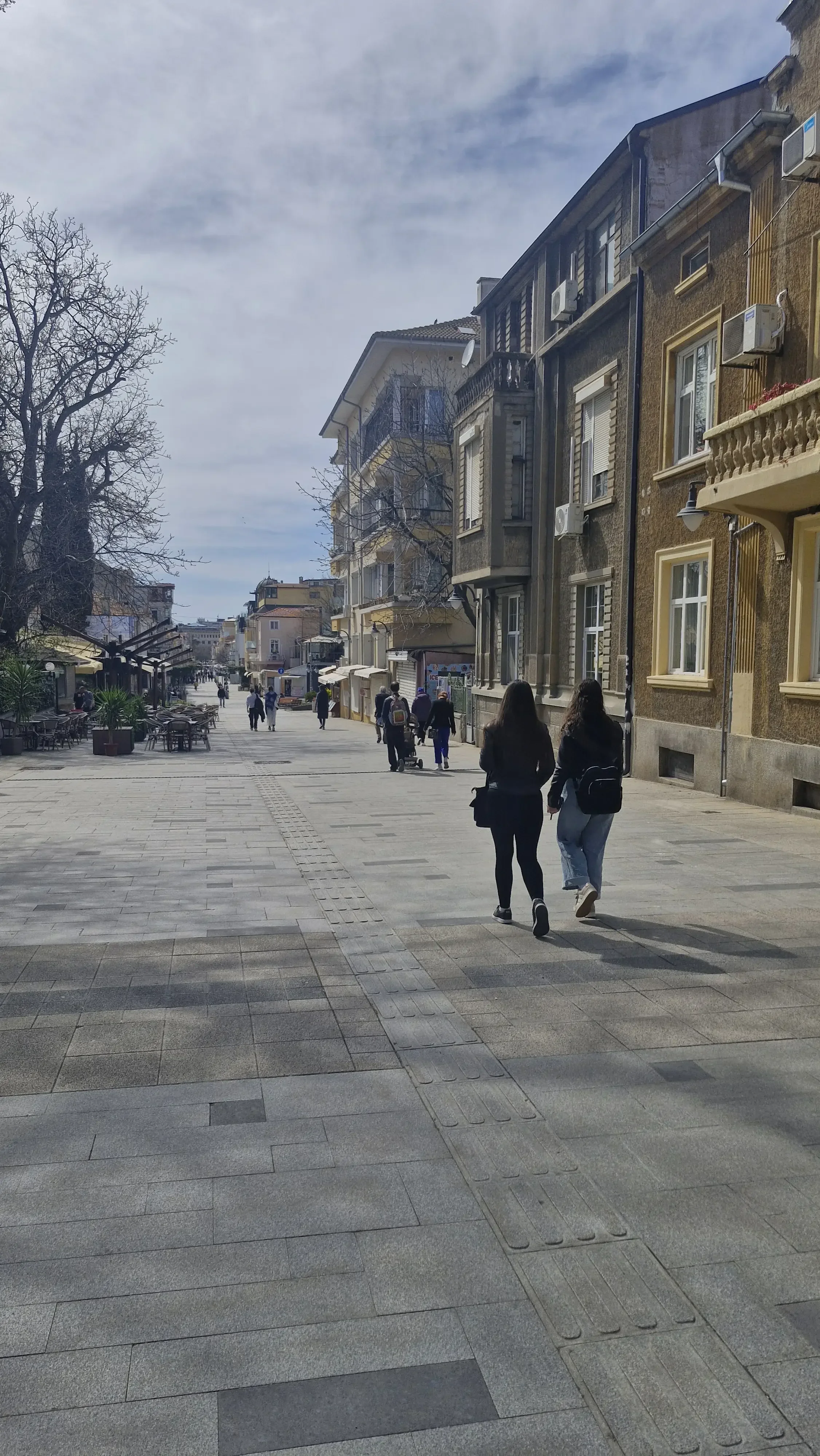
A chance observation during an experiment at the height of the COVID-19 pandemic led to an unexpected discovery about the way we move. Scientists found that humans have an innate tendency to move "counter-clockwise" when walking – a trend that manifests regardless of "cultural background", "gender", or whether a person is "left-handed" or "right-handed".
Accidental discovery in a social distancing experiment
The results of the study, published in "Nature Communications", were born as a byproduct of a project originally aimed at how pedestrians maintain "social distancing". A team from the "University of Navarra" in Spain was analyzing video footage of participants moving indoors when they noticed a striking pattern: in "32 out of 33" experimental trials, people preferred to move "counter-clockwise".
"Analyzing the experiments, my colleagues discovered quite by accident that in 32 out of 33 trials, when people were moving and turning, they clearly preferred counter-clockwise turns," says associate professor "Claudio Feliciani", who was working at the time in the Department of Aeronautics and Astronautics at the "University of Tokyo". "This was completely unexpected, because intuitively, when people move randomly, you imagine they turn however is comfortable for them, without any clear general preference."
Testing the hypotheses: culture, gender, handedness
Intrigued by the observed pattern, the scientists from the "University of Navarra" contacted colleagues from "Japan" to check if the effect was specific to a certain country or cultural context. Together, they developed a series of new experiments in different conditions, with variable "group sizes" and diverse "demographic characteristics" – in both Spain and Japan.
The result proved remarkably robust: the preference for moving "counter-clockwise" persisted, regardless of whether participants were moving alone or in a group, and regardless of whether they were "men" or "women", "left-handed" or "right-handed". The only factor that had a tangible influence was "age". "In children, the preference for moving counter-clockwise is more pronounced, so it seems that age influences how strong or weak this effect will be," notes Feliciani.
Ruling out visual and physical explanations
The researchers also tested the role of vision, as in separate experiments they "covered the left or right eyes" of the participants to see if visual perception could tilt movement in one direction. The results showed that this was not a decisive factor – the preference for moving "counter-clockwise" remained, regardless of which eye was covered.
Some physical hypotheses were also rejected, including the influence of the "Coriolis force" or the "Earth's magnetic field". Based on the available data, scientists assume that these factors are unlikely explanations for the observed effect, which directs attention to deeper biological and biomechanical reasons.
Biomechanical mystery: the asymmetric human
The final mechanism behind this innate inclination is not yet fully understood, but the team believes the key lies in the fundamental characteristics of human biology. "None of us are perfectly symmetrical, and the way each person's brain processes sensory information and coordinates it with muscle movements, in all likelihood, tilts us slightly in one direction," explains Dr. "Iñaki Echeverría Uarte" from the "University of Navarra".
More detailed experiments with "individual participants" rather than just groups are planned to identify the specific biomechanical mechanism – whether it is related to the "vestibular system", "muscle tone", "micro-asymmetries in the skeleton" or other factors. Only after such studies will it be possible to discuss a definitive explanation.
Practical applications: from urban environments to sports tracks
Although it may seem like a curious detail, the discovery has potential applications in "architecture", "urban planning", and "crowd management". If people have a natural slight preference for moving "counter-clockwise", this could be taken into account in the "design of pedestrian zones", "evacuation exits", and "corridor layouts" in public buildings to reduce the risk of congestion and chaos.
The researchers note that this could also explain a long-observed but rarely analyzed practice: why "sports tracks" are traditionally designed in a "counter-clockwise" direction. If human biomechanics truly "prefers" this vector of movement, then such track arrangements are not just a historical accident, but an intuitive adaptation to the body's natural inclinations.


Коментари (10)
Ех... ама наистина ли всичко трябва да го доказват по научен начин? Да не ни кажат сега, че е ген
Абе, сериозно ли?! Щот ако не беше, щеше да го ка
Ама наистина ли?! Щот да си вървиш само направо - к'во ще стане? 😂 Аз съм го усещал от малък!
Абе тоя свят изобщо спрял ли се е да си мисли?! 😂 Сега и ходенето имат "вродена" посока? Да бе, значи ли, че ако започна да се вървя от дясно, ще ме лекуват? 🤦♂️ И к
Ебати циркове! 🤣 Сега ще трябва и за това да има финансиране от ЕС, нали? За да докажат, че се