
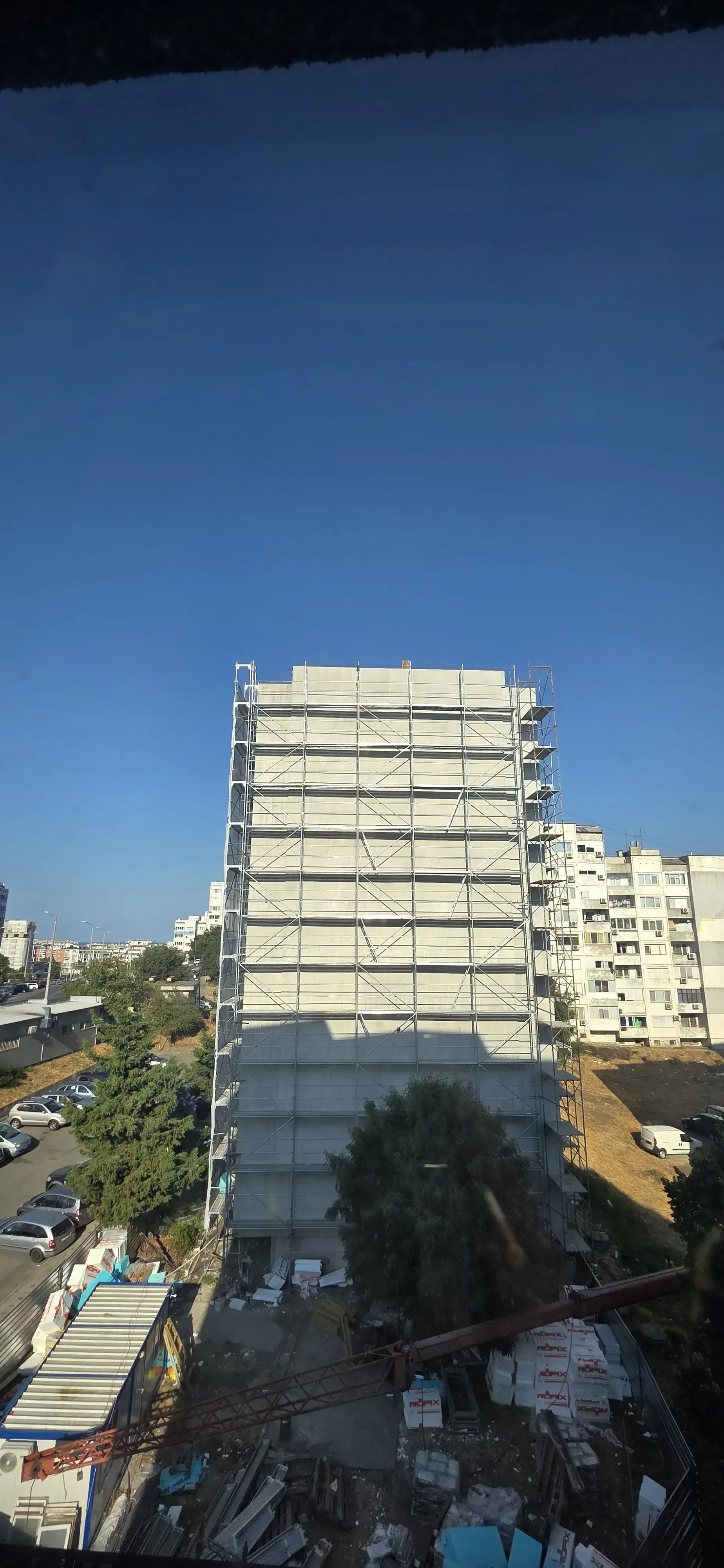
March 2026 finds the construction sector in the European Union in a situation of cooling activity, high interest rates and rising financing costs. While some countries are reporting a decline in permits issued and a delay in new projects, in Bulgaria construction is moving on a "double track": against the background of weaker housing construction, energy renovation programs are accelerating and the pressure for higher energy efficiency is becoming a leading factor for the sector.
EU and the Eurozone: PMI below 50, signal of contraction
The Construction Purchasing Managers' Index (Construction PMI) in the Eurozone in March 2026 fell to around 44.6 points compared to 46 in February. A value below 50 means a contraction in activity, and the March data confirm that construction has remained under pressure since the end of 2024. Econometric models suggest that by the end of the second quarter, the index could return to levels around 49.5 points, but without a clear transition into a zone of growth.
Parallel data on construction volumes in the Eurozone for the first months of 2026 show a decrease of 1.9% year-on-year in January – the most serious decline since the autumn of 2024, after a revised growth of 0.7% in December. The impact is strongest on housing construction and part of civil construction, while specialized construction activities (installations, finishing works) are contracting less.
The picture across the EU remains uneven. Some countries in Central and Eastern Europe – Austria, Romania, Czech Republic – reported monthly growth in construction output in 2025, while southern countries such as Portugal and Slovenia, as well as Poland, recorded more serious declines. March 2026 rather confirms this fragmented picture than brings a turnaround.
Bulgaria: between weaker housing construction and a boom in renovation
In Bulgaria, March 2026 finds the construction sector in transition. After years of rapid growth in housing construction, fueled by low interest rates and strong demand in large cities, a cooling has been observed since the end of 2024 and throughout 2025 – fewer new building permits for residential buildings and more cautious behavior on the part of investors and buyers.
In parallel, however, energy efficiency policies and European funding are pushing forward the building renovation segment. In March 2026, the Ministry of Regional Development and Public Works is presenting the National Plan for the Renovation of the Building Fund by 2050 – a strategic document that envisages the phased improvement of the energy characteristics of the residential and public building fund, including new requirements for designers and builders.
Thus, the portfolio of construction companies is increasingly shifting from "green fields" – new neighborhoods and complexes – to "brown" projects: thermal insulation, replacement of installations, doors and windows, renewable energy systems, repair of common areas. For companies, this means a different revenue structure, smaller but more numerous sites and more intensive work in the urban environment.
Stricter norms: energy efficiency is no longer a formality
In 2026, the Bulgarian construction sector is operating in conditions of a gradual tightening and refinement of the regulatory framework. The changes do not come as a single new code, but as a series of corrections to the requirements for energy efficiency, fire safety, accessible environment and administrative procedures. Their effect is felt directly in the deadlines, the budget and the design method.
One of the most noticeable changes is the increased control over the energy characteristics of buildings. Energy models and calculations are no longer a formal application to the project, but a real verification tool. This requires a more careful selection of facade systems, doors and windows, heating and ventilation installations already at the conceptual phase. For investors, this means higher initial costs, but also better chances for their sites to meet future standards, without the need for expensive renovation in a few years.
In parallel, the requirements for fire safety are also being updated – not only in terms of materials, but also of functional schemes: evacuation routes, separation of fire sectors, ensuring access for fire equipment. Increasingly, these requirements lead to changes in the distributions, corrections in the projects and additional coordination between architects, engineers and supervision.
Administrative burden: longer preparation, less risk of stopping
Despite the introduction of electronic services, administrative procedures remain one of the most sensitive elements for the construction business in Bulgaria. In 2026, a tendency towards more detailed requirements in the approval of projects is observed – especially for more complex sites in the urban environment or near protected areas.
For companies, this means a longer preparatory phase and more work "at the desk" before the first sod is turned. At the same time, a more in-depth preliminary control reduces the risk of a site being stopped at a later stage due to omissions in the documentation or non-compliance with legal requirements. In the long term, this can bring more predictability – a key value for the sector, in which projects are often planned for years to come.
The pulse of the sector: "Architectural-Construction Week" 2026
In March 2026, Sofia is again hosting the "Architectural-Construction Week" – the largest specialized exhibition for construction and architecture in the country. From March 11 to 14, manufacturers of building materials, designers, contractors and investors gather at Inter Expo Center.
This year's edition focuses on modern facade systems, dry construction, energy efficiency and digital tools for designing and managing construction sites. The strong presence of international companies and Bulgarian companies with a focus on "green" technologies shows that the sector, although under pressure from high interest rates and stricter norms, is actively seeking the direction of development for the next few years.
What does all this mean for Bulgaria?
Against the background of the overall European slowdown, the Bulgarian construction sector is proving to be both vulnerable and with potential. On the one hand, more expensive financing and lower demand for housing are cooling the "hot" markets in Sofia, Plovdiv, Varna and Burgas. On the other hand – national and European programs for energy renovation, infrastructure projects and increased requirements for quality and safety open new niches for companies ready to invest in competence and technology.
In order to remain competitive within the EU, the Bulgarian construction sector will have to move from a model based primarily on volume and low cost to a model in which energy efficiency, sustainable materials, digitalization and better planning are key. March 2026 shows the first clear contours of this transition – and on how quickly and qualitatively it will be made, depends the place of Bulgaria on the pan-European construction map in the next decade.

Коментари (8)
Абе хора, сериозно ли 2026-а? Явно никой не е сигурен какво ще стане утре, ами то па за 4 години напред! 😂 Но да, важното е какво правим с нормативната рамка, все пак сме в ЕС.
Абе 2026-а?! Това ли е новината - за след 5 години говорите?
Абе хора, сериозно ли 2026-а? Да си гледаме сегашните проблеми! Добре че сме в Европа, иначе ще бяхме кат' Русия - строят къщи от пръст и се хвалят с вели
Абе, хора, сериозно?! 2026-ТА... като че ли сме отишли на Марс да строим там, а не тука, на собствената ни земя! 😂 И да видим сега, "забавяне в еврозоната"... то е ясно, те винаги са забавени нещо. Ние пък какви шансове имаме? Енергийно обновяване и строга нормативна рамка... значи пак ще ни начукат с бумаги и разрешителни, да се молим на някой чиновник да ни подпише!
Абе, хора, я си го казвам – тая статия мирише на лазаня! 2026-та?! Да видим до тогава дали изобщо ще имаме държава… 🤣 Сериозно, енергийно обновяване - добре, ама с тия бюрократични спънки и корупция, май ще ни стро